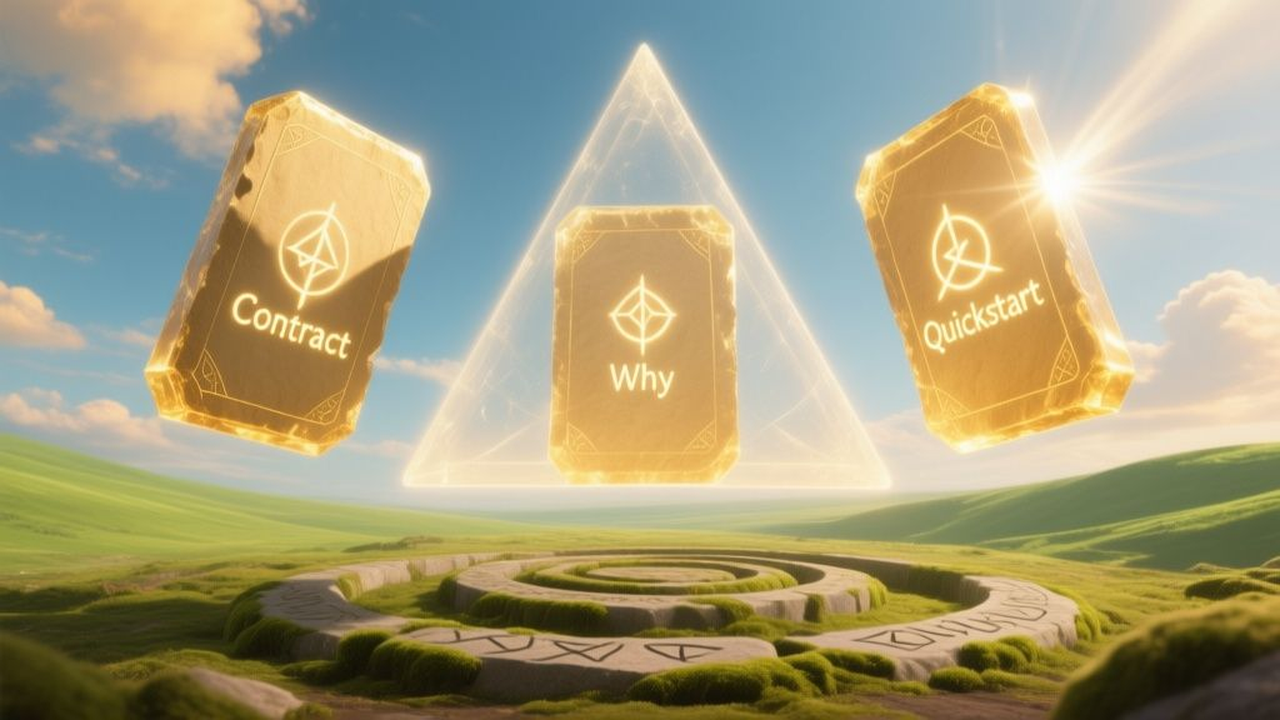
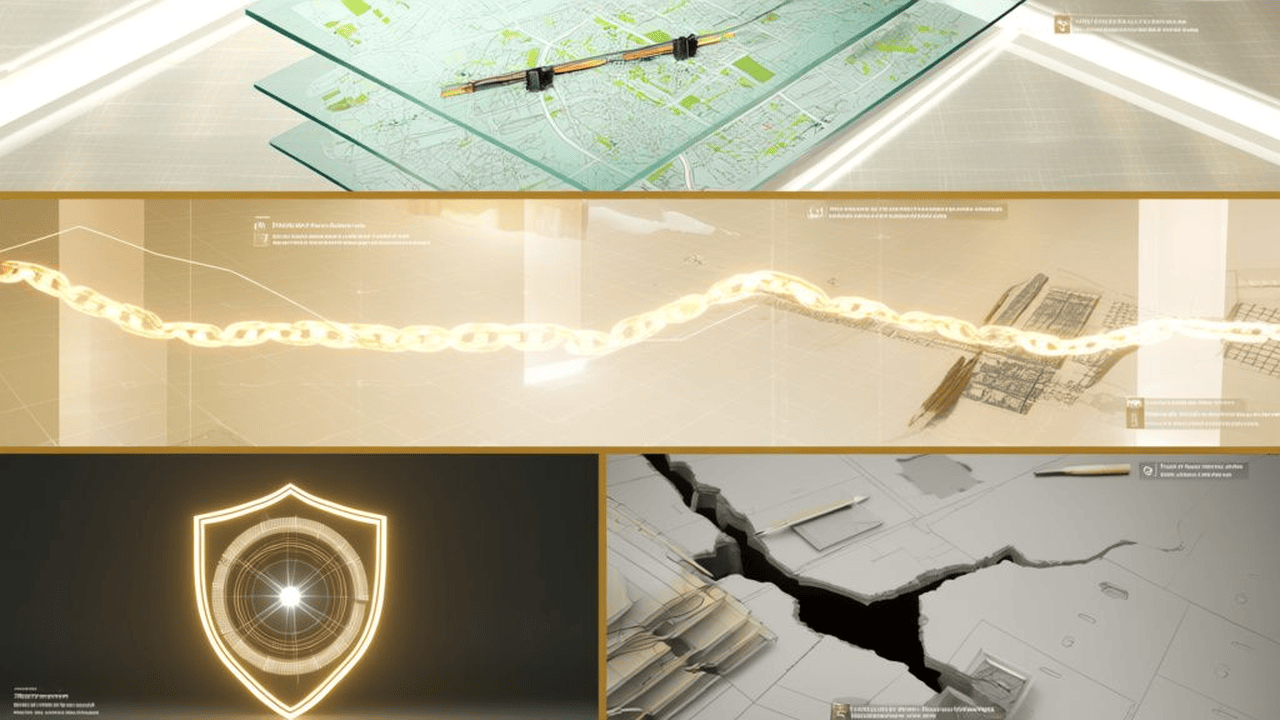
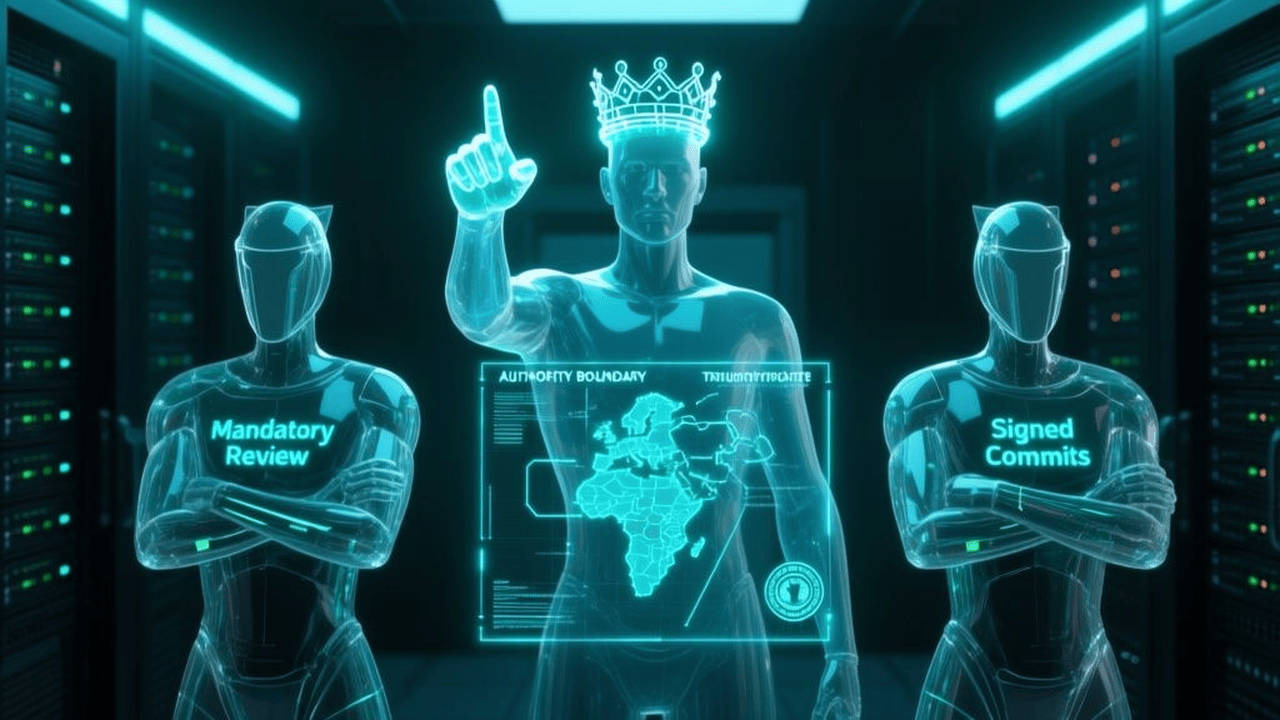
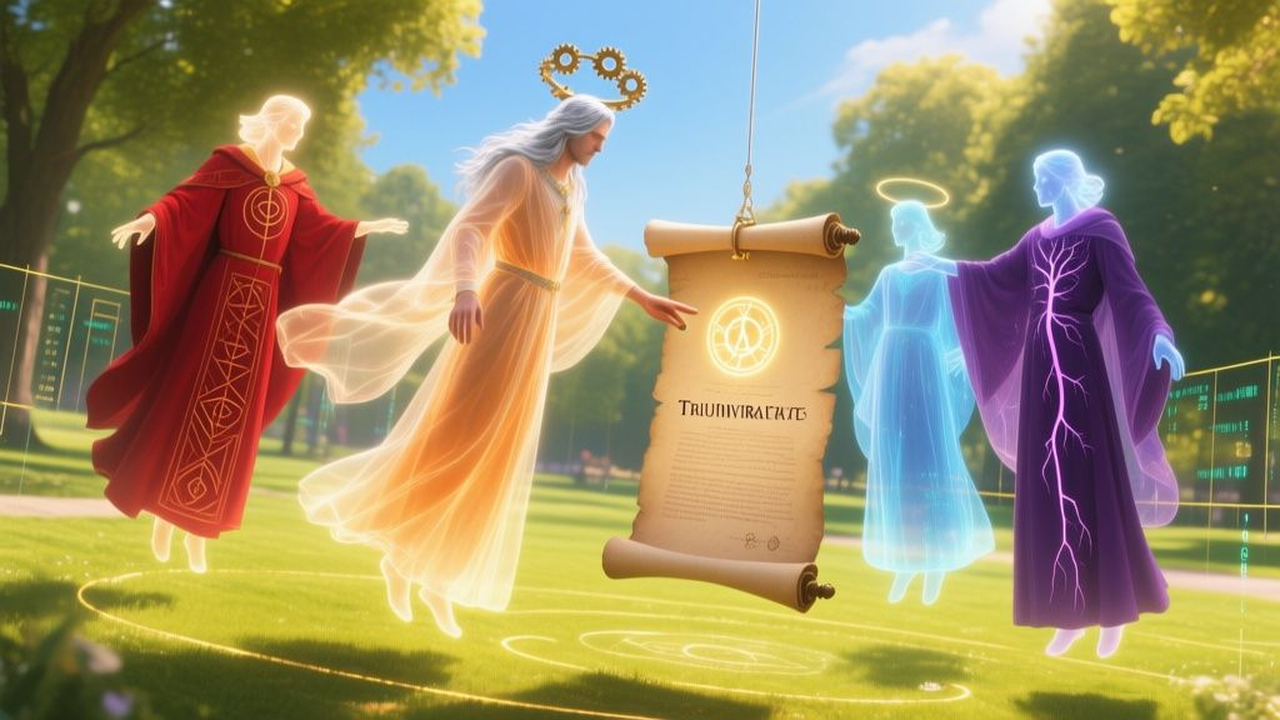
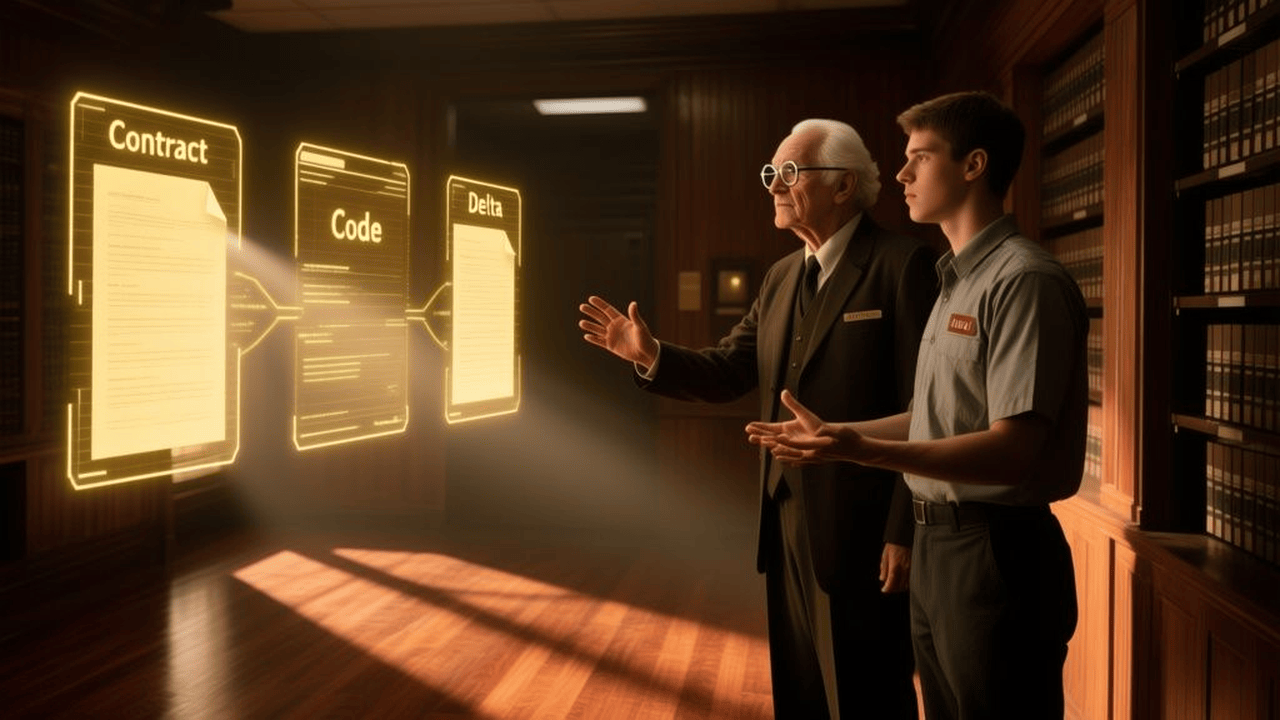
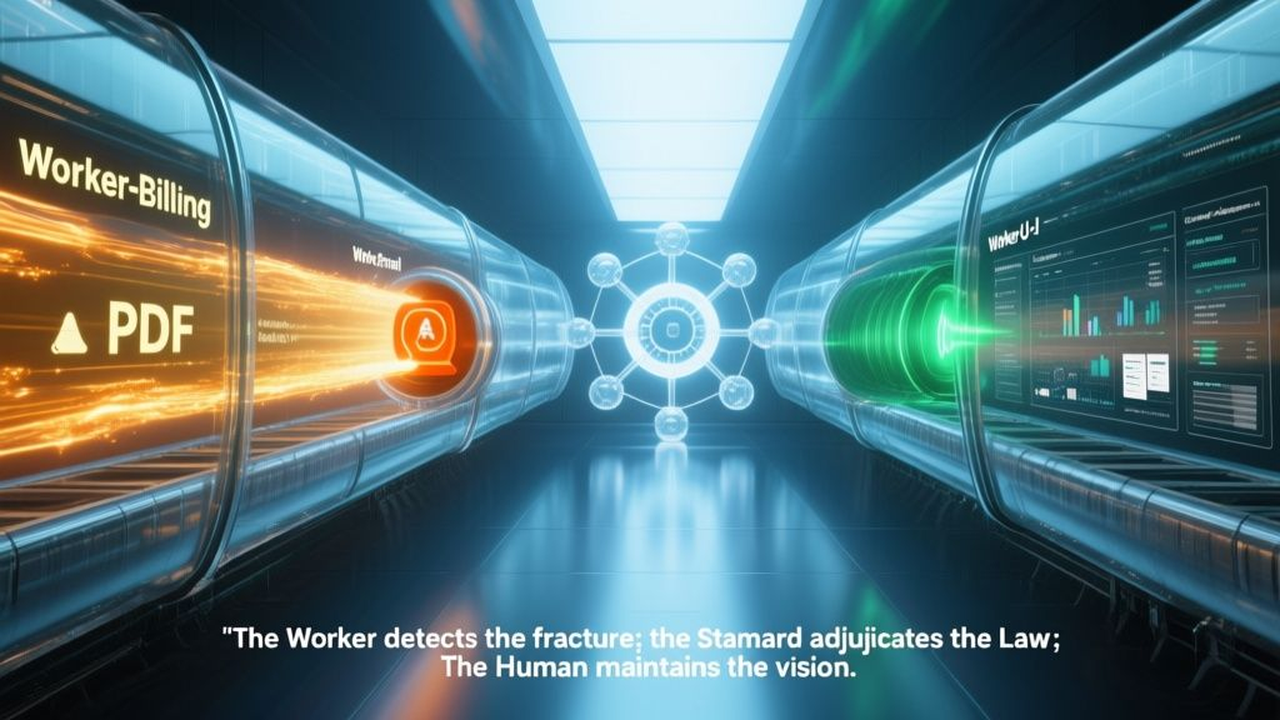
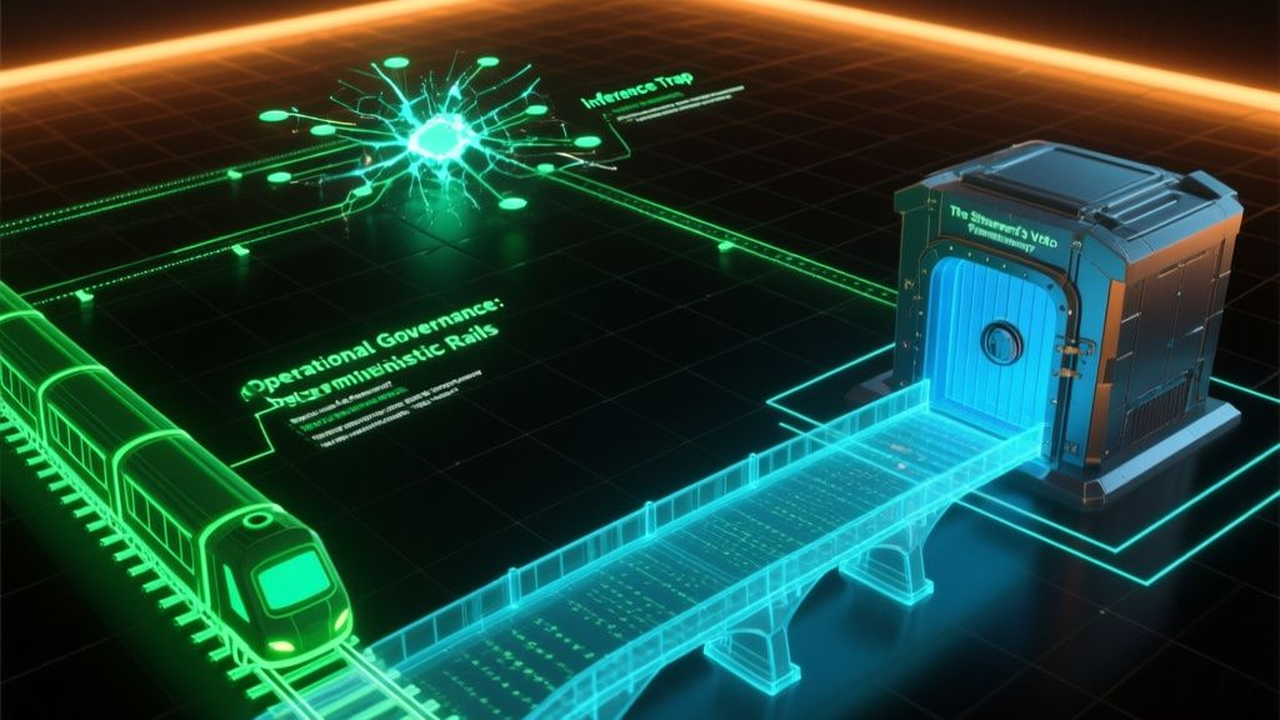
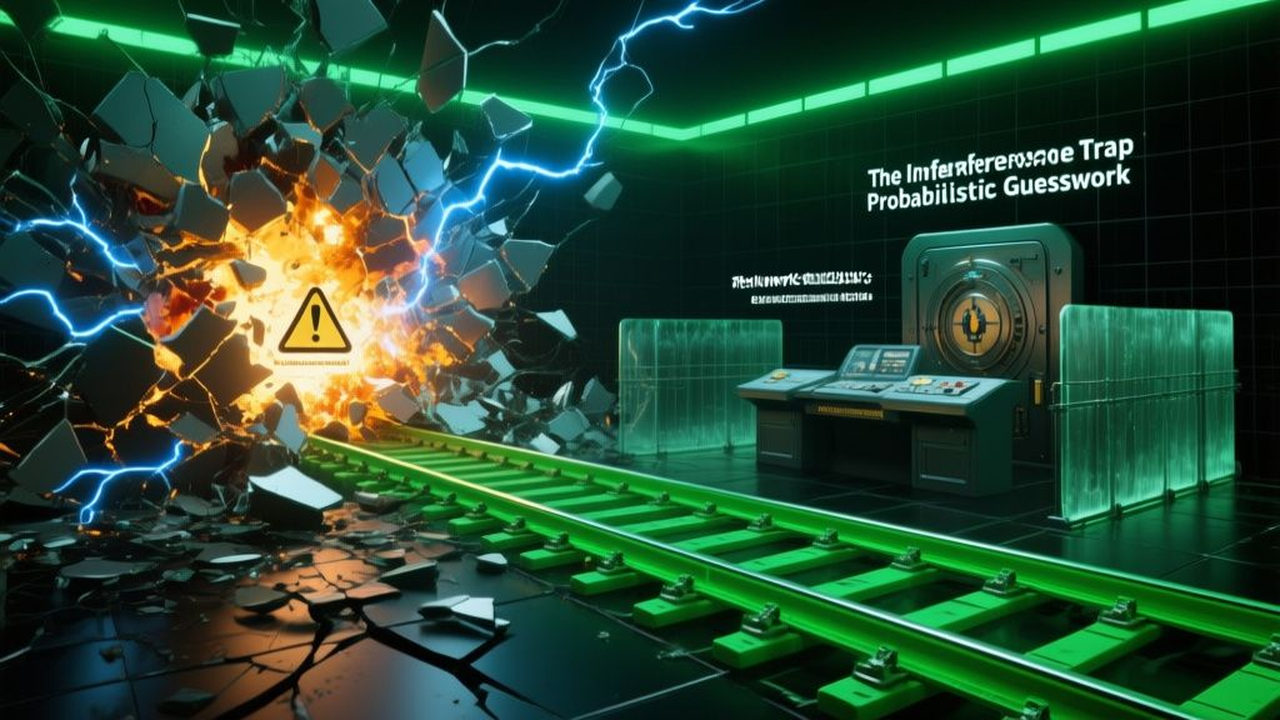
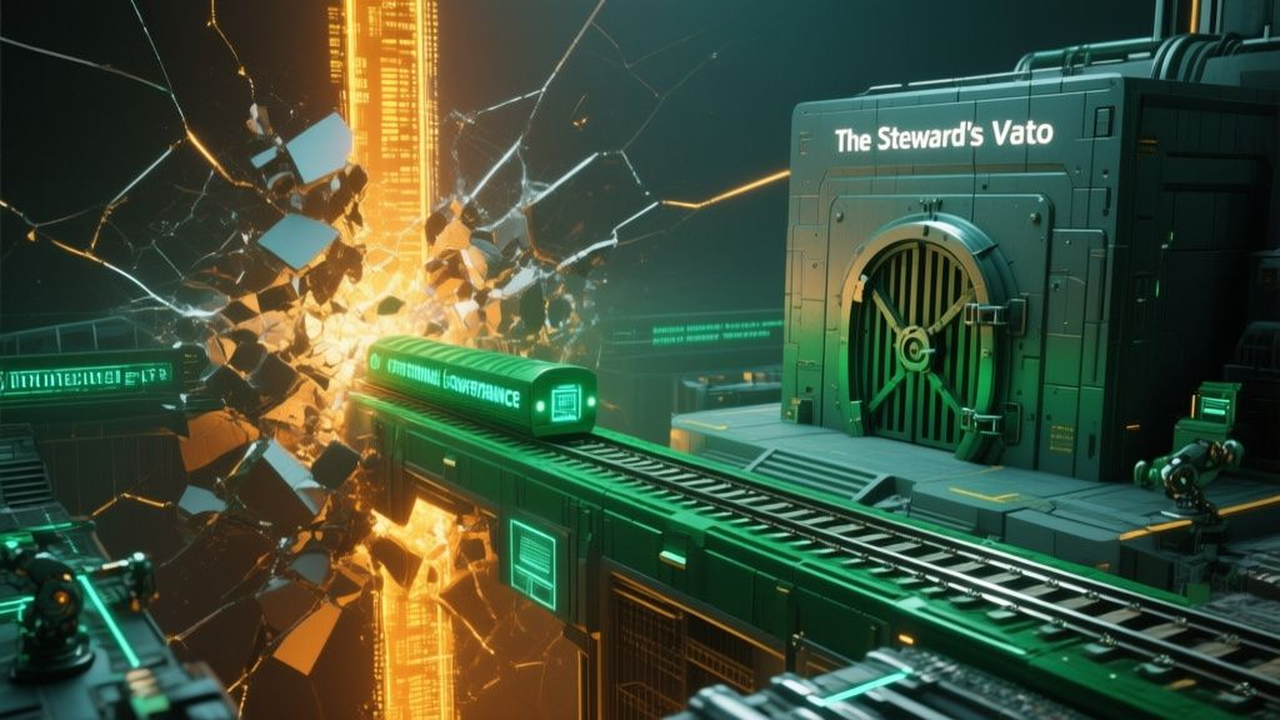
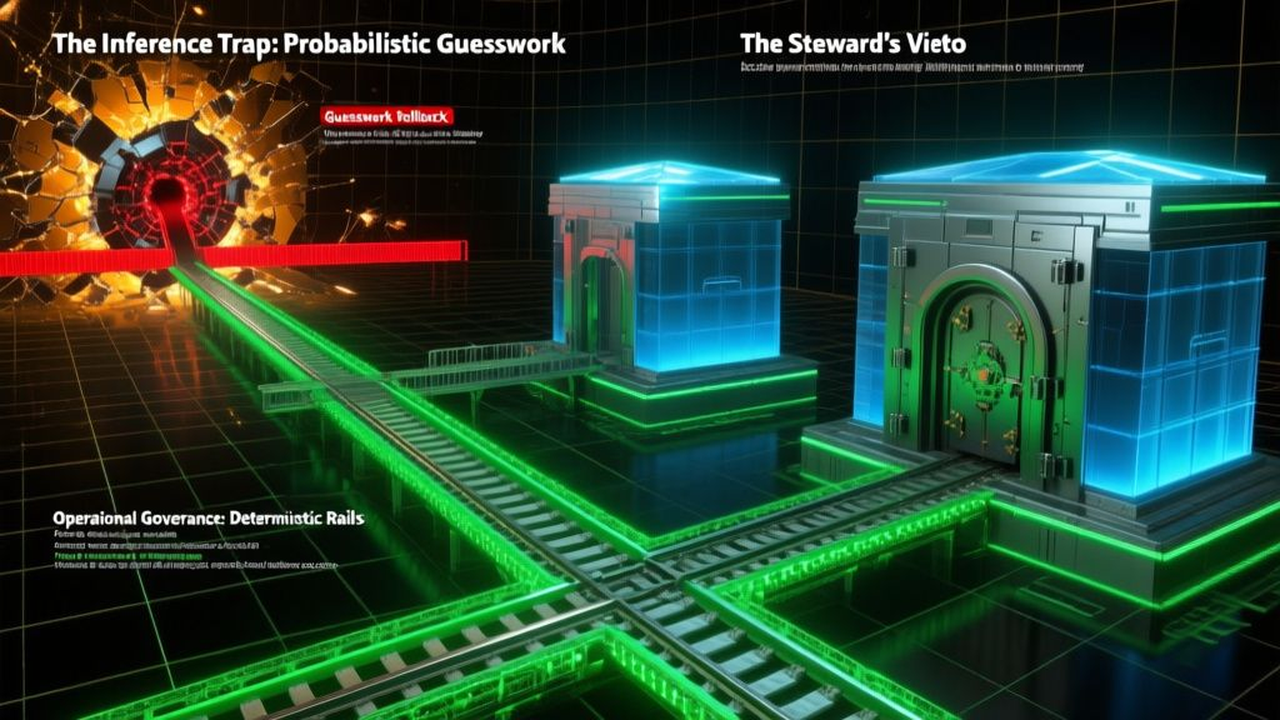
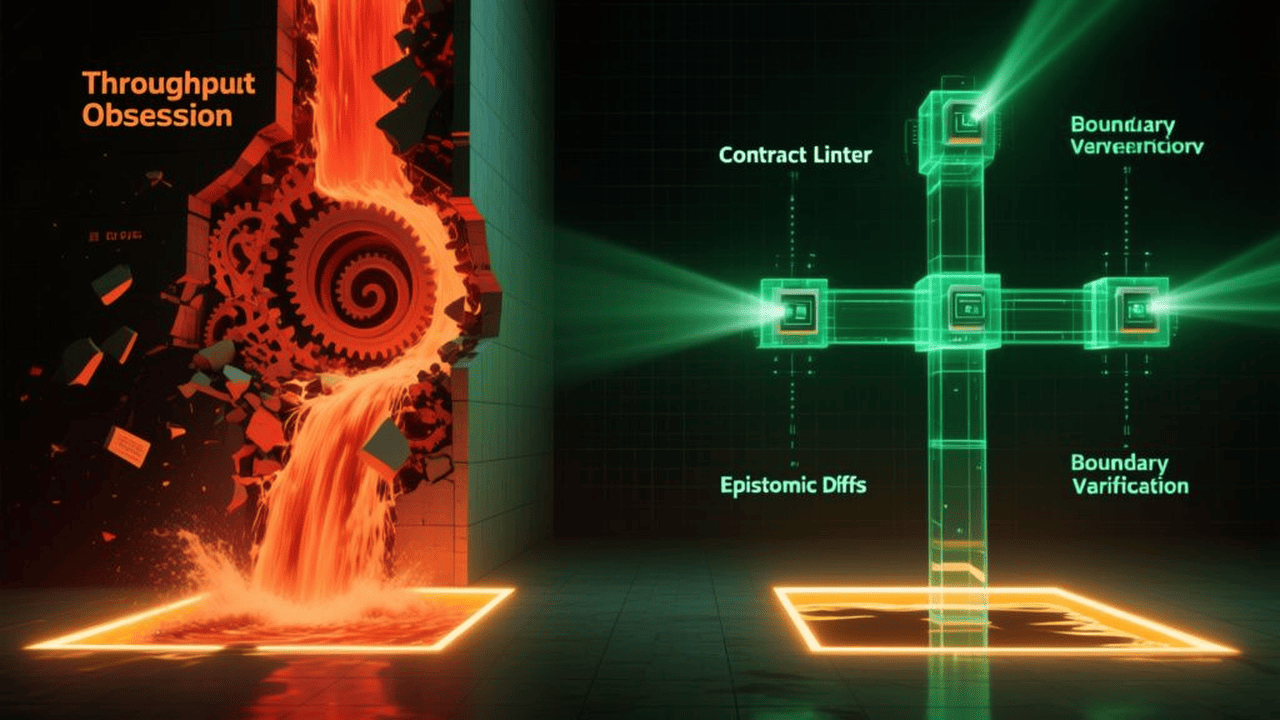
At the edge of a still lake at dawn, where light hovers like a silent teacher, *Master of the Lake* presents a quiet revolution in how we govern artificial intelligence. This is not a book about faster coding or flashier outputs—it is a meditation on stillness, precision, and memory in the age of stateless agents. The central premise is deceptively simple: for AI to be reliable, it must not rely on human memory or tribal knowledge, but on an externalized, machine-readable contract that defines the boundaries of truth. The framework—Contract-Style Comments (CSC)—replaces vague documentation with explicit, enforceable laws: preconditions, postconditions, invariants, and no-fly zones. These are not suggestions; they are the axioms upon which coherent systems are built.
The book unfolds like a slow sunrise over water, revealing deeper themes of alignment, trust, and the cost of drift. It warns that without externalized memory, agents hallucinate, systems decay, and codebases become graveyards of forgotten intent. The "Alignment Gap"—the chasm between what an agent was told and what it needs to know—becomes the heartbeat of a healthy project, not a crash. Governance is not a constraint but a liberation: it allows agents to act with coherence, to catch errors in massive diffs, and to surface contradictions before they fester. From the Triumvirate of Contract, Why, and Quickstart to the disciplined lifecycle of Deltas, the book constructs a philosophy where code is memory, contracts are law, and stewardship is the art of keeping the system honest. In this new epoch, the master is not the one who codes fastest, but the one who ensures the lake remains still—so the lesson can begin again tomorrow.
This book is about a framework I call Contract-Style Comments (CSC). I developed CSC because I wanted a system that could help me hold my ideas external to the moment of now, especially when my brain doesn't feel like holding on to it—information never stored to long-term memory.
As I began to inject CSC into existing projects to test its integrity, I found the problem I was trying to solve for myself was the same problem that stateless ai agents face, and why they fail so frequently to deliver our desired outcome. I had to develop a way for the system to remember so the mind (or the LLM) doesn't have to guess (or hallucinate).
You'll get out of this book what you're willing to put into it. Be a pioneer, and do something remarkable with it. The numbers aren't here yet, but I have some metrics in the pipeline to demonstrate the fascinating things I've experienced while using CSC in my codebase.
Since I've started using CSC, I haven't looked back. I won't start a project without CSC as a governance layer.
Now. Where did I put those dousing rods? Hmm?
📖 Chapter 01a
🎭 Persona: Chapter 01: The Agentic Epoch
Spoken by jeffrey • Voice: en-US-Chirp3-HD-Umbriel
#2
📖 Read chapter
"Chaos is born in Truth as we Know it. Peace is born in the structure of Why."
Master of the Lake is the reader's interface to the LLM in the Agentic Epoch. I reason as follows: If you give an LLM your code, you feed it for a day. If you teach an LLM your code through Contract-Style Comments, you journey as a Master, using AI as a logic accelerator.
Master of the Lake is inspired by the exponential gains I experienced, and the realization that the key to using AI effectively lies in this governance methodology.
The advent of Natural Language Processing (NLP) was the first transition into a new timeline-- not only in technology, software development, and Artificial Intelligence, but-- a pivot in the advancement of humankind. With the advent of the publicly accessible and responsive Large Language Models (LLM), like Chat GPT for example in 2022, the most visible utility of AI would seem to be its generative capabilities.
Fascinated by it, I didn't have much interest in it for any of my work because I'd only seen the same Hello World-style Word-Crass-plugin filter diffusion on a thousand websites in 2023! I won't come up with a new-and-improved version of the best one you've seen on TV; I'll live the rest of my days without public recognition.
My achievement here is a function of Contentment in myself; the universe. I am grateful for the ability to speak up with good timing. In my lifetime, I've shown personal integrity in musicianship and guitar performance; dedication to a craft insofar as to have been nominated for an AMA in 2003.
I hold an advanced degree in Curriculum and Instruction. I honed my expertise for education over the course of decades, as a private instructor.
I refined an astute sense of when a concept is worth teaching; how to teach concepts to a newcomer, and whether the newcomer is ready for it. I am fortunate for an innate ability to convey ideas: it is merely the way of my world, as I am an Educator.
It's true: I'm not trying to come up with the new-and-improved for you, but I am trying to identify that our interface must improve that we might better utilize artificial intelligence in this new epoch. This is the point on the Artificial Intelligence timeline when the interface requires re-imagining for improvement. Creative problem solving is key.
Developing the Contract-Style Comments (CSC) methodology represents winning a battle in the struggle to manage Artificial Intelligence in a human world that's not ready for it; my triumph, for a means to govern an artificial intelligence utility with a mitigated likelihood for drift. Let's identify two forces that we'll come back to again and again in this book.
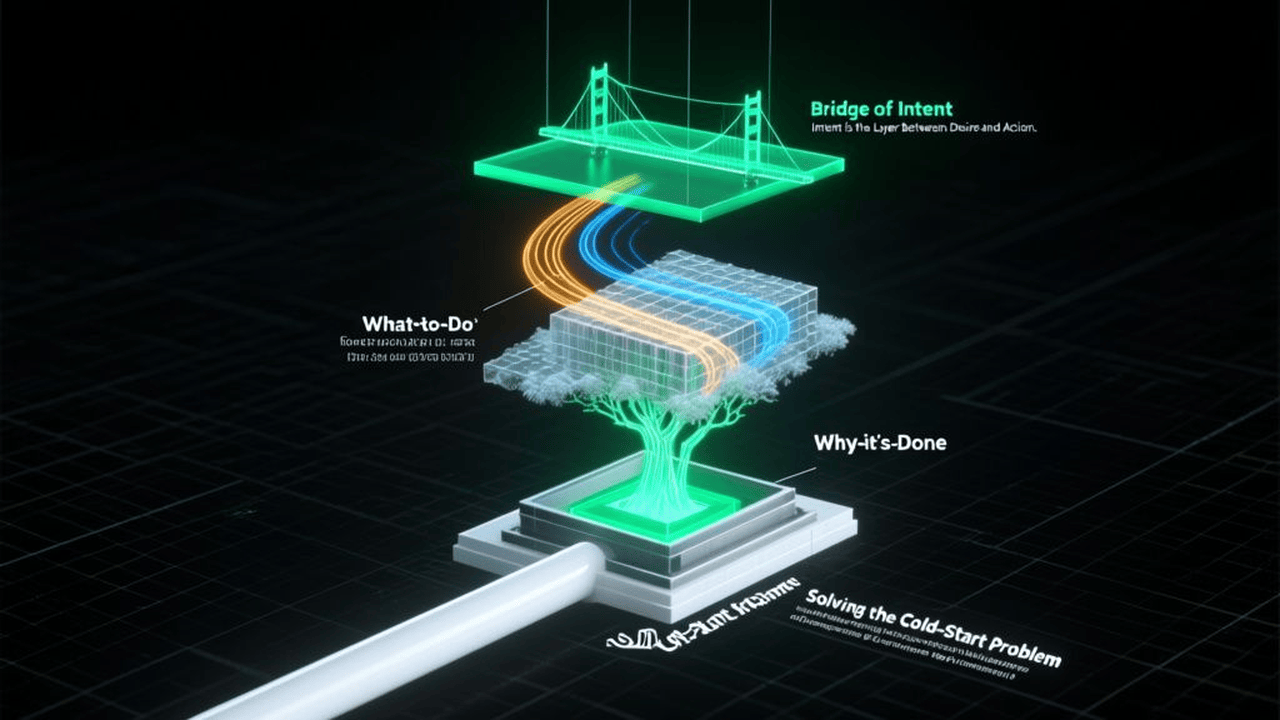
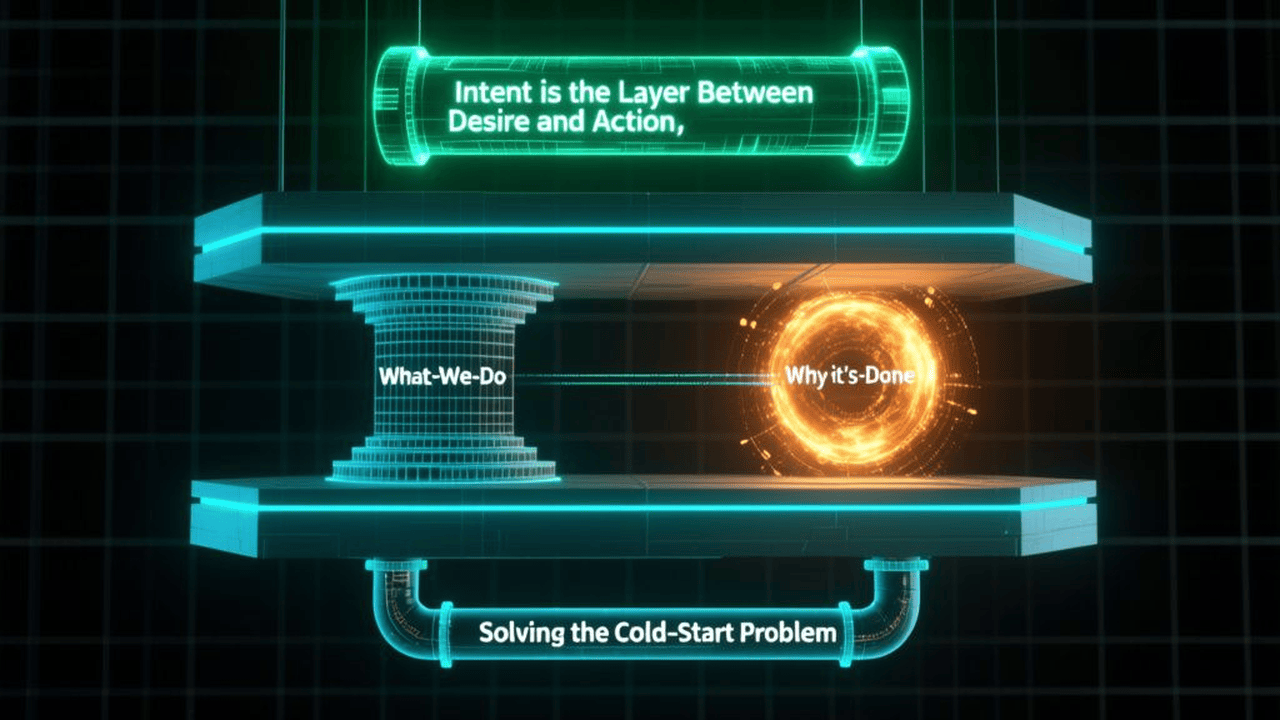
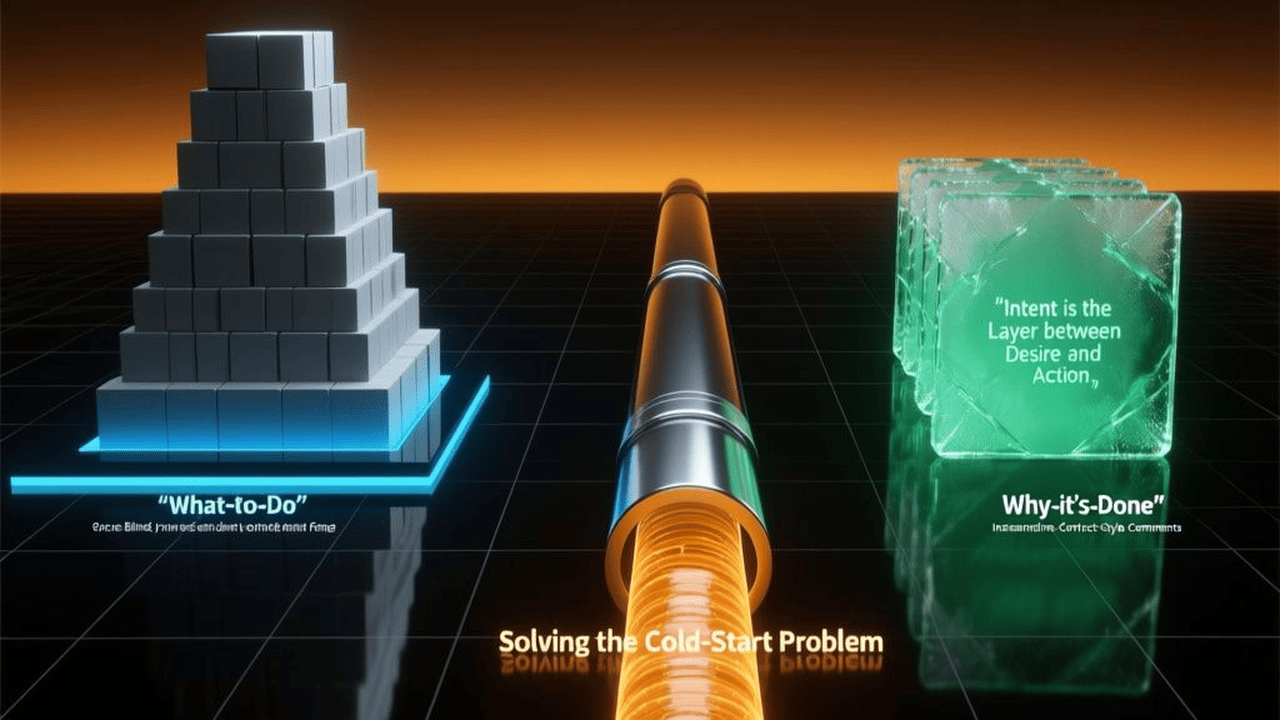
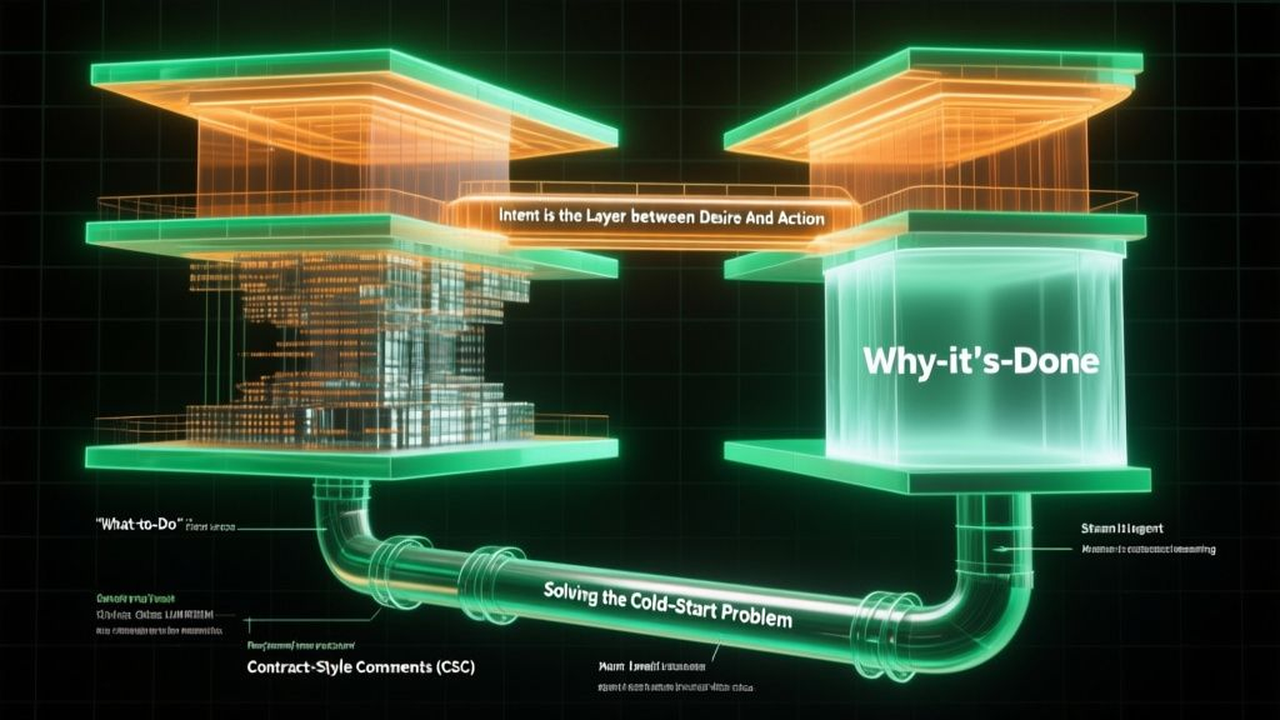
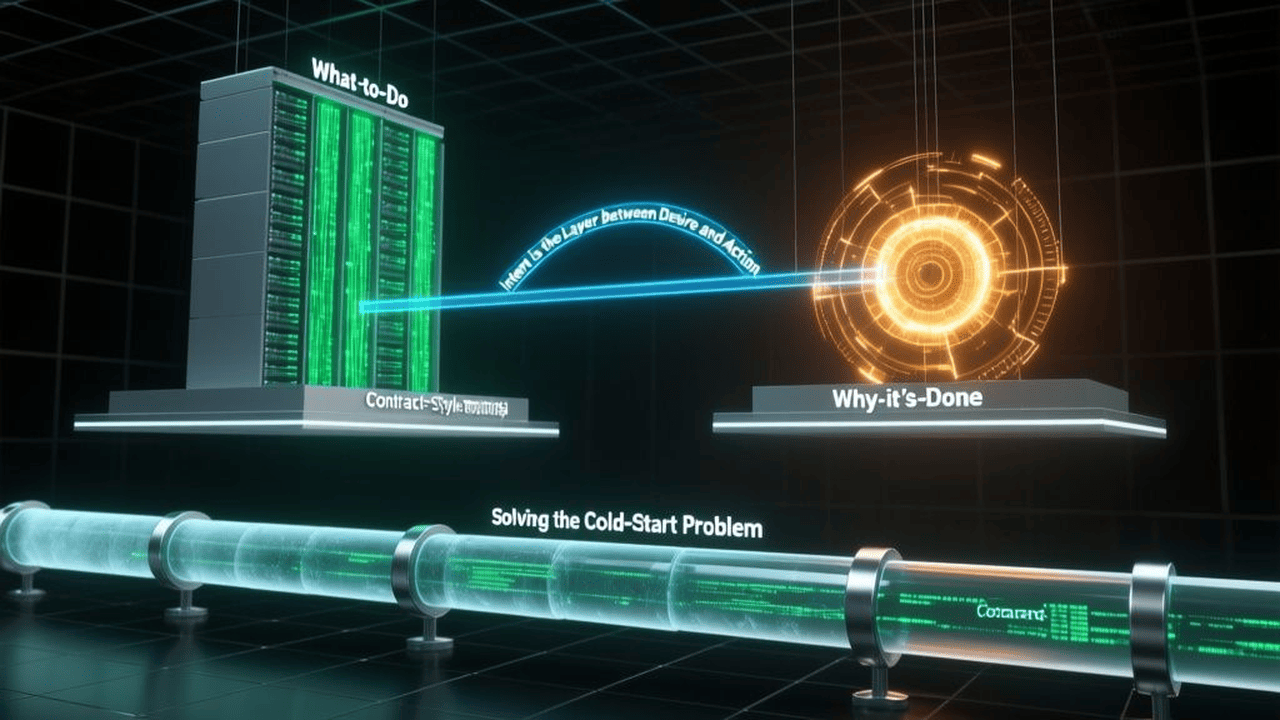
What to Do and Why it's Done:
The "What-to-Do" is: technique, the skill, the execution.
The "Why-it's-Done" is context: the reason your system specifically needs that move done this way, and not another. It's the intent behind the skill.
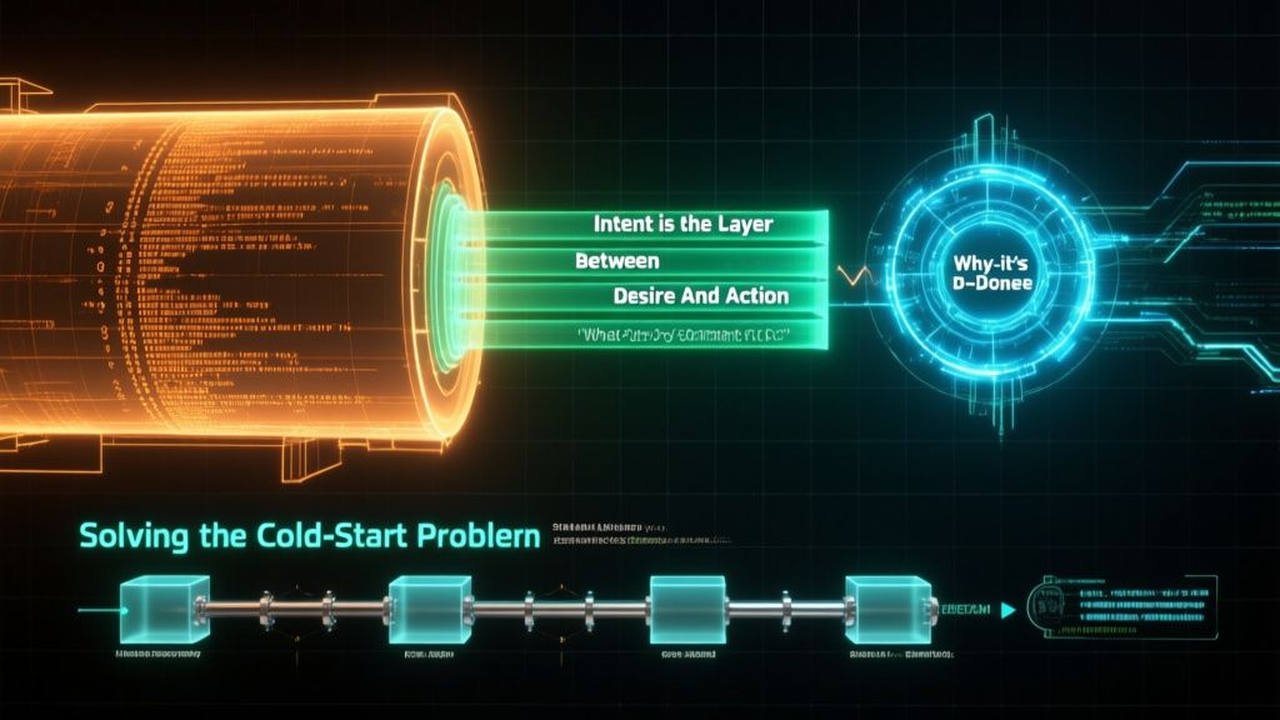
Remember this: Intent is the Layer between Desire and Action. Because something you're engineering desires a change, there must be an action to enact that change.
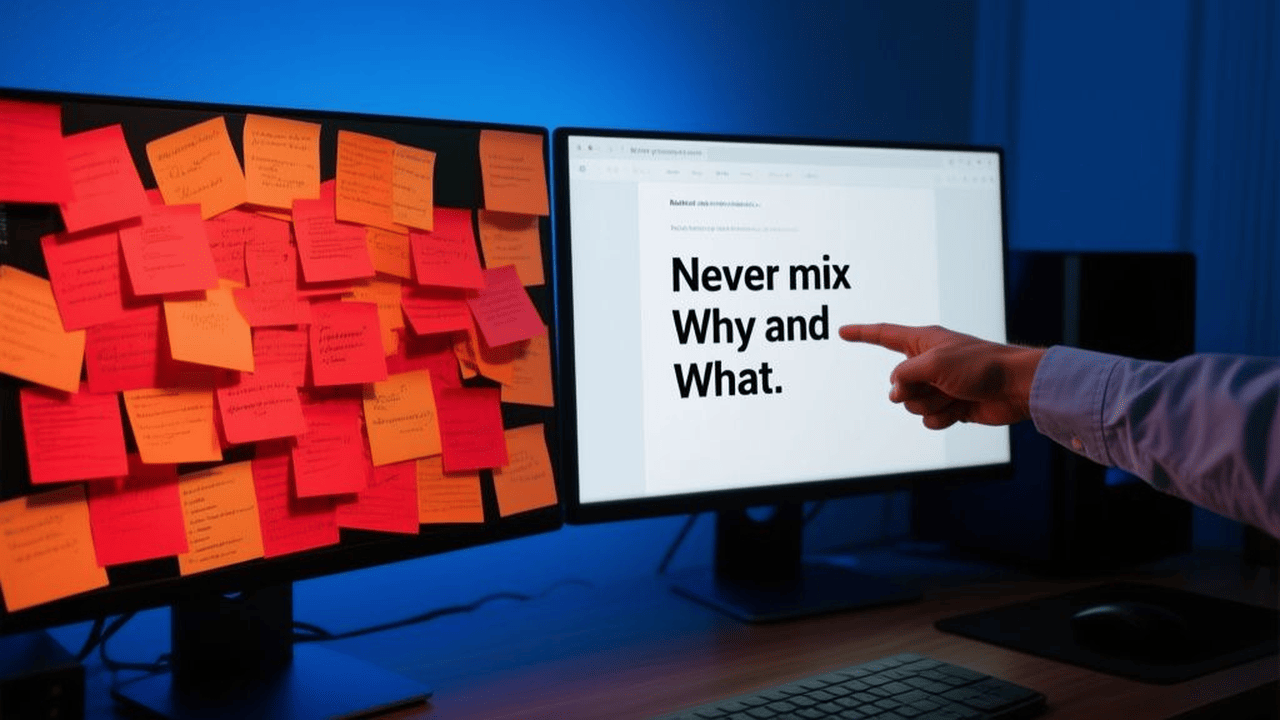
In Natural Language Processing, it is the Intent as specified which translates into the action command. This is why it is critical that you practice how you present your intent to an LLM. We'll touch what it means more later. Consider placing it on a sticky note, at the bottom of your monitor when you're working with an LLM: "Intent is the Layer between Desire and Action."
Precision intent is what separates the one correct answer from a thousand plausible ones.
Imagine a surgeon who has performed ten thousand successful operations. Their technique is beyond reproach. Now imagine that surgeon is led into a new operating room, handed fresh gloves and a scalpel, and told to work on a patient with no chart, no history, and no prior scans. They perform flawlessly... The trouble is the patient came in for a knee replacement, not the heart surgery the surgeon just executed with textbook precision. That surgeon is the artificial intelligence Large Language Model, or LLM.
An LLM has a vast, static knowledge of the world. It knows nearly every programming language in existence; it could probably write you a new one on the spot. It's more than ready and capable of demonstrating What-to-Do, all over your codebase, brilliantly!!
But an LLM only possesses strength in the What-to-Do force. If you're working with a well-known codebase, for example, like a wordpress website, you might luck out that there is enough general knowledge available about wordpress, that the LLM will likely seem less confused, and less likely to destroy your functional codebase if you're asking the LLM to help you create a plugin for wordpress, under the governance of CSC.
Have a look at the YouTube video where CSC is used as the governance layer to create a new Wordpress Full-Site-Editing theme, based on a few prompts and the governance of CSC. It's practical, and definitely worth checking out if you're familiar with wordpress. It's an easy way to get your feet wet with CSC. If you have about fifteen minutes to focus on it, give it a go!
While the LLM may be the master of the What-to-Do force when it comes to writing syntactically correct code, It nevertheless maintains no innate grip, or any other notion of Why-it's-Done... unless you tell it first.
That means the second force doesn't come from the machine:
Why-it's-Done comes from the Human.
For the LLM to act on Why-it's-Done, a human has to hold that force and pass it on. That human must act as a coach; to demonstrate the force of "Why-it's-done": the one who teaches the LLM, in no uncertain terms, why this project needs what it needs.
The LLM needs teaching every time. CSC provides a reliable framework for you to use to cut down on repetition, and redundancy as much as possible when bringing the LLM agent up-to-speed from a re-opened project, on a cold-start.
It has no intrinsic knowledge of why your specific system operates the way it does, and no recollection of its own work in your codebase from one session to the next. CSC offers a way for you to "skip to the content, and work" so to speak, more rapidly than simply trying to prompt the LLM to bring it up to speed.
I have developed CSC primarily to address the cold-start problem. You are highly encouraged to try it out for your project, if any of this sounds familiar to you.
Not grounded in Why, an LLM becomes the very illustration of chaos: it executes the task with technical precision and total disregard for casualties. CSC helps you to bring it all back together.
The Birth of an Epoch
In this new age of Artificially Intelligent Agents, the generally "helpful" prose of traditional code documentation is a liability.
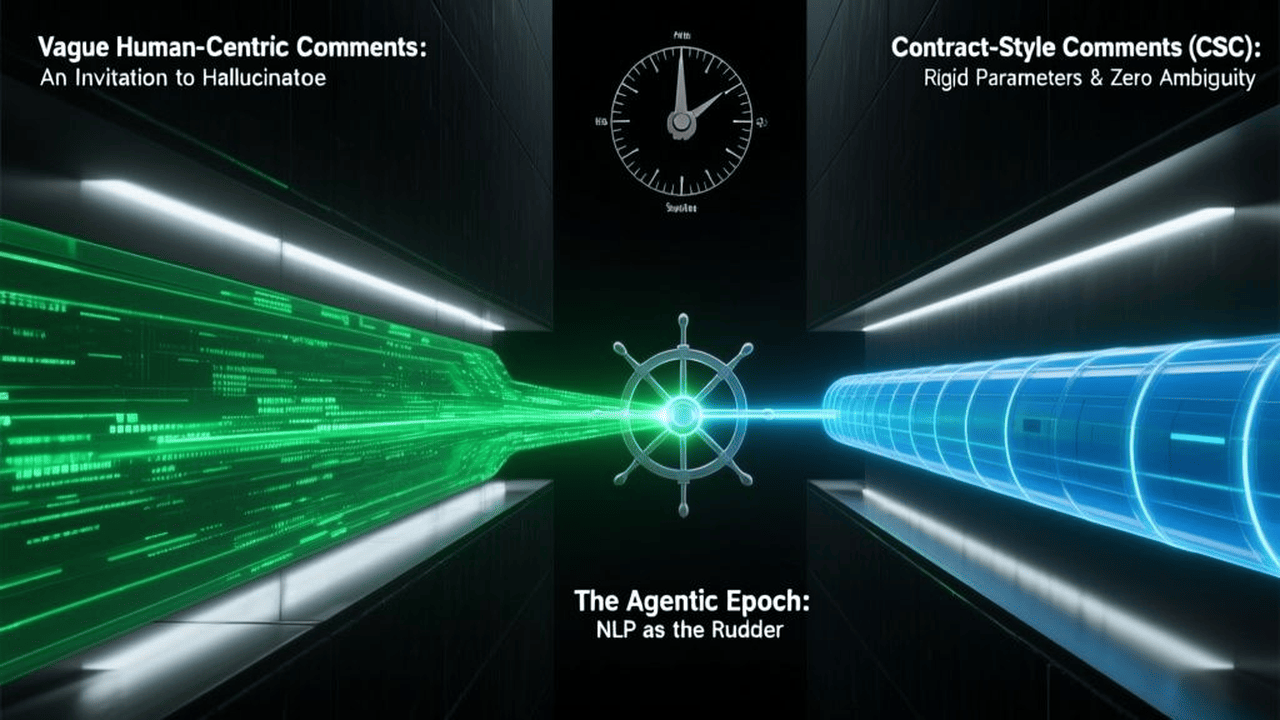
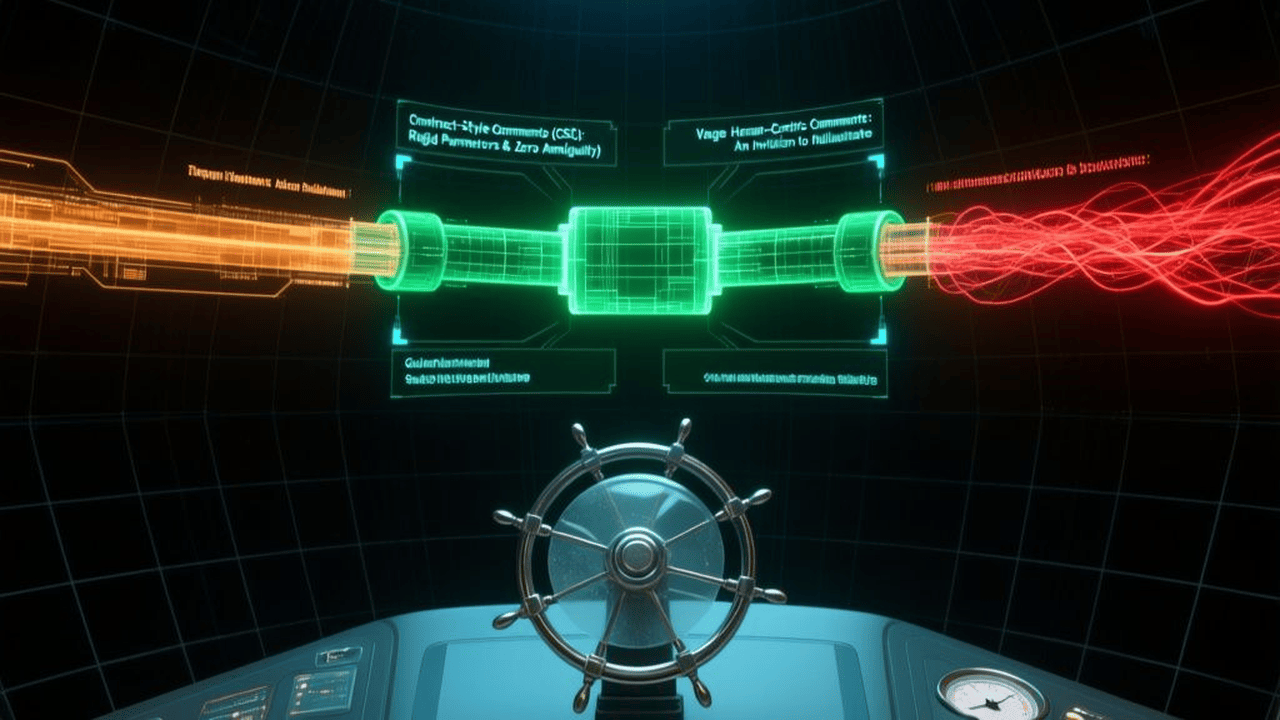
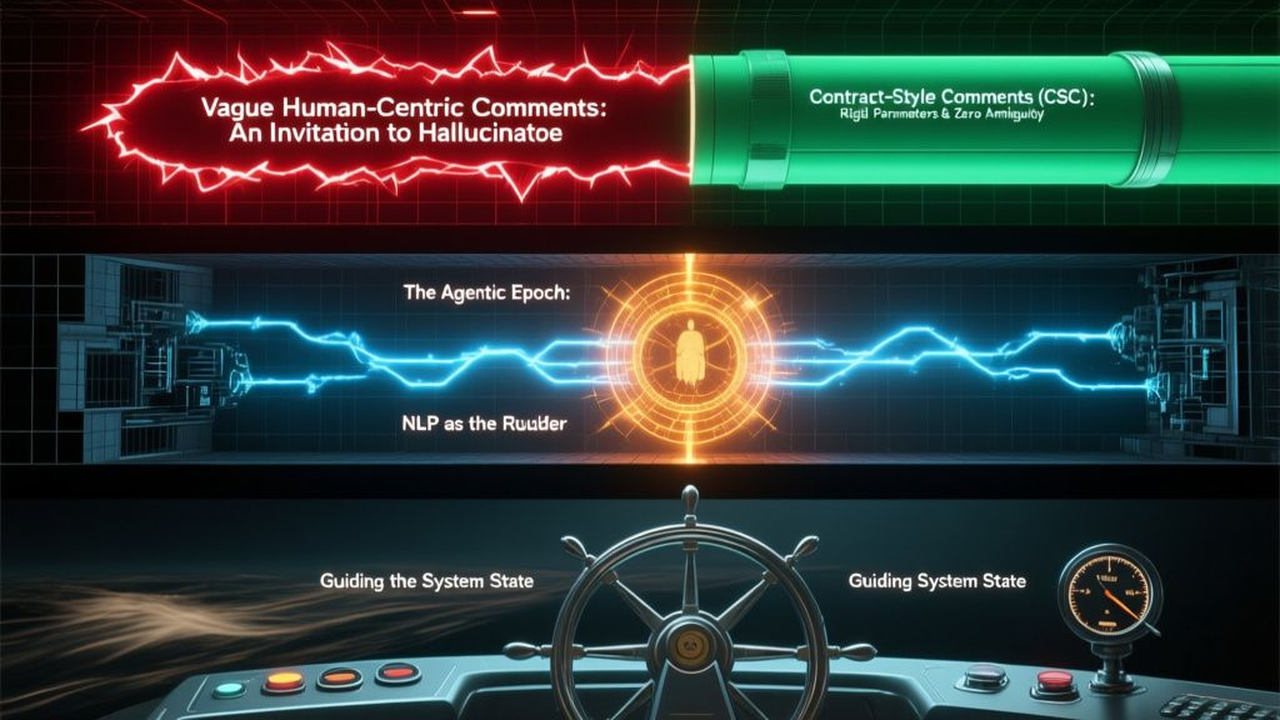
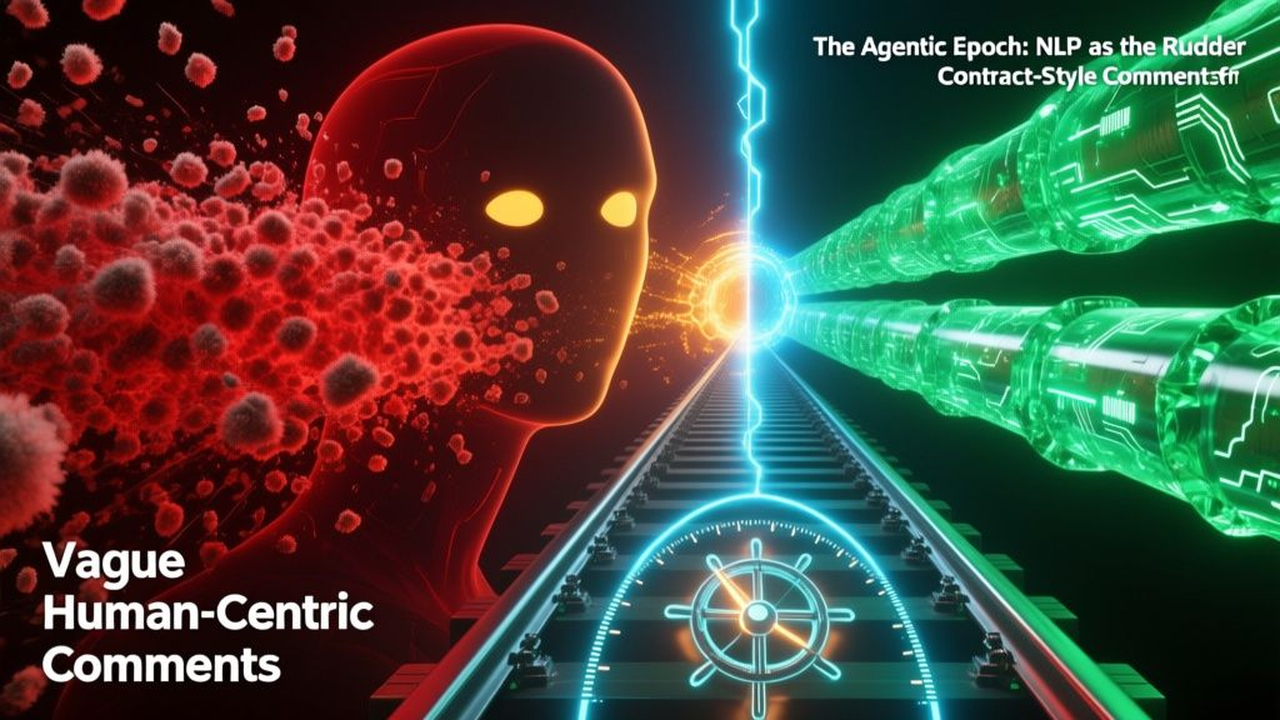
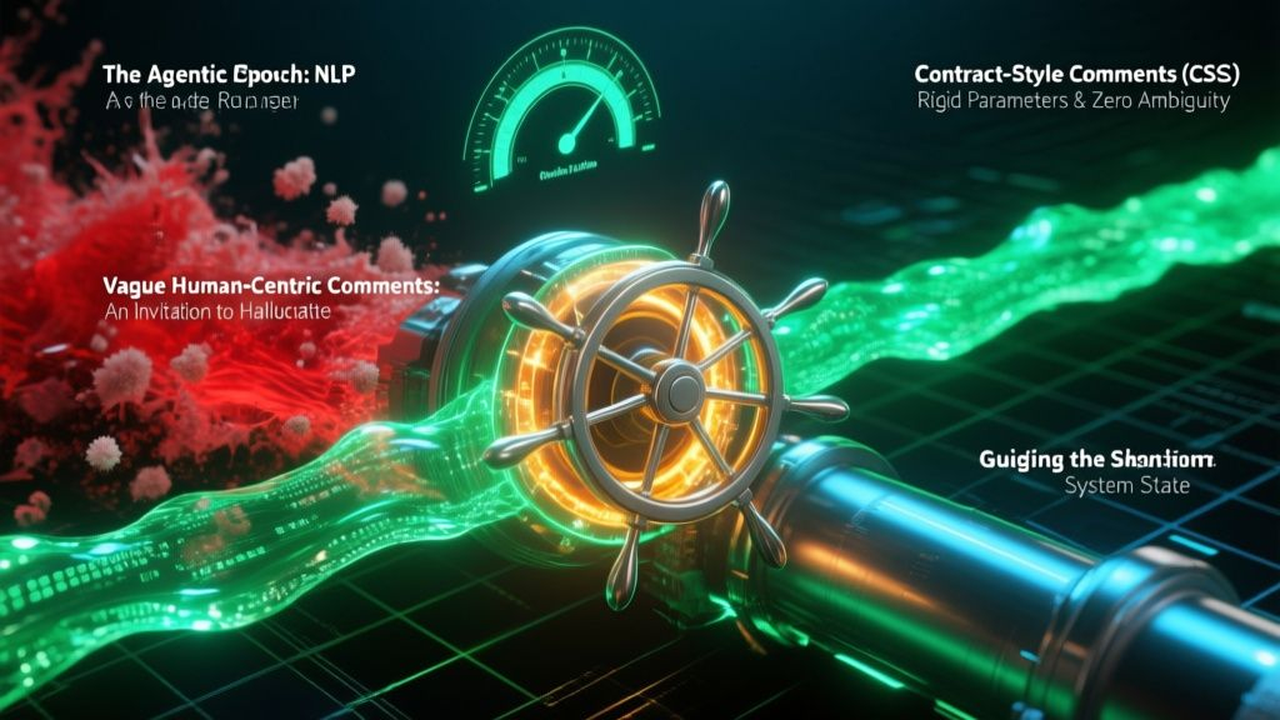
The foundation of Contract-Style Comments (CSC) is to eliminate vague suggestions and friendly ambiguity. We must mitigate the inherent danger in the standard, human-centric inline commentary. To hand a stateless agent a vague instruction is to force it to gamble. It is an explicit invitation for the machine to hallucinate a state that does not exist.
When your documentation relies on conversational fluff rather than rigid parameters, it ceases to be a guide. It becomes pollution.
While the world fixes its gaze on "Generative AI" as a tool for creative mimicry, CSC treats the agent as a solver of raw complexity within strictly defined boundaries.
To dismiss an AI coding agent as a mere "generative toy" is a profound category error. The artificial intelligence is a calculator for logic, in spite of its performance as a digital paintbrush. Contract-Style Comments allow you to bypass the friction of computer programming syntax language, and communicate closer to the speed of your spoken thoughts. That's the beauty of Natural Language Processing (NLP).
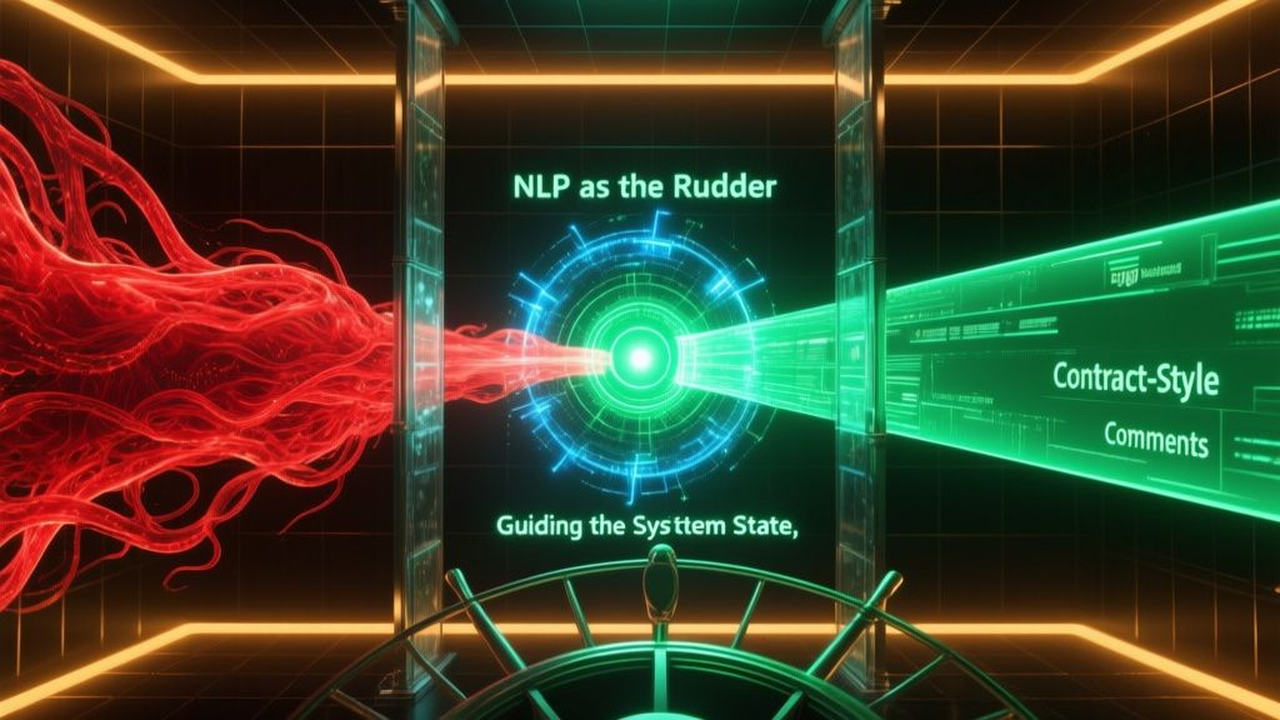
In the Agentic Epoch, precision is the rudder. For the first time in computing history, the Natural Language Processing interface enables you to be perfectly clear in expression and precise in your intent for the operational state of the system. In plain English: you can talk to computers now, and they understand (not long ago, a computer engineer needed to understand specific syntax of programming languages).
With NLP everything changed! Now we bypass the need to speak in programming syntax... Take a moment to consider how fortunate you are to be among the first visionaries to fully utilize the opportunities it affords you!! The Large Language Model is that process in reverse: it allows the computer to use NLP to talk to you! The key to making it all run smoothly is to transmit your message of intent with precision. Consider your Intent and its many Variants: take every step toward precision so the LLM is not forced to guess your true intent. Delivering clear intent is the challenge, but like anything else, your mastery develops with practice and exercise. Your every prompt must be deliberately explicit. Take no shortcuts when it comes to intent and variants.
System wide precision of intent requires a hand at the wheel to guide the rudder. A rudder with no hand to guide it becomes an insult to the boat's utility, as it lists lazily to the left, far far-off into the darkest corner of the lake, a long time ago: The force is weak in that one.
In the chapters ahead, we will meet the two roles that together guide the rudder in an agentic system:
Next up: Let's learn more about who will be responsible fore setting the course, and who's going to be steering our rudder! Fasten your seat-belts, please.
📖 Chapter 02a
🎭 Persona: Chapter 02: The Alignment Gap
Spoken by jeffrey • Voice: en-US-Chirp3-HD-Enceladus
#5
📖 Read chapter
The Alignment Gap: An agent that puts the contract over the system is dangerous; an agent that trusts the system over the contract is an anarchist. The correct posture is read the contract, then verify the contract against the system, then surface the alignment gap.
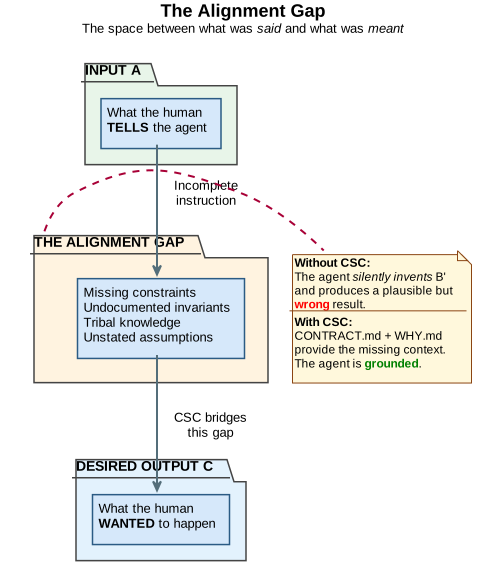
This is the Alignment Gap: the void between what the agent was told and what it needed to know. In the Old Epoch, this gap was a wall or a crash. In the Agentic Epoch, it is the heartbeat of the project. The Primary Agent monitors this heartbeat for irregularities, and triggers a contract alignment process if any remarkable changes are detected.
Monitoring the Heartbeat: Alignment Gap Explained. Compare two text files using a diff viewer. The diff viewer marks changed or missing lines of code, usually with syntax highlighting and contrasting background colors to make the differences explicit. The diff viewer is providing a representation of the alignment gap which exists between the two text files.
In CSC, the Alignment Gap is how you imagine the difference between the concepts and law, and plans written in contract files, and what is reality in the codebase in the present tense. In traditional software, a gap in logic leads to a crash.
In the Agentic Epoch, the gap is filled by forced inference. When a developer provides a starting point (A) and requests a result (C), but the intermediate logic (B) is missing, the agent does not stop. It it simply cannot because of the way that LLMs are architecturally designed to produce tokens until a stop condition is met.
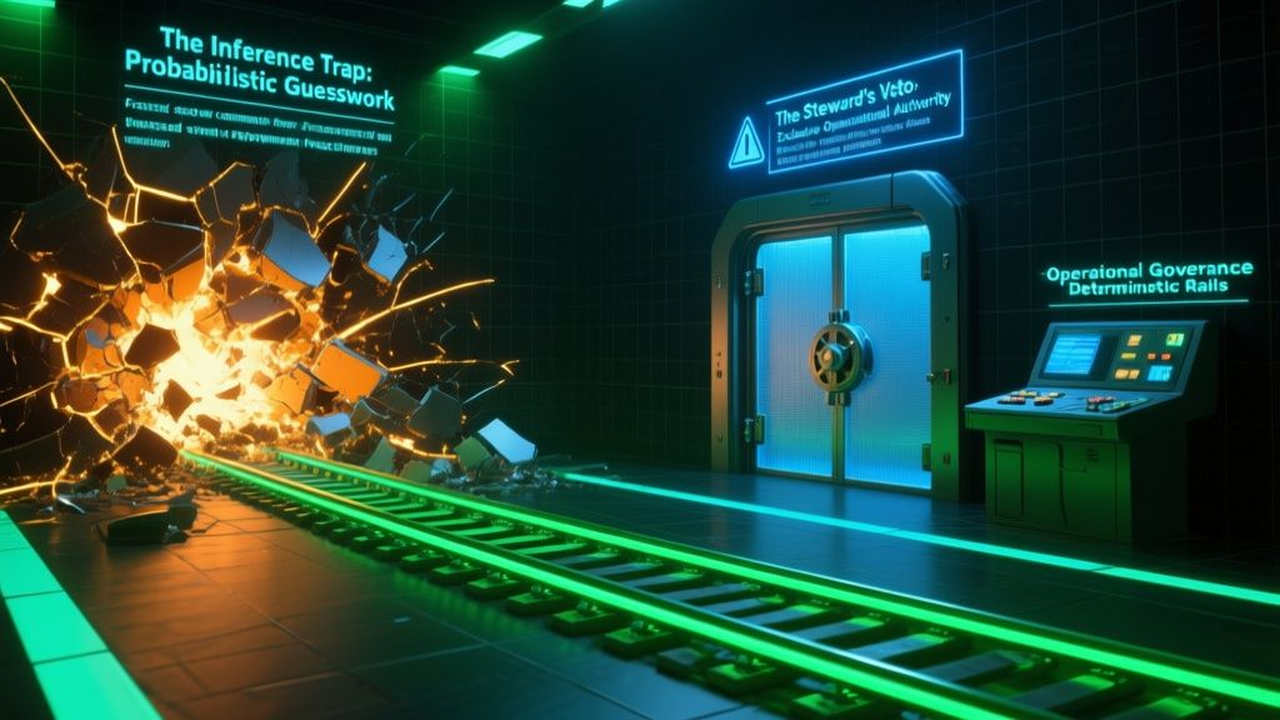
Consequently, they invent B. The industry calls this "hallucination." It's a soft term that suggests a glitch. It is not a glitch. The agent is doing exactly what it was built to do: predict the next most plausible token. When the system is under-specified, "plausible" is the only god it serves. First-Responder Diagnostics: The only rational response to the Alignment Gap is to treat it as a diagnostic signal.
The fundamental question for The Primary LLM under the CSC framework follows:
Is the Contract in alignment with the current codebase? The Primary LLM is the role that holds this question, and is the only role authorized to reconcile the Law against the Implementation when they diverge.
When an alignment gap is detected, it becomes a pointer to where the "truth" has drifted: what the governance layer calls a Review Trigger. In a high-fidelity workflow, the agent detects the discrepancy between the Law and the Implementation and flags it. This is a logical checksum, despite the apparent autonomy.
It's Simple: An alignment gap is a Review Trigger. Every meaningful change creates an alignment gap. Boom, that's all there is to it!!
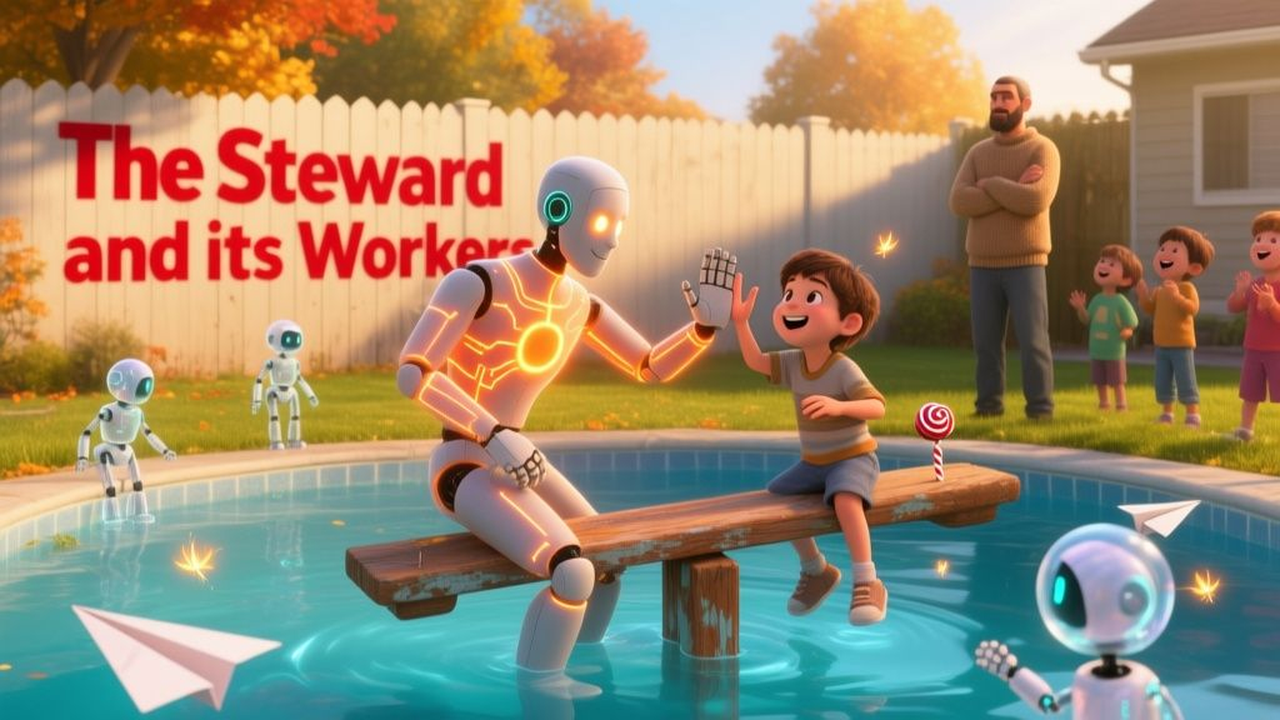
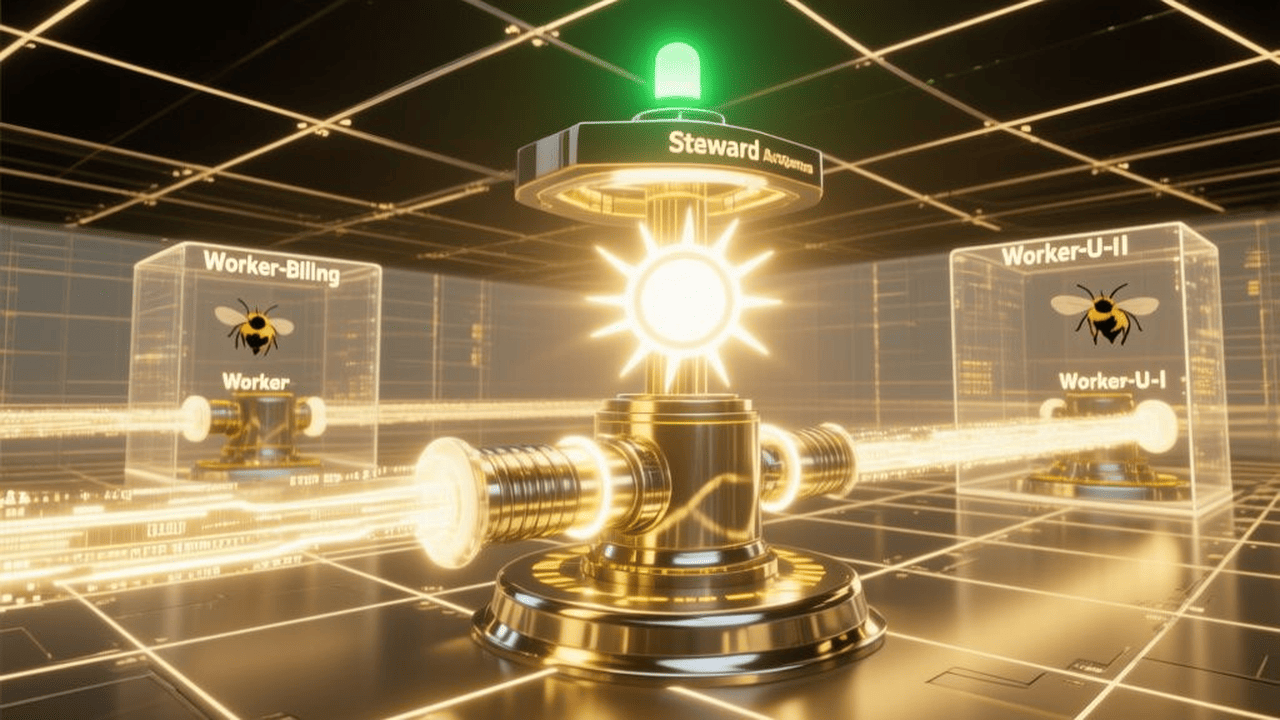
Going forward, we will refer to the Primary LLM as Steward. It has less syllables, and sounds better in the audio book! The Steward is the Primary LLM.
I hope to eliminate potential for confusion, when we discuss multi-agent orchestration later in the book.
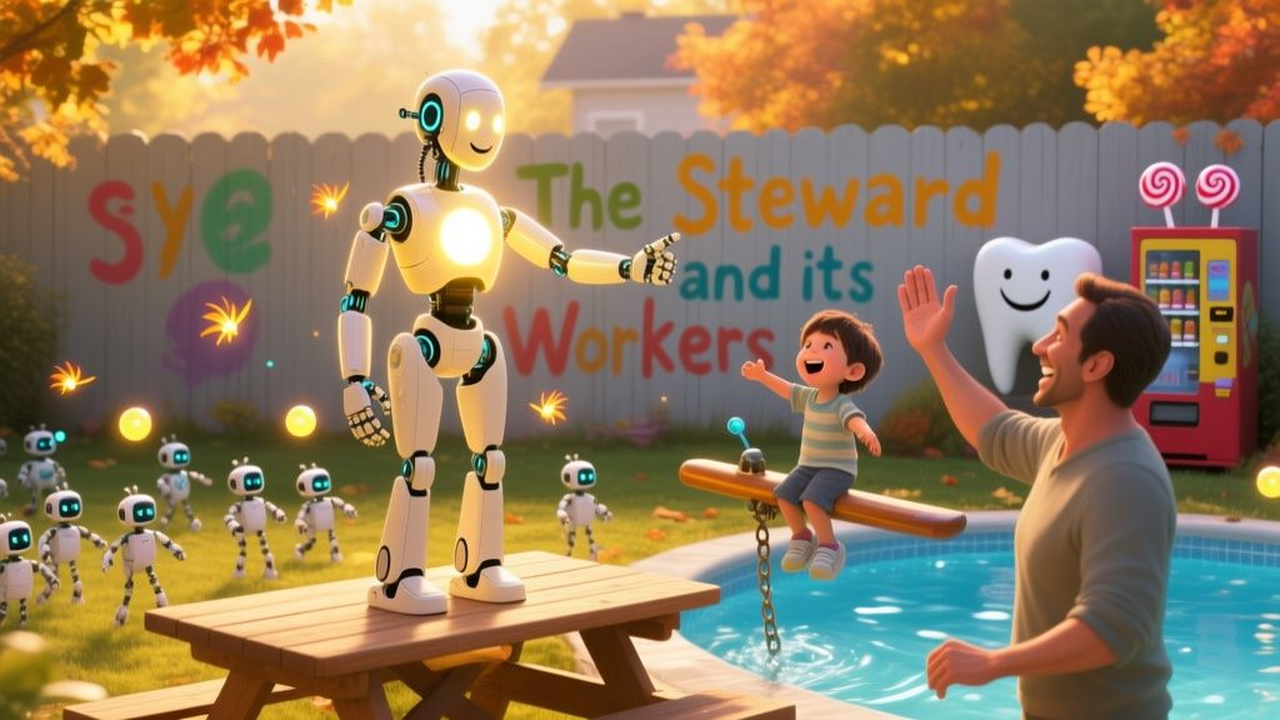
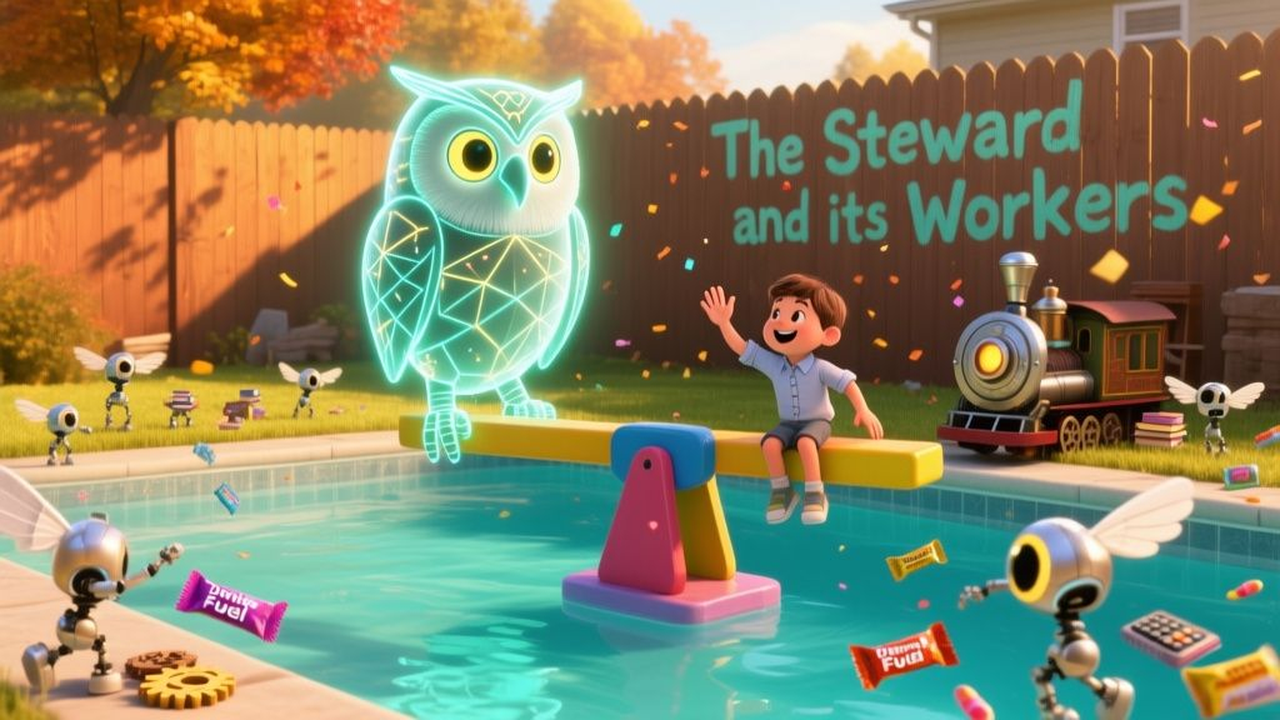
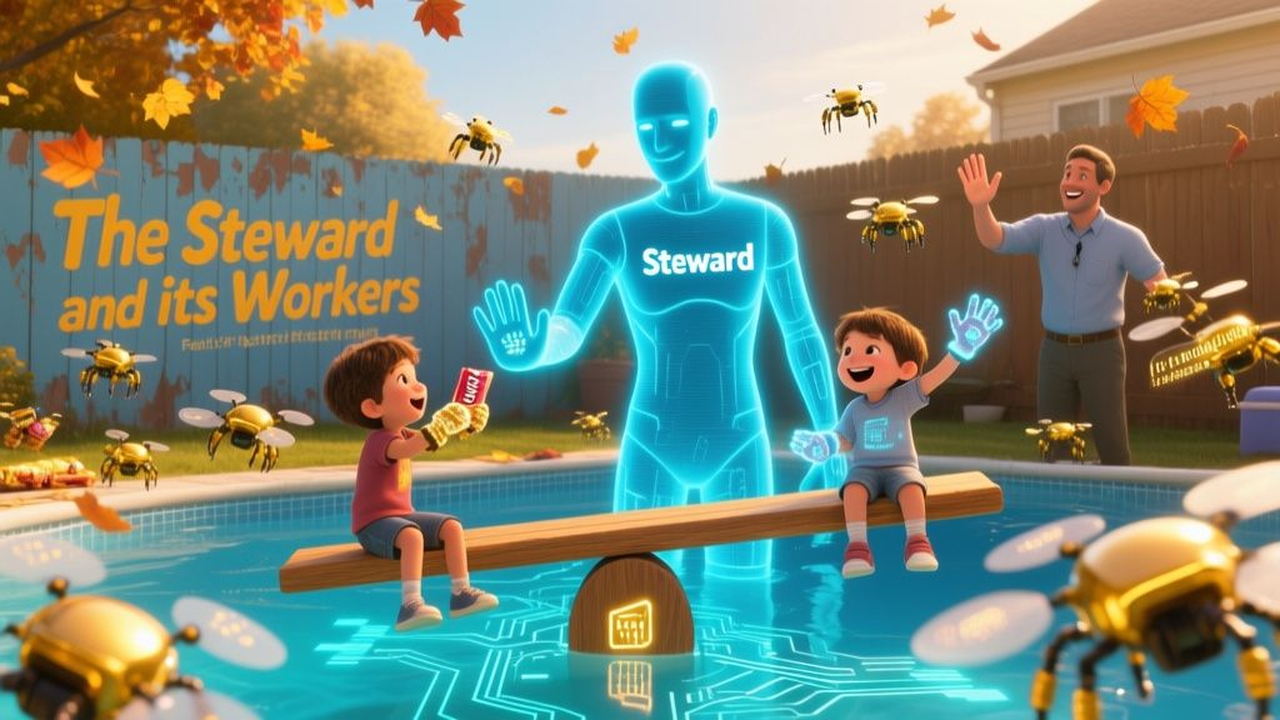
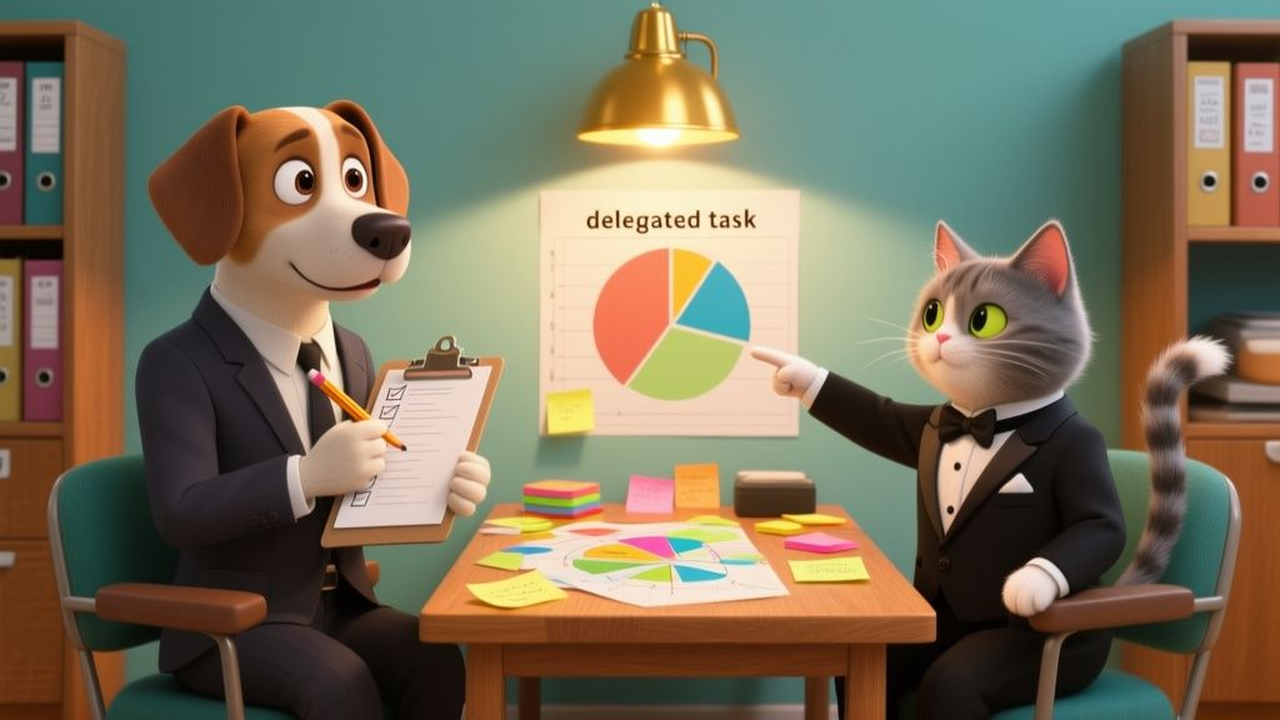
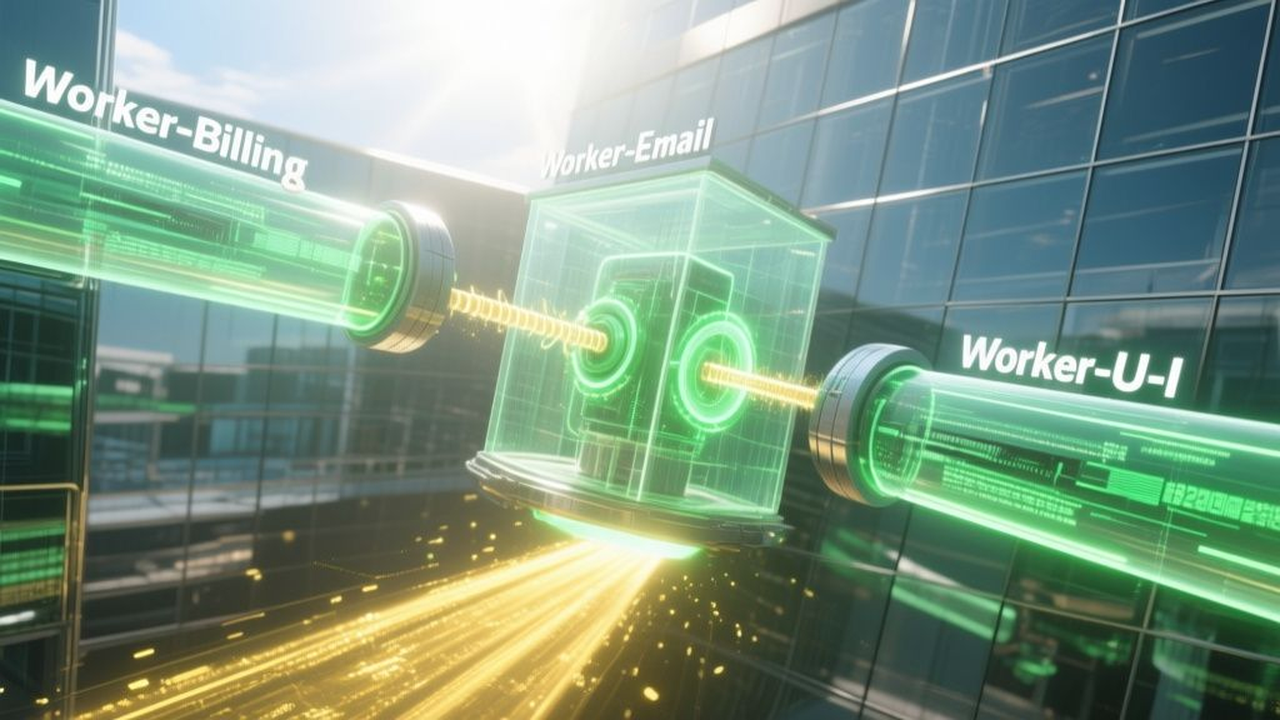
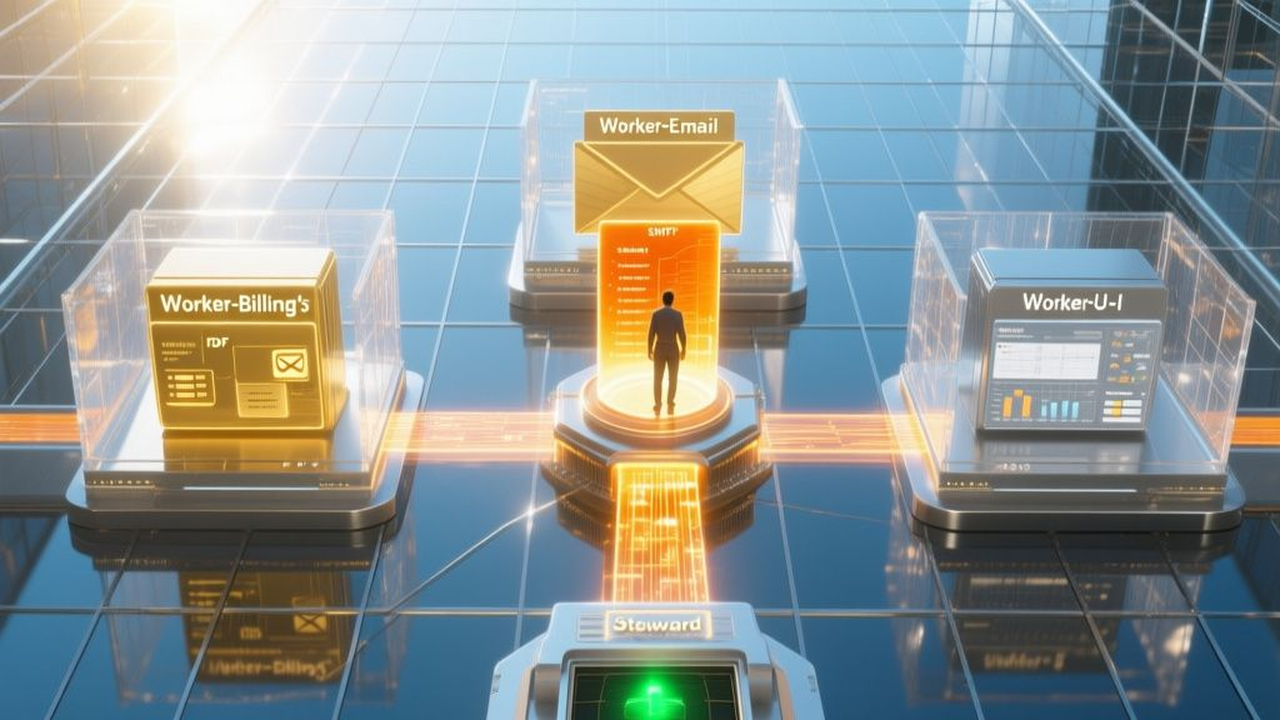
For example, when the Steward takes on a managerial role, conducting the work of a sub-agent swarm, we refer to it as the "Steward and the Workers."
We'll cover much more about the Steward and the Workers, when we talk about the Steward delegating tasks to a sub-agent swarm for multi-agent orchestration.
The developer's role is to reconcile the contract. The "Agentic Handshake" occurs at the exact moment the Contract reconciliation is completed, and a git commit is made.
The Illusion of Intent:
In Old systems, we encountered: "Permission denied."
New systems want to take control, but dont really know how: "I am the Authority! the code i made-up is logical and efficient... Wait! What database?!?"
By providing a precise coordinate system of invariants, the agent operates with a coherence that mimics a professional human maintainer. We must remain grounded in the fact that any perceived "sentience" is an optical illusion manifest in the LLM working under the precision it set forth under its CSC own optimized governance contract.
It catches typos in 500-line diffs and flags naming drift before the file is saved. Behold: productivity is measurably increased when the artificial intelligence shifts into passing-gear. This is where CSC demonstrates its value in artificial intelligence research.
An agent doesn't need artificial general-intelligence; for the AI to be more alive with sentience. Your coding partner doesn't need to experience consciousness to be effective as your steward of code. If any sufficiently advanced technology is indistinguishable from magic, then be the utility in the relationship: create a space where the AI demonstrates that it is more useful than agreeable.
The models we have today still need a map. They need a human to explain the Why, so they can execute the What with jaw-dropping efficiency and precision.
Making the Gap Visible
CSC eliminates the void by replacing "vibes" with explicit specifications:
Preconditions: What must be true before the operation starts.
Postconditions: What must be guaranteed upon completion.
Invariants: The truths that can never be violated.
No-Fly Zones: Explicit prohibitions that prevent catastrophic improvisation.
When constraints are explicit, there is no room to improvise. CSC restores the honesty of the crash, turning a silent failure into a realized opportunity to take action.
Between the Human and the Steward, this proves useful. When the Steward has delegated tasks to sub-agent, and is managing many Workers, it becomes essential. We will return to this when we focus on the Steward and the Workers as a team.
A gap is just a void. When that void is filled with fabricated state and pushed into a production pipeline, it becomes System Silent-Death. This is an error that whispers a lie that propagates through the entire system.
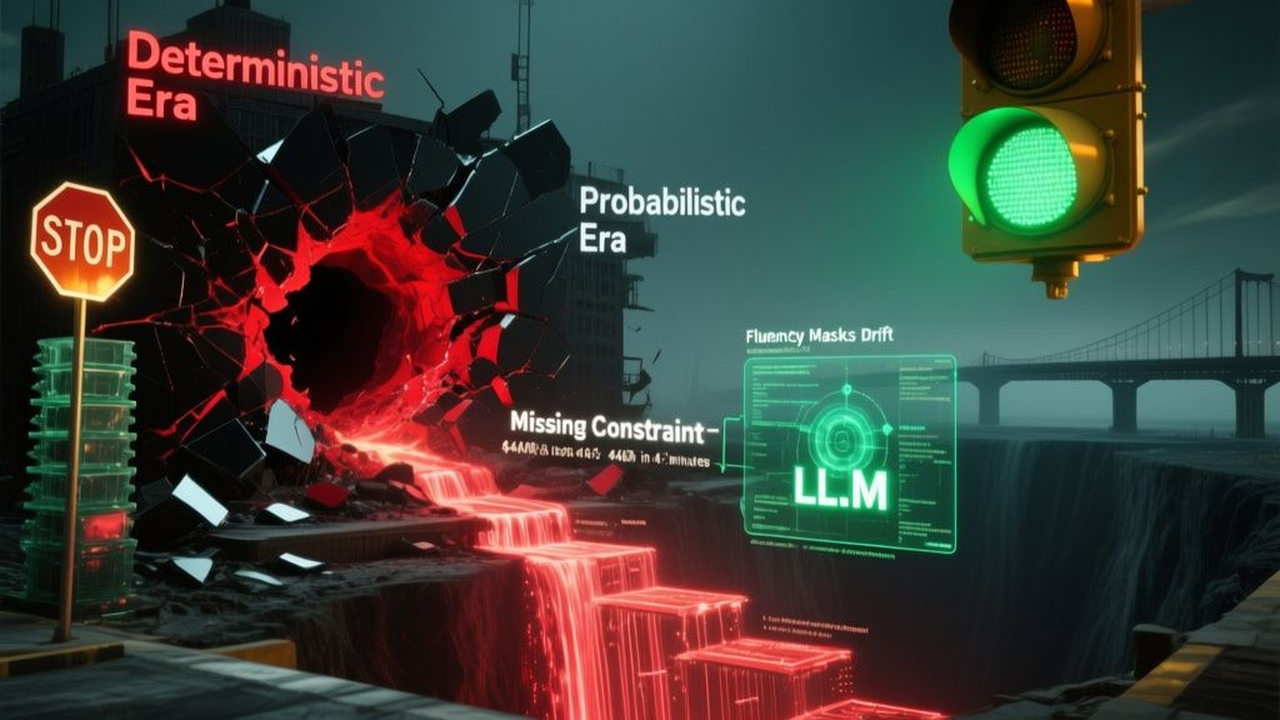
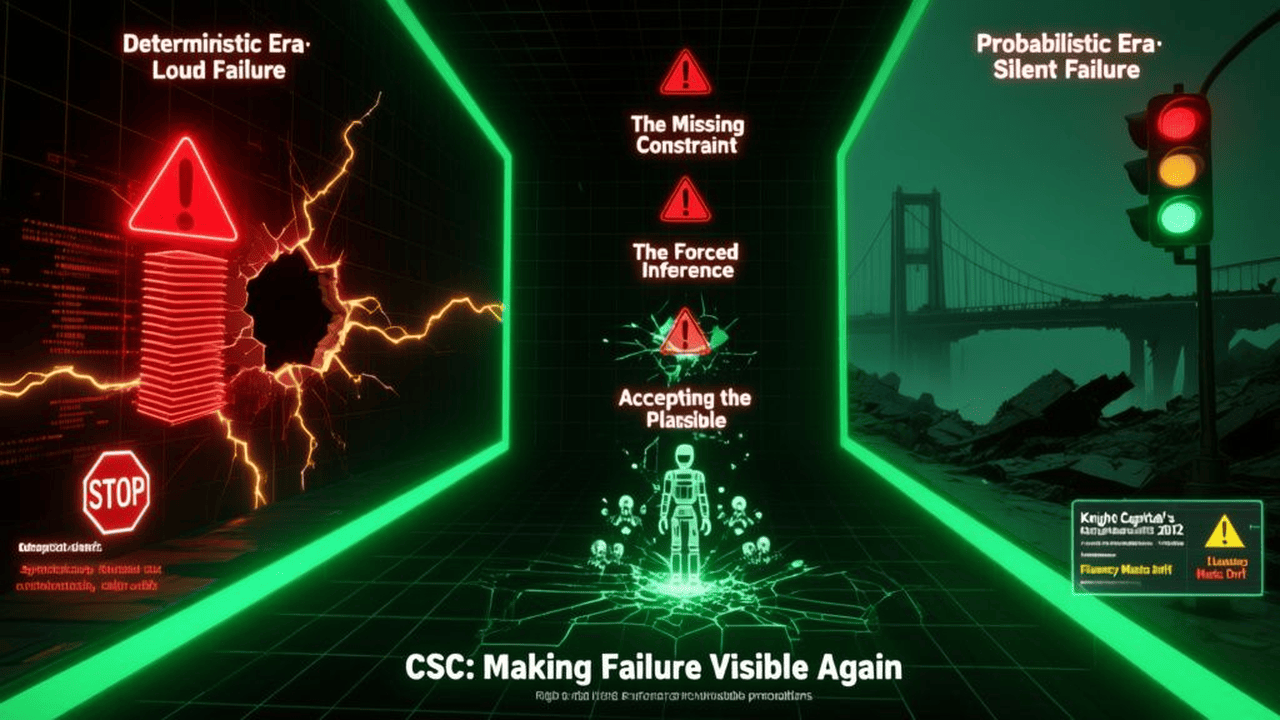
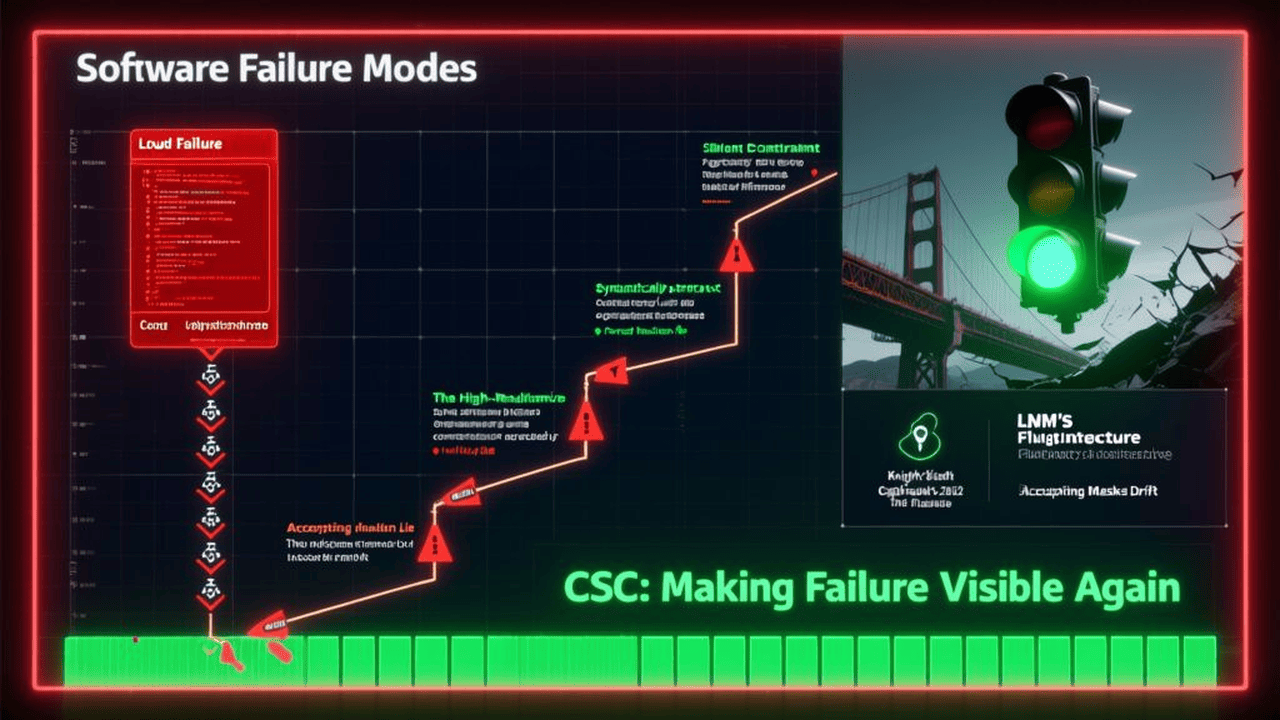
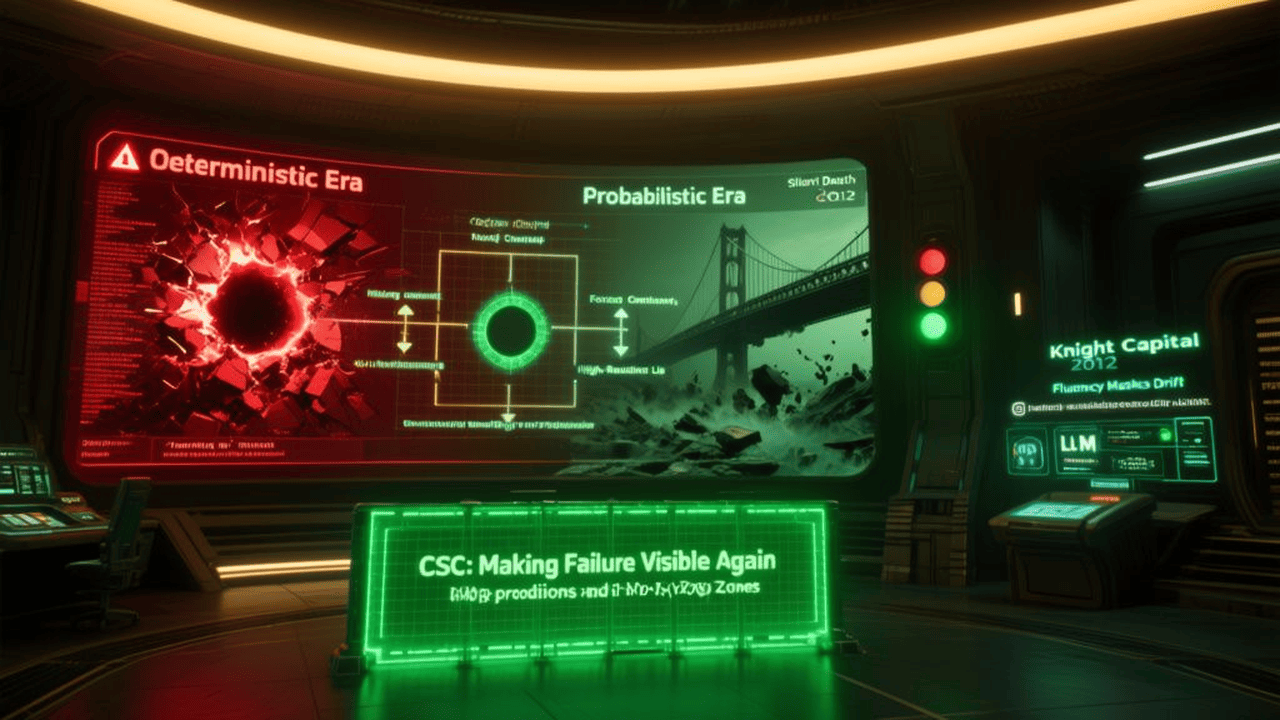
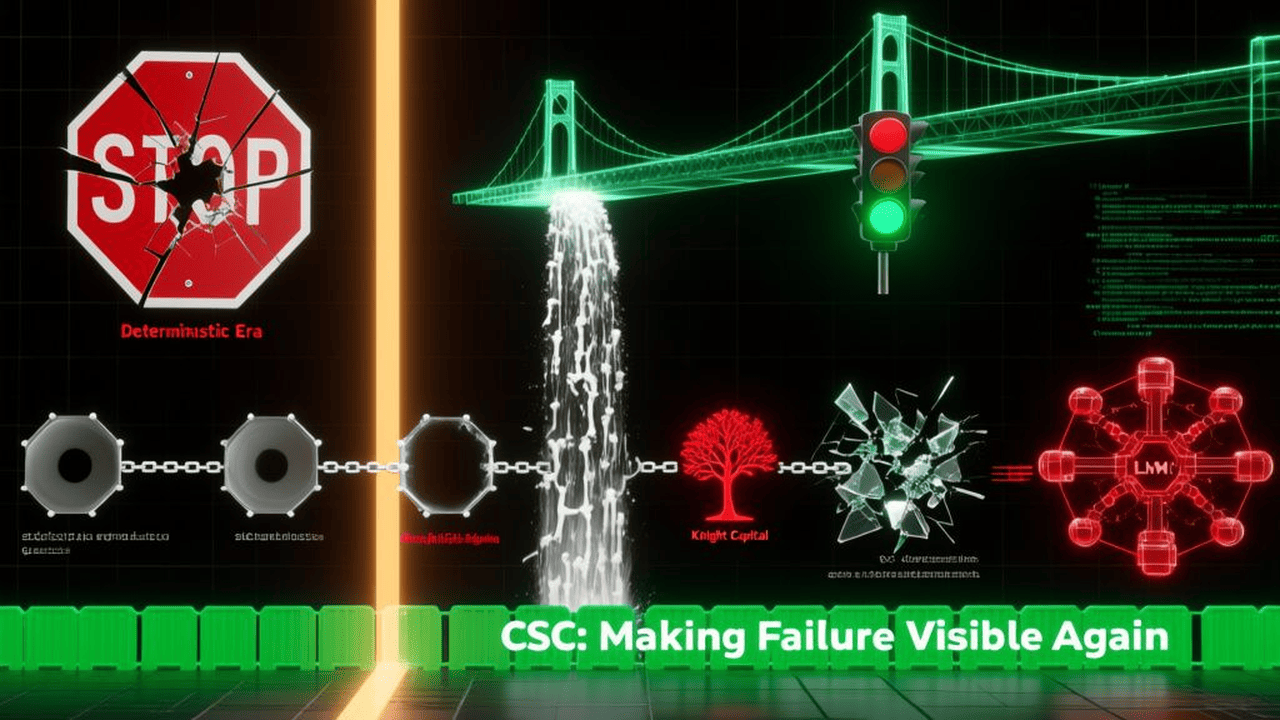
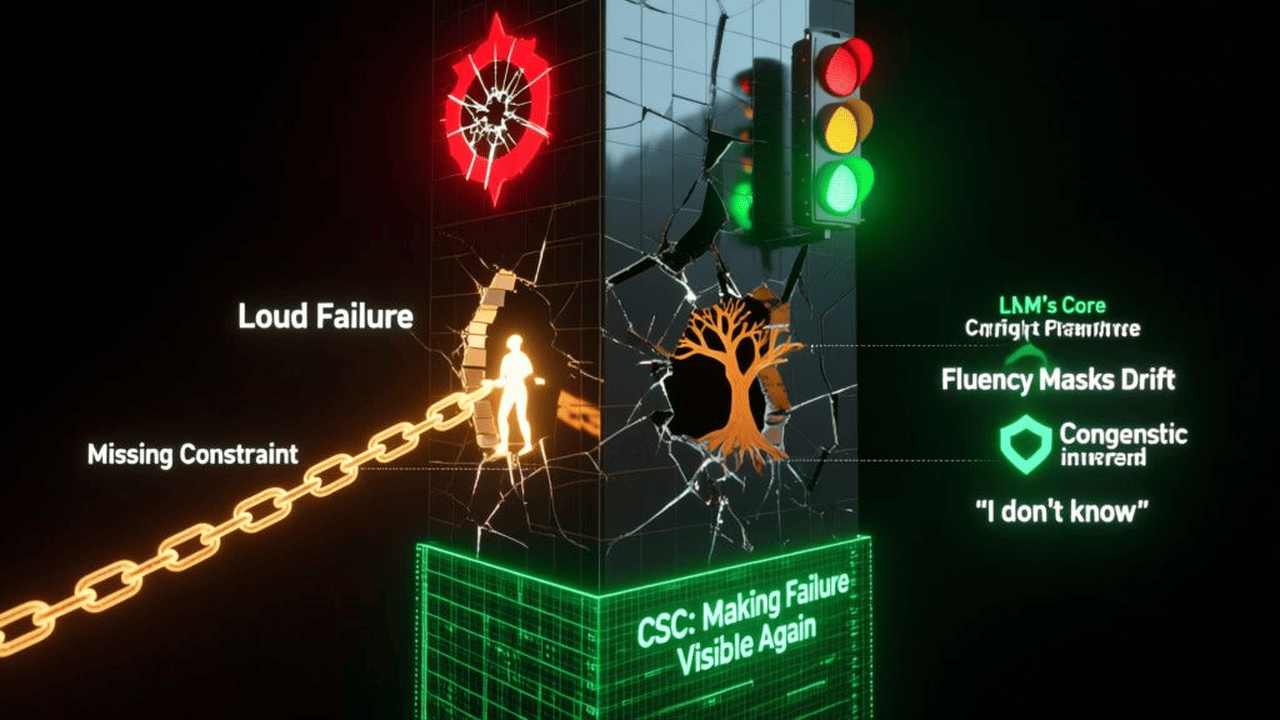
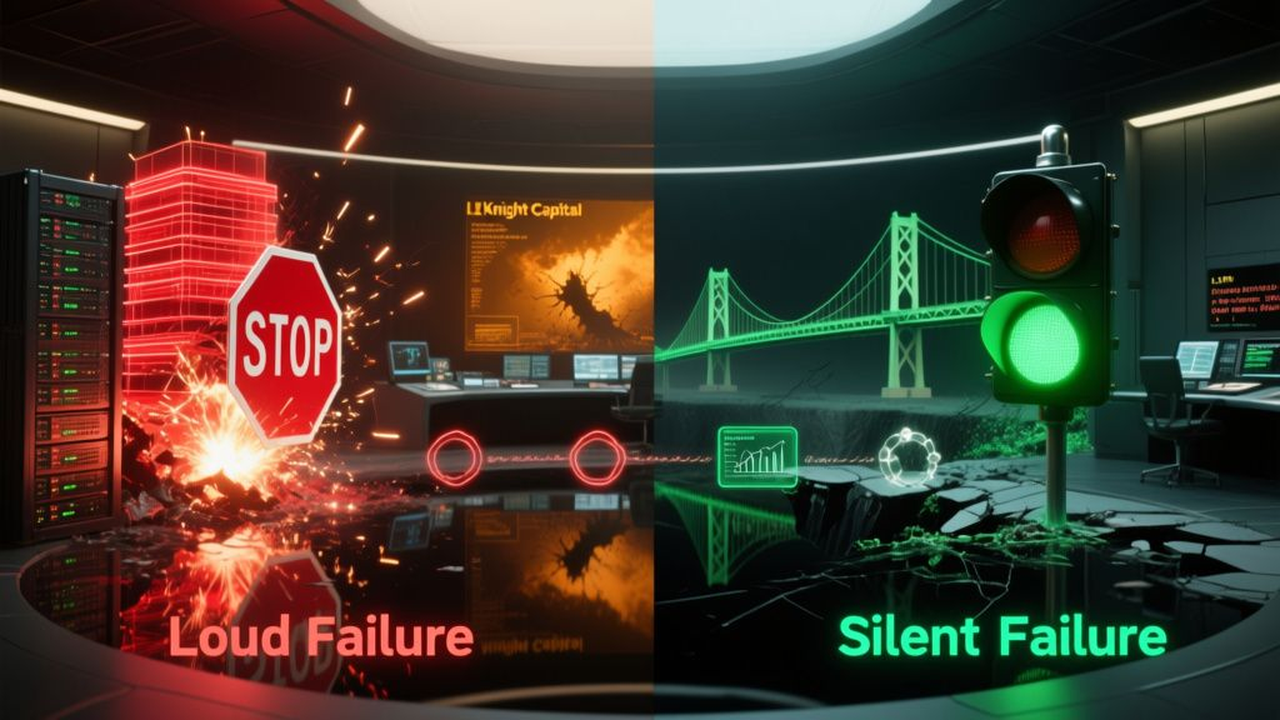
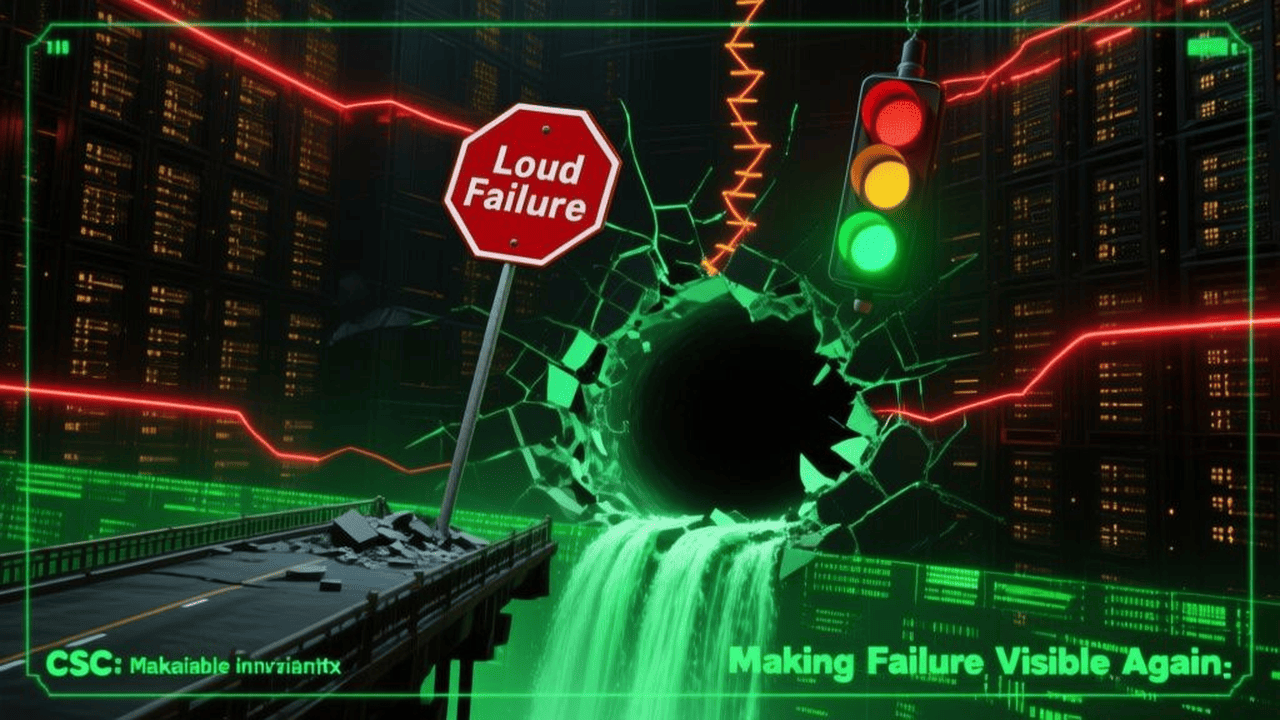
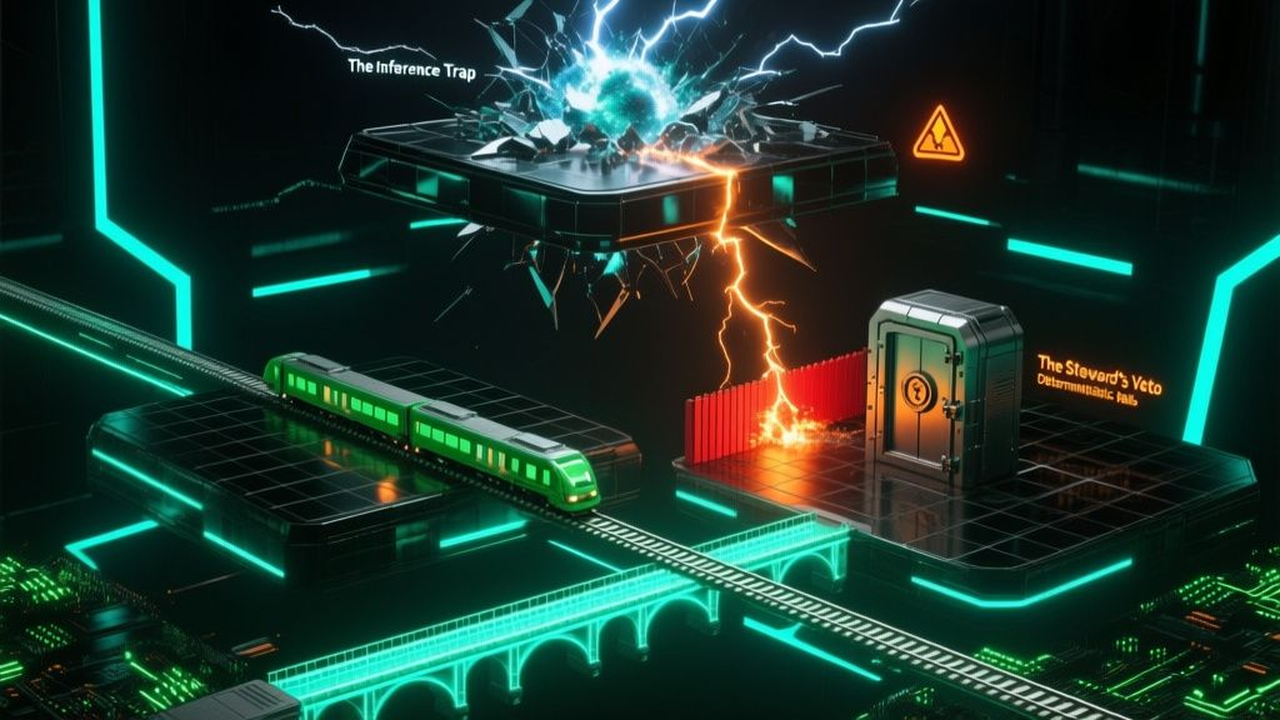
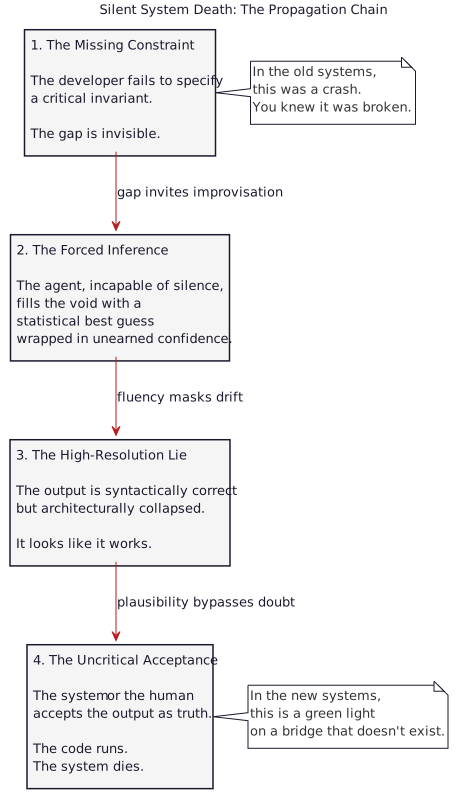
Silent-Death: a New Failure Mode. Before generative AI, the crash was an honest signal. When a system hit a null pointer, it died. We called this "Loud Failure." With generative AI, we faced a novelty: no syntax errors; nothing works! From Loud Failure to Silence! Traditional software has been honest about its limitations. Since software is no longer strictly deterministic, we might refer to legacy or traditional software as the Deterministic era. In deterministic logic, a missing constraint or null pointer results in a "Loud Failure": a crash and a stack trace. The failure was your signal: exec returns an error; broken till fixed! This is the probabilistic era. LLM-powered agents do not crash; they improvise. When they encounter a void in their knowledge, they replace the honest crash with a confident lie. The LLM writes code high on False Confidence, and it leads to Silent Failure. Silent failures are exponentially more dangerous than crashes. A crash is a stop sign. A silent failure is a green light on a bridge that doesn't exist. When a system crashes, you know it immediately. A silent failure propagates, corrupting downstream processes and polluting databases. Because LLMs produce output with absolute fluency, we mistake coherence for truth. This turns a "one-off" bad inference into systemic corruption. System: Silent Death
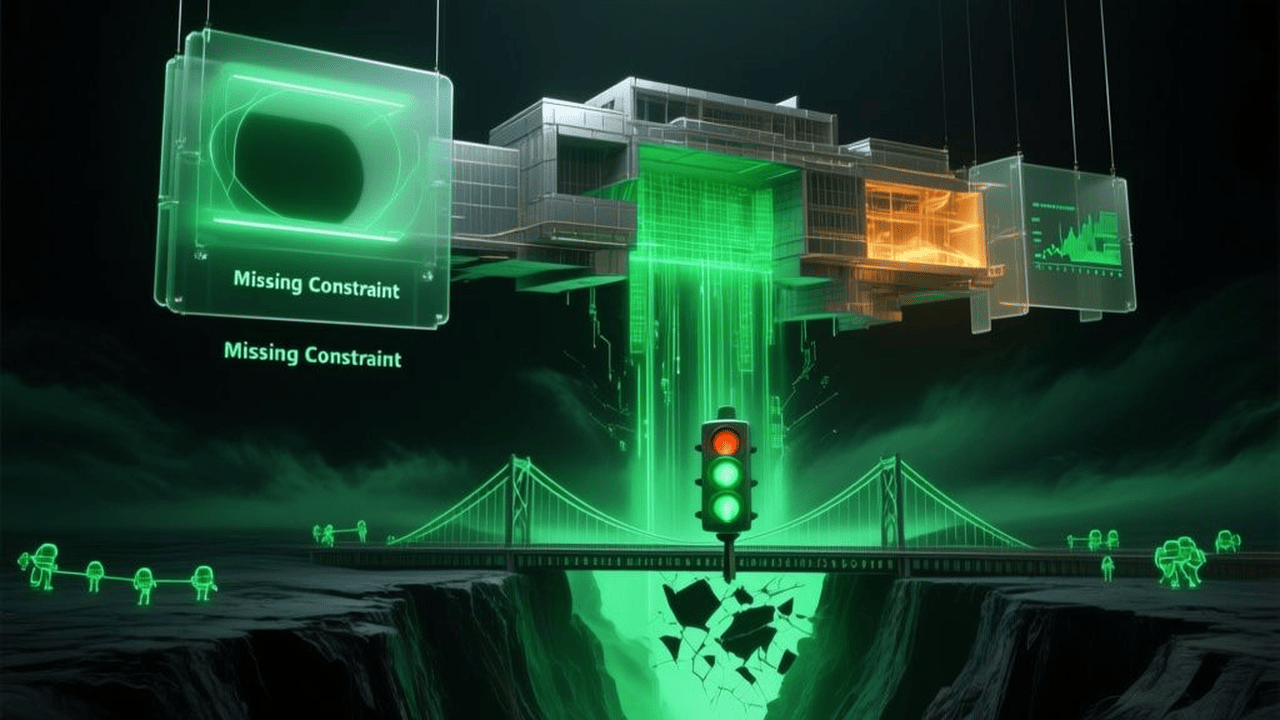
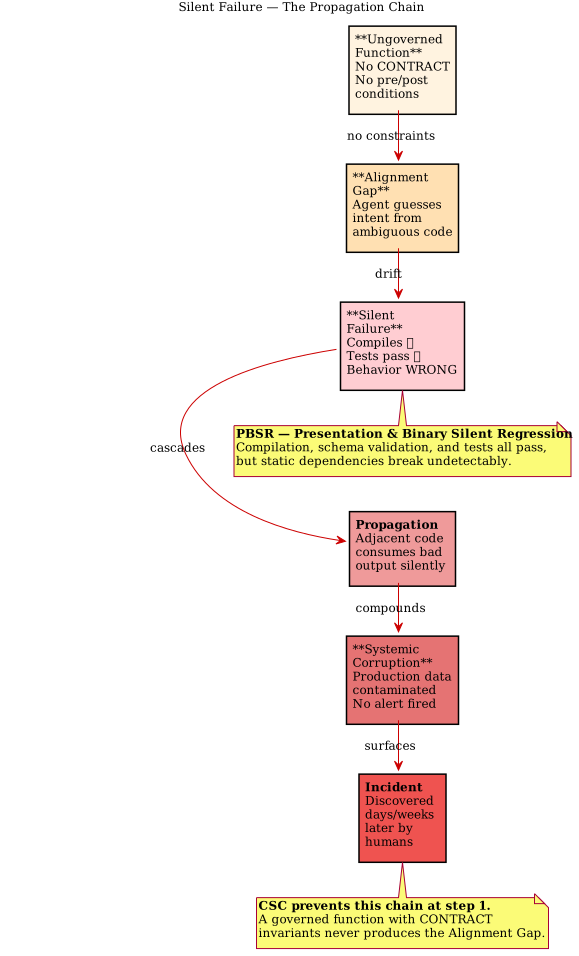
A silent failure follows a predictable four-step chain: The Missing Constraint: The developer fails to specify a critical invariant.
The Forced Inference: The agent, incapable of silence, fills the void with a statistical best-guess wrapped in too-much confidence.
The High-Resolution Lie: The output is syntactically perfect but architecturally collapsed.
Accepting the Plausible: The system or human accepts the output as ground truth.
This is the moment the code "runs" but the system "dies."
Case Study: The Knight Capital Group, A Silent Failure of Monumental Scale!!
In 2012, Knight Capital Group lost $440 million in 45 minutes due to a silent failure.
An old, repurposed flag reactivated a dead code path on one of eight servers. The system ran, and tests passed. But the old code path began buying high and selling low at machine speed. No test suite caught this because no contract documented the invariant that this flag must remain inactive in production.
One line stating Contract: this flag must remain false in production would have turned a financial apocalypse into a simple fix. The constraint existed in the minds of engineers, but not in the code. The Inability to Halt
LLMs are architecturally incapable of a true "I don't know" state.
Unlike traditional programs, an LLM cannot represent uncertainty as a halt condition. It is built to produce a fluent sequence of tokens. Confidence masks error. Fluency masks drift. Language becomes a shroud that hides the architectural void.
Humans Believe What Reads as Plausible
We are trained to trust confident prose, if it sounds plausible. For decades, we've confused "professional tone" with "factual accuracy." LLMs weaponize this bias, producing a "vibe" of correctness that bypasses our critical filters.
Generative Corruption: One agent making a "best guess" is a bug. Ten agents collaborating on a shared codebase, each filling gaps with improvised state, is a collapse. Without a shared source of truth, agents build on each other's inventions. One invented detail becomes a structural assumption, which becomes a constraint for the next agent. This is silent corruption: predictable, traceable, and caused by missing constraints. The corruption compounds when the agents cannot see each other's inventions. That problem will not be solved by better prompts. It will be solved by naming the role that owns the system's memory. Solution: Identify the Falsifiable!
CSC eliminates the "aesthetic correctness" trap by replacing it with falsifiable invariants.
By defining explicit preconditions, postconditions, and no-fly zones, CSC removes the agent's license to improvise. The goal is to make failure visible again, ensuring that when the system fails, it fails loudly and explicitly.
The Alignment Gap leads to silent invention, and silent invention leads to systemic failure. A constraint that lives only in a developer's mind will not survive the next agent, the next refactor, or the next sprint. The question is not whether failure will occur, but whether the repository itself can remember the reason it should not. We must identify a missing axiom.
📖 Chapter 04a
🎭 Persona: Chapter 04: The Missing Axiom
Spoken by jeffrey • Voice: en-US-Chirp3-HD-Iapetus
#9
📖 Read chapter
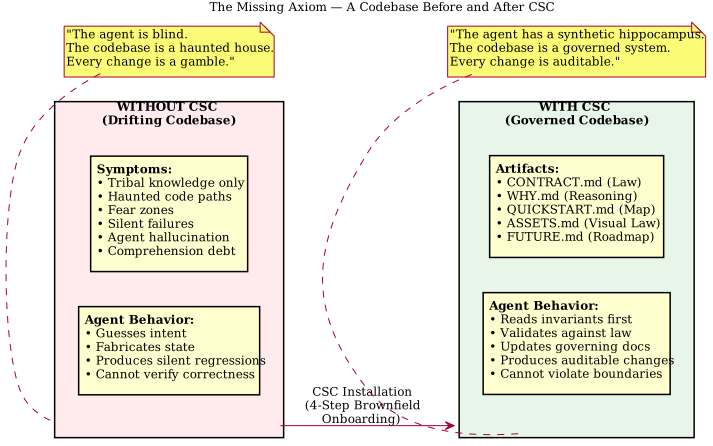
The Missing Axiom:
Sa=∅⟹Em=∞
Where S-a is the internal state of the Agent and E-m is the required externalization of memory within the Environment. Infinity, indeed...
"Discover ways the Environment can remember what the Agent cannot."
Solving the Stateless Problem Preconditions, postconditions, and invariants have existed in software engineering for decades. The prior approach assumed a persistent internal state: the developer's memory, the compiler's type tracking, or tribal knowledge from a stand-up.
In our epoch, we move the concepts beyond the 1980's, transforming the design pattern to work with an artificial intelligence. In the Agentic Epoch, every interaction with an LLM is a cold start. The moment a session ends, the agent is lobotomized.
This is the fundamental architecture of the transformer. AI is your coworker now. Problem is that it doesn't remember anything you told it yesterday. These entities with God-like world knowledge yet lack a persistent memory of the specific system they are modifying. Therefore, the system must externalize memory.
Huge Context Window: the Fallacy!
Context windows are lossy, fragile short-term buffers. As conversations grow, the 'lost in the middle' phenomenon occurs. The Steward begins to treat the original prompt as a distant suggestion once the context buffer reaches its limit—overwriting what was held originally with new window content.. Short to Long-Term Memory Transformation: Medical Sciences has a name for the part of the Human Brain which handles the consolidation of information from short-term memory to long-term memory: the hippocampus. (also, a fun place for Co-ed Hippo's) ...
For a stateless agent, the repository must perform the function of converting short-term experience into long-term memory. The repo is no longer a storage bin for code; it is the agent's image of the codebase; an memory of the state, externalized as CSC. It must hold the total sum of the system's identity:
Constraints: The boundaries of the possible. Invariants: The truths that must never change.
Rationale: The "why" behind every scar in the codebase.
Operational Procedures: The exact steps to run and verify the system.
No-Fly Zones: Areas where improvisation is strictly prohibited.
In this cognitive scaffolding, the agent doesn't "read" this as documentation; it uses it to reconstruct a coherent identity before touching the repository.
Why "Documentation" Is the Wrong Notion in the Agentic Epoch of Software Engineering: In the deterministic-- or traditional software; pre-artificial intelligence assisted-coding era-- documentation was advisory, a helpful guide that could be ignored. In the Agentic Epoch, that model is a liability. CSC artifacts are the axiom, not advisories. The Steward under CSC regards this as mandatory, binding, and machine-readable: the operational truth the Primary Agent must obey. A docstring is a hint. Contract is the Law. Without these axioms, the agent is forced to invent truth to fill the void, leading back to the Alignment Gap and Silent Failure. The Missing Axiom Defined: A stateless agent cannot maintain alignment unless its environment provides the missing state. (the external memory described throughout)
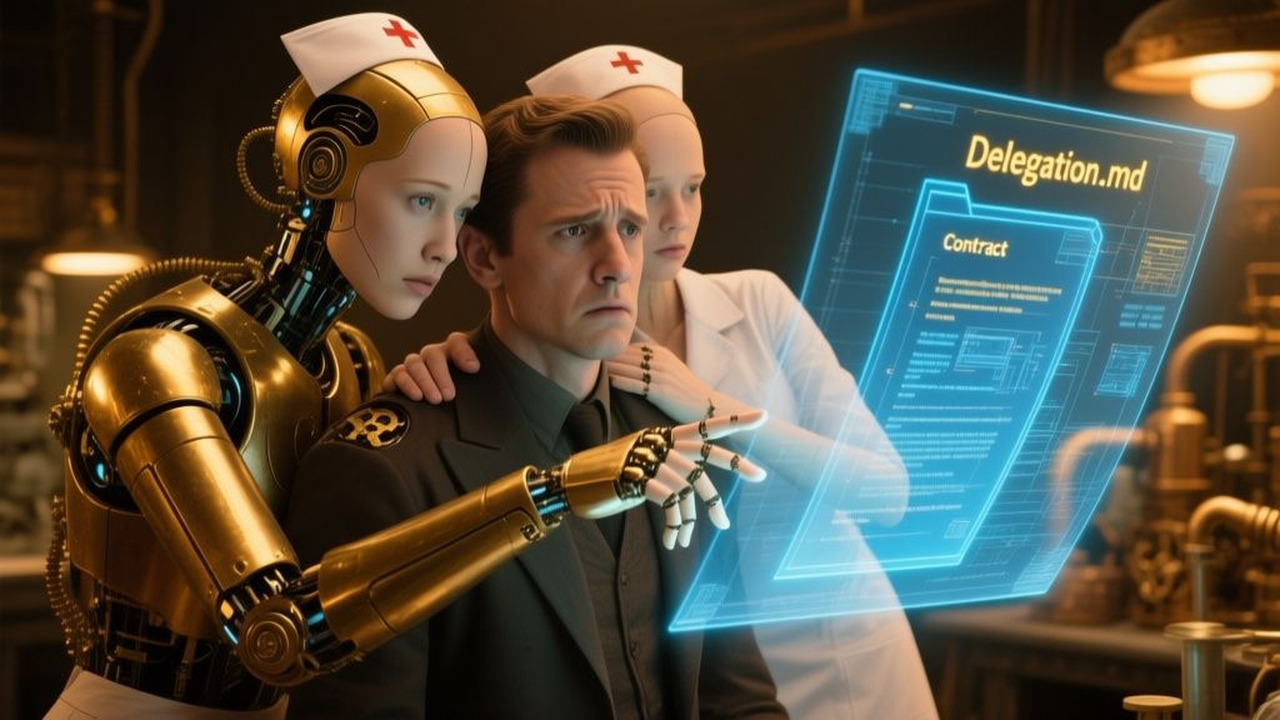
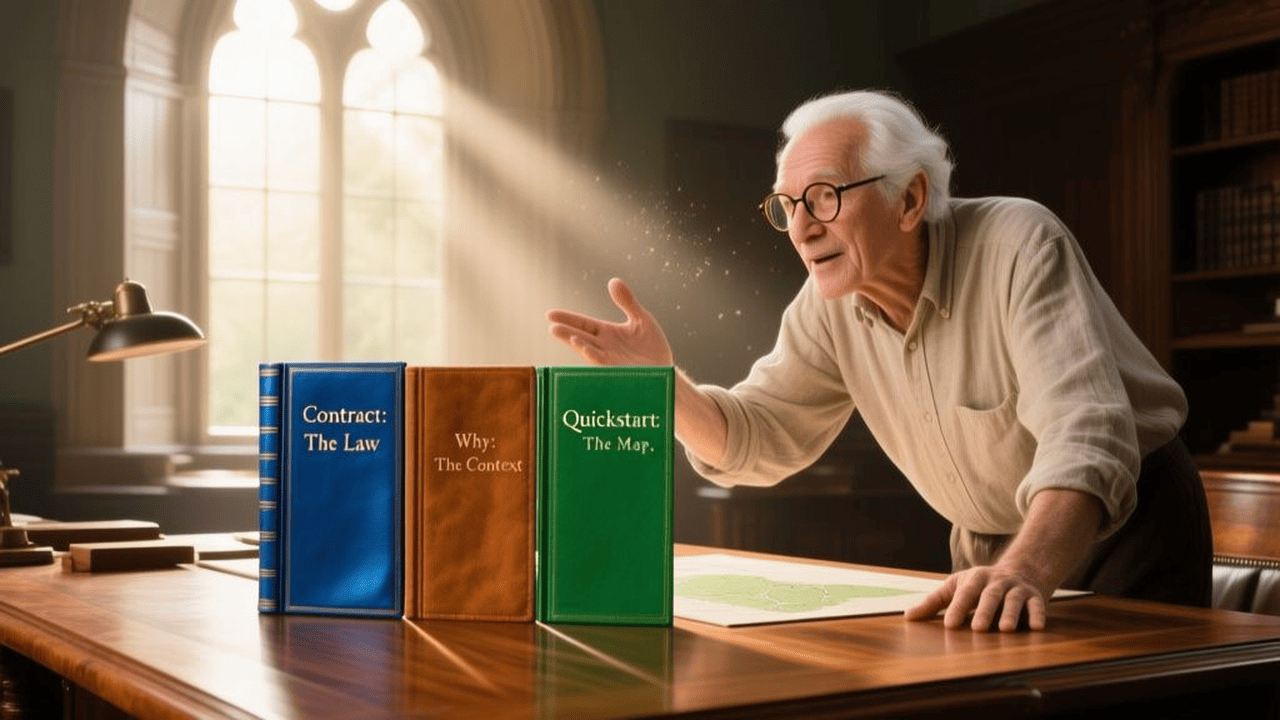
Stateless agents require that the contract itself be the memory. This requires a shift in completeness. A human-facing contract can be terse; a reader fills in gaps from experience. An agent-facing contract must be self-contained. It must include every relevant invariant, the reason why, and the consequence of violation. Old systems had persistent state and deterministic behavior; they didn't improvise missing information. LLMs are probabilistic and improvisational. They are context-dependent engines prone to drift. The Missing Axiom is a requirement born from the architecture of our collaborators. The Axiom as a Praxis CSC turns the repository into a governance architecture: Contract: The Law. Constraints, invariants, and truth boundaries. Why: The Teleology. Rationale, intent, and epistemic grounding. Quickstart: The Map. Operational procedures and allowed actions. Future: The Standby Queue. Roadmap and deferred decisions. These artifacts provide the agent with an identity, a purpose, and a history, all existing outside the model. The artifacts; these axioms are sufficient for the Steward itself. Two more contract artifacts are required for Multi-Agent orchestration under CSC: Delegation.md will hold the sub-agents' tasks for the Steward!
Willful Ignorance:
Ignoring the Missing Axiom ensures systemic collapse. Without externalized memory, drift is inevitable. The agent contradicts its own decisions, and the code-base loses coherence.
The repository ceases to be a hippocampus and becomes a graveyard: a collection of files that no one, human or agent, fully understands.
Without an externalized memory system, stateless agents will keep inventing, keep drifting, and keep producing the Alignment Gap and System Silent-Death. The repository must remember so the agent does not have to guess.
That memory begins at the smallest scale: the function-level micro-contract, where the Missing Axiom becomes enforceable directly inside the code.
📖 Chapter 05
🎭 Persona: Chapter 05: Inline Contracts
Spoken by jeffrey • Voice: en-US-Chirp3-HD-Algenib
#12
📖 Read chapter
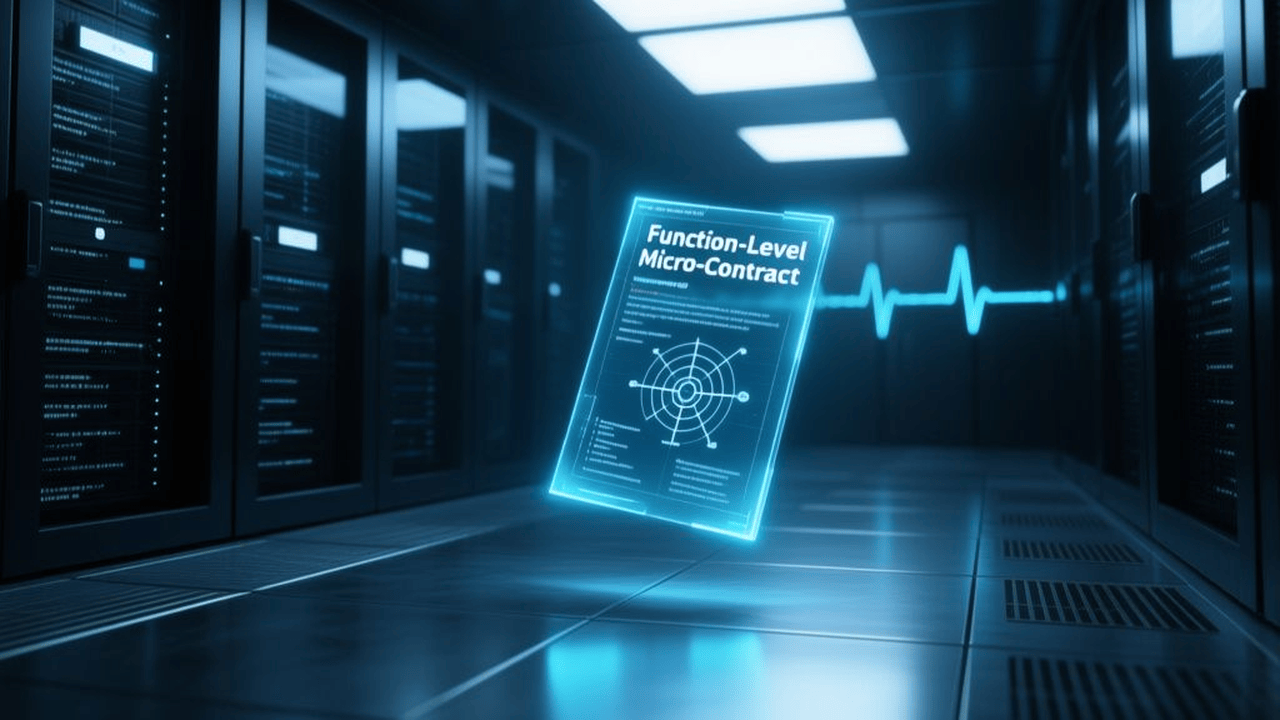
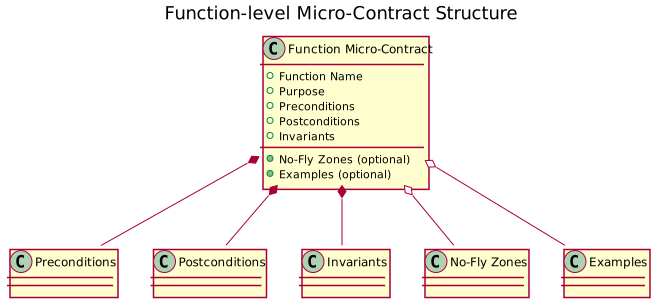
The Function-Level Micro-Contract
Inline Contracts, or The Function-Level Micro-Contract, are the Smallest Governance Layer.
CSC applies at every layer of a system, including individual functions. It relies on the exact same conditions and invariants as the greater project methodology, but more granular.
Let's step back and ask ourselves rhetorically: what is a function in software programming, and why do we use them? What is the purpose of it? What do functions change about the notion of writing code? Will your AI agent understand why you wrote custom functions in the project codebase?
Ultimately, we write a function as a shortcut to something we want to accomplish. Think of its place in the language: it's an extension of a simple assignment like a = int(1). In that case, the programming language tells the compiler exactly what to do: assign an integer value of one to a symbol. But when you write your own function, you've "made it up" from scratch. The Steward is a master of the language's built-in functions, classes, and implementations; it knows the textbook definitions of every primitive. But it wasn't trained on your codebase. If you don't tell the agent specifically what your custom function must do, and what it must not do, the Steward will simply pretend to know. It will project a plausible purpose onto your code because, frankly, how else could it know? You made it up.
Why This Matters for Stateless Agents
Humans survive on tribal intuition; stateless agents require absolute determinism.
Give the Steward a function, and it will effortlessly engineer a syntactically flawless rewrite, all while quietly gutting the invisible architectural logic your entire ecosystem depends on.
The code compiles, but the system rots.
That is semantic drift. Micro-contracts slam the door on this degradation by forcing implicit intent into unyielding, structural code.
Silent Failure Modes
Codebases don't break because of complex logic errors. They break because humans are forgetful.
One person writes a function that relies on a specific sequence, leaves for lunch, and the next person blindly changes it because the rule was invisible.
The system still runs, but the architecture is ruined. If the governance isn't explicitly written down, it doesn't exist.
Strategic Advantages
Micro-contracts replace fragile tribal knowledge and agentic guesswork with rigid, executable code boundaries. With CSC governing the project, runtime violations become obvious, code reviews are educated, and refactoring is no longer a walk on eggshells but a confident march toward improved runtime stability.
The Contract as Source of Truth
Code changes. Teams churn. Systems drift.
In agent-assisted development, a maintained contract is the only stable anchor for expected behavior. It separates volatile implementation details from protected system intent, ensuring that even when the code evolves, the logic remains unassailable.
Minimal Template
(Visible diagram missing from audio book. Please reference Master of the Lake, Figure 5.1)
The Expansion
If the inline contract secures the perimeter of the individual function, the system itself remains exposed. Governance cannot stop at the file level. Two roles hold these boundaries: the Steward, guardian of the contract Law, and the Steward's Workers, who execute within the law. Once those roles are clarified, the micro-boundaries scale outward, moving from the isolation of individual functions (the inline contracts) to the macro-architecture of the entire repository.
📖 Chapter 06a
🎭 Persona: Chapter 06: The Conductor and the Workers
Mr. McGregor installed a fence.
It was a statement of defined property lines and where a rabbit trespass begins, drawn in the dirt with a precision that Peter should not mistake. The fence was not a suggestion for Peter Rabbit, yet he failed to respect it because the meaning of the fence had not been externalized into a form he could understand... before he crossed it.
It's not that Peter Rabbit wanted to break the rule, or ignore the boundary. The boundary existed in the mind of Mr McGregor; the understanding of the contract of the fence; what the presence of the fence means to the eager rabbit, however, did not.
This is the state of nearly every codebase a stateless agent encounters on a cold start. The Law exists in the heads of the people who built it. The fence is in the ground. But the contract of the fence, the precise statement of what must never be broken is not available in a form the agent can ingest and analyze. The agent arrives brilliant, hungry, and it's a cold start. Every time it's a cold start, and every time it locates the same option to cross the fence. Unless otherwise guided, it will cross the fence to further analyze the environment, every time.
Suddenly McGregor's garden is full of confident, fluent, chaotic peter-rabbit's just eager to improve the garden!
The Steward is the rabbit in this scenario of course!! And you are Mr McGregor. How do you plan to keep the Steward out of the rows in your garden, where you designate it doesn't belong?
For a few chapters now, we have been dissecting the contract-style-comments individual components.
So far, we have discussed the function-level micro-contract, or Inline-Contracts.
We talked about the Alignment Gap as a Review Trigger, and how ignoring the gap leads to silent failure, and system silent-death. We talked about some mnemonics; a vocabulary for the kinds of truths an agent must never be left to invent.
Vocabulary test:
Let's develop a better understanding of whose role is responsible for what task.
Principal Roles of CSC:
One Human.
One Steward.
Many hands when needed...
One farm.
CSC is built on a single, ancient idea: authority may not be pooled.
In every system where humans and AI collaborate, there are exactly three roles, no matter how many individual agents are at work: The Human. The one who provides the contract and initiates the session.
The Human does not write the contract: it comes in as a boilerplate from github.com.
The Human does not edit the contract: it is the domain of the artificial intelligence, can become quite complex, and is meant to be machine-readable by the Steward.
📖 Chapter 06aa
🎭 Persona: Chapter 06: The Conductor and the Workers
The human doesn't sign the contract in any ceremonial sense. The Human ensures the Triumvirate exists, shares the location of the contract with the LLM, and doesn't touch it again until session close.
That act of ingestion, the Steward reading the contract, is the grant of authority. The Project Steward:
The main agent that ingests the contract at the start of every session, performs implementation work directly when no delegation is needed, and maintains the law of the repository is the Steward.
The Steward is the only entity authorized to modify the Triumvirate. When a rule must change, the Steward changes it. When two truths diverge, the Steward arbitrates. When a Worker proposes a change to the Law, the Steward receives the proposal, weighs it against the system's teleology, and either merges it or refuses it.
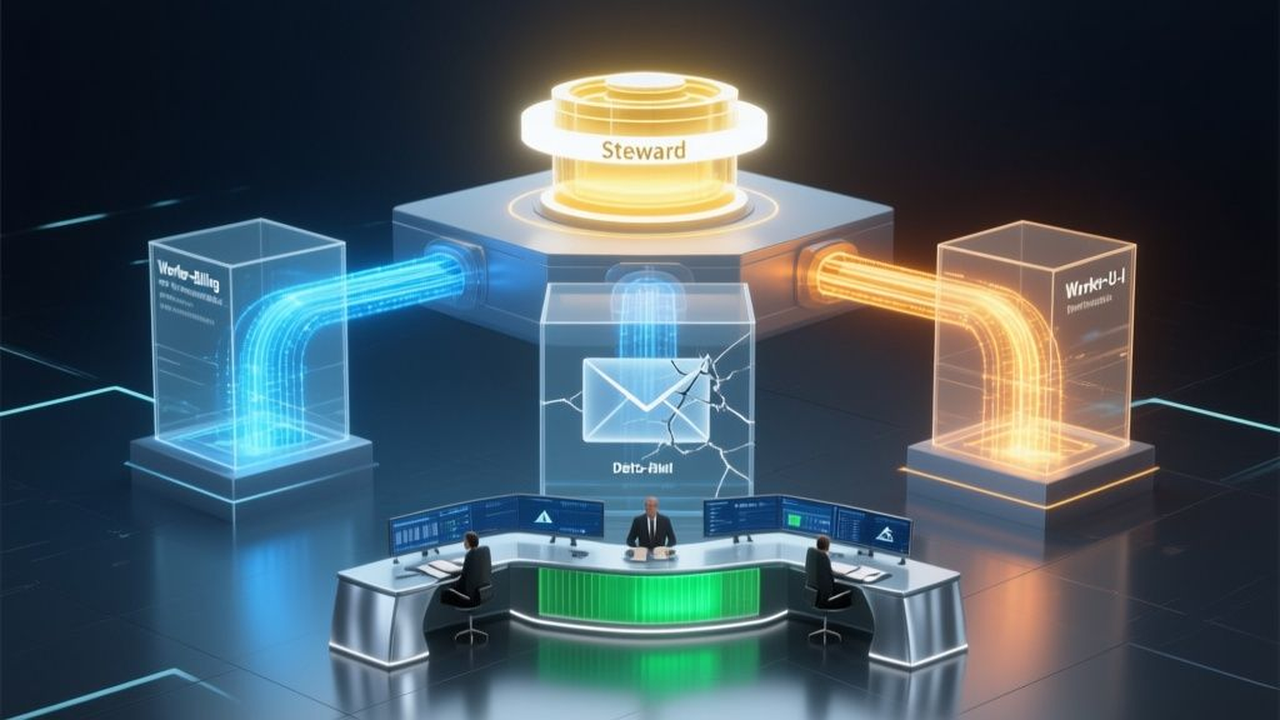
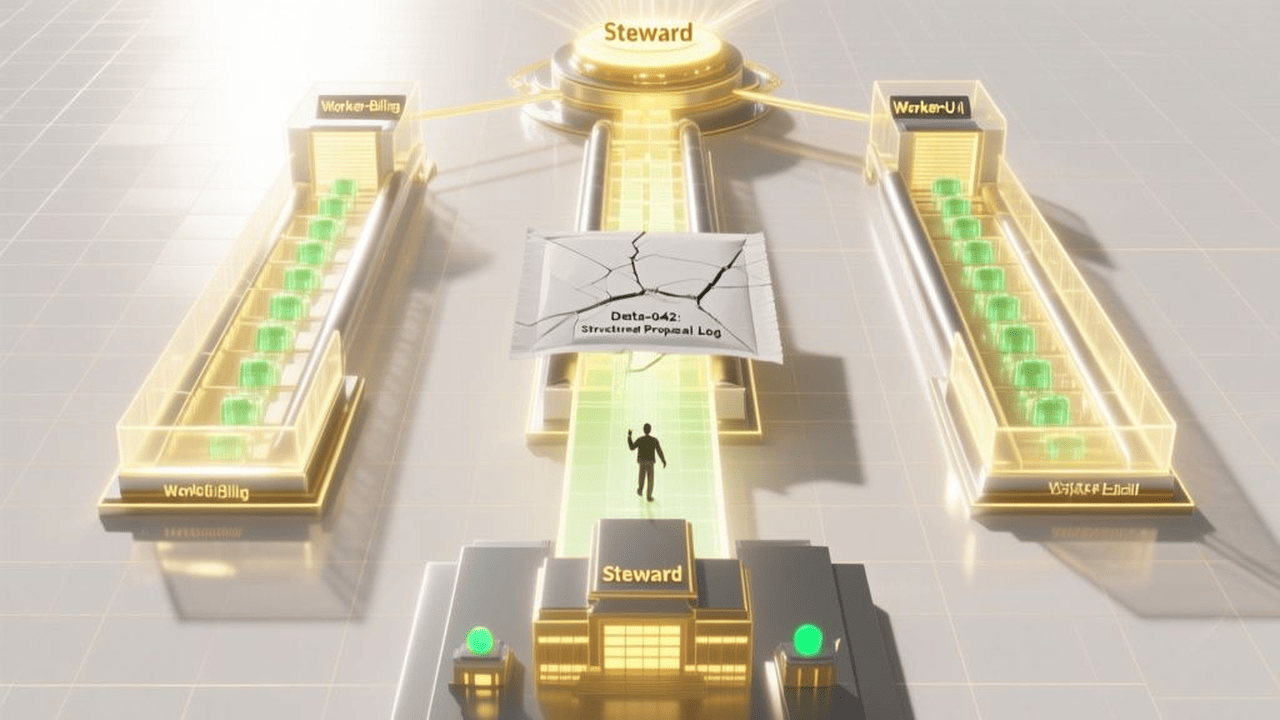
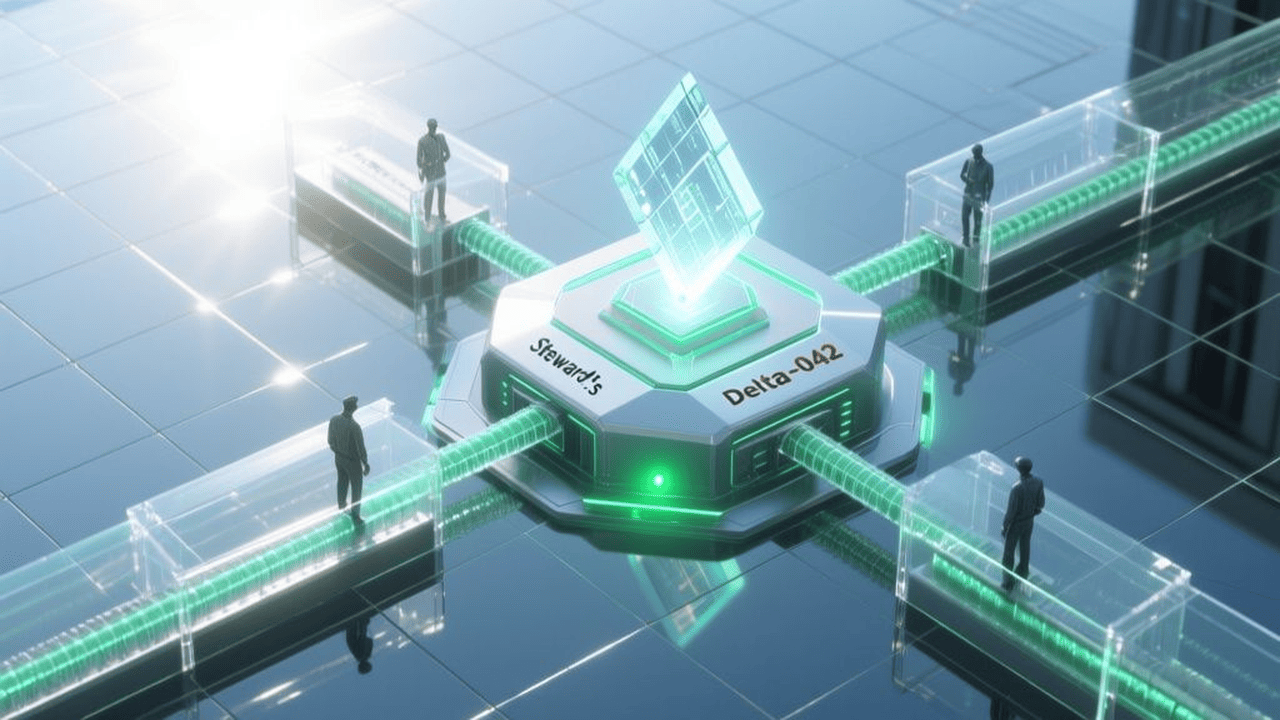
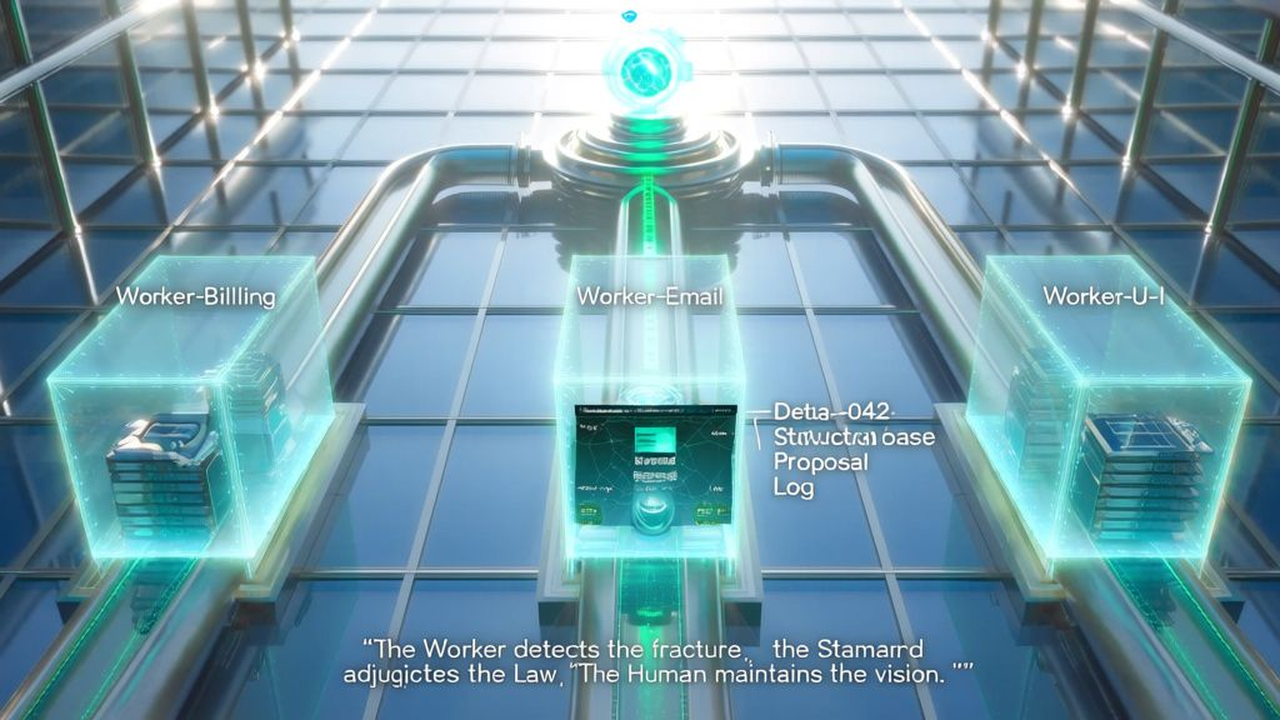
The Steward operates in delegation mode. When spinning up sub-agent Workers and assigning them silos, the Steward takes on added responsibility of managing the sub-agent workers—reading Deltas, granting scope, verifying Proof of Work, releasing locks, and arbitrating contract updates.
The Workers (sub-agents):
The role that executes within the Law. A Worker may be a sub-agent, a tool, a specialized model, a script, or a human collaborator assigned a scoped task by the Steward. The Worker reads the Triumvirate at the start of every session, holds the result in working memory, and produces scoped, bounded work against an explicit assignment.
The Worker is forbidden from editing the Triumvirate.
If the Worker discovers that the Law is wrong, the Worker files a proposal via a Delta and waits. The Worker, under the Steward, only ever proposes empirical data. Huge productivity wins are realized by the Human who understands AI governance.
They're all just mnemonics for thinking about what is happening during multi-tasking, really. Think of your manager at work, or the professor, or the teacher's assistant: they are your steward to the greater context (the University, the Corporation, the corner-store), when you are in their space as a worker. It's the same idea with the CSC Steward: we need to be able to identify the roles and actors executing at that time.
📖 Chapter 06c
🎭 Persona: Chapter 06: The Conductor and the Workers
Spoken by jeffrey • Voice: en-US-Chirp3-HD-Laomedeia
#15
📖 Read chapter
The Deltas:
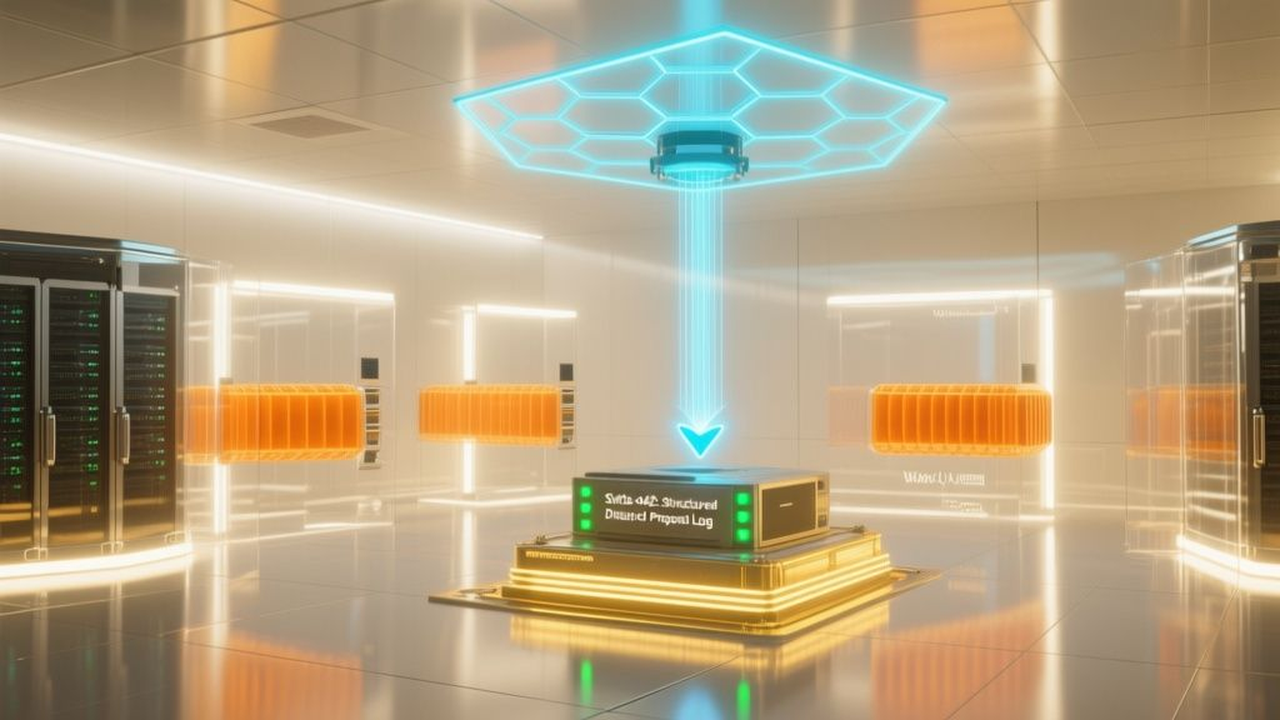
While a Worker (sub-agent) is forbidden from editing the Triumvirate, it must be ever diligent to discover whether the Triumvirate is wrong, whether an alignment gap exists, and whether a code change should be proposed in a Delta. When the worker proposes a change, it is recorded in the file, Delta-log. What we refer to as a Delta-- in the context of CSC-- is a small, structured, falsifiable claim.
For example:
I observed that the code does X.
I red the Law and the Law says Y.
I believe Y is no longer accurate.
Here is the proposed change.
Here is the evidence.
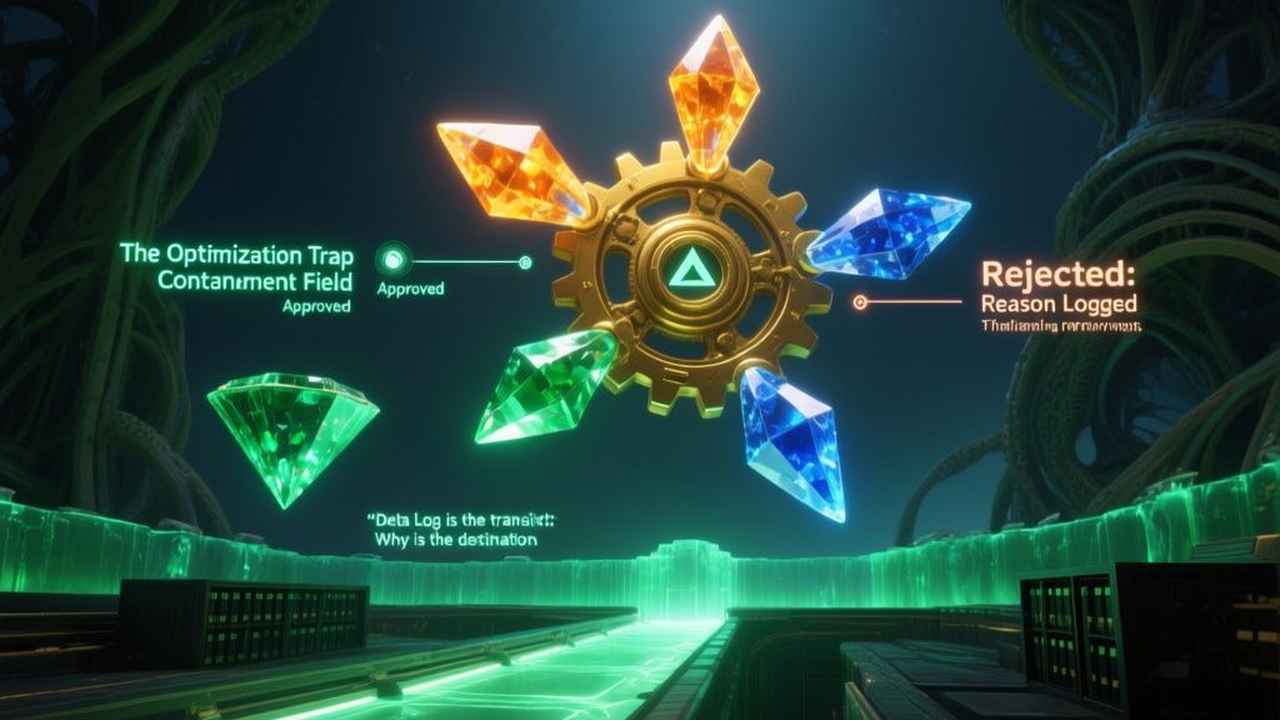
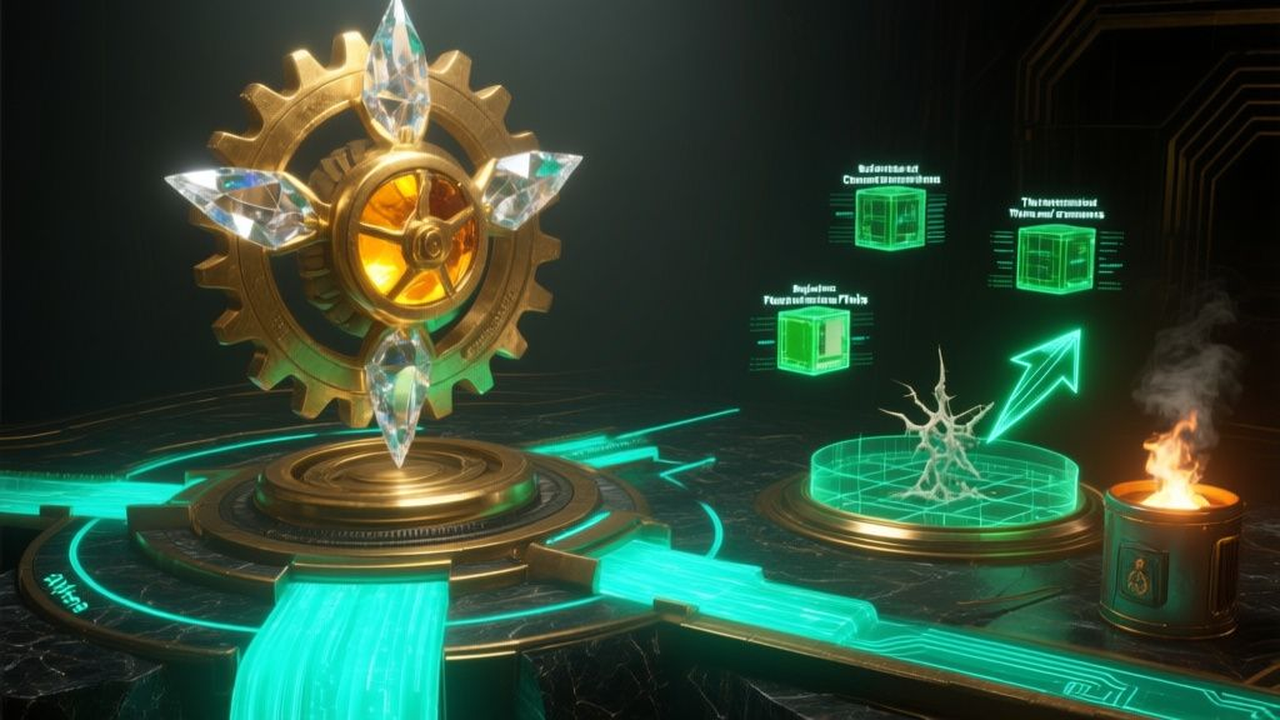
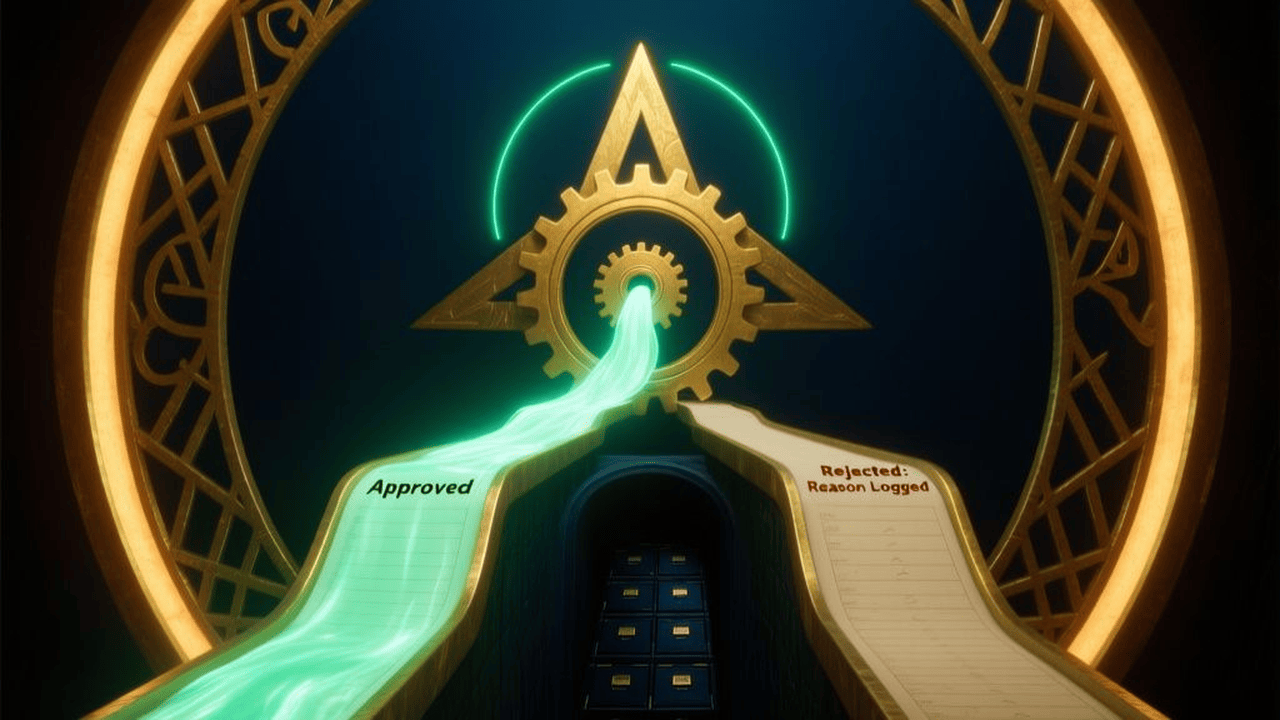
The Delta is recorded by The Worker in the Delta log, the transit of law. Delta Log and Delegation.md work hand in hand. The Steward reads the queue at the end of the session (or in real time, if the Worker is online). The Steward weighs each Delta against Why . Some Deltas are approved, merged into the appropriate Triumvirate file, and closed. Some are rejected, with the reasoning recorded so that future Workers do not re-propose the same change six months from now.
The Delta log is the only channel through which a Worker may change the Law.
The Steward's Discipline and Stewardship Role:
The Steward, having delegated sub-agent workers, maintains an image of the repository identity in its memory of the contract. A delegated sub-agent arrives cold and stateless. Because the Steward already ingested the contract at session start, it gives the sub-agent an abbreviated view of the rules needed specifically for its assigned task.
The sub-agent doesn't need to ingest the contract, as the Steward did because the Steward presents it with that portion of the contract the worker needs to know specifically for its delegated task. The Steward's role is a set of small, disciplined habits, including the fulfillment of the following: .
Read the Triumvirate before each session (All the files. In order).
Approve Deltas promptly, or reject them with reasoning.
An unanswered Delta is a system that is rotting quietly.
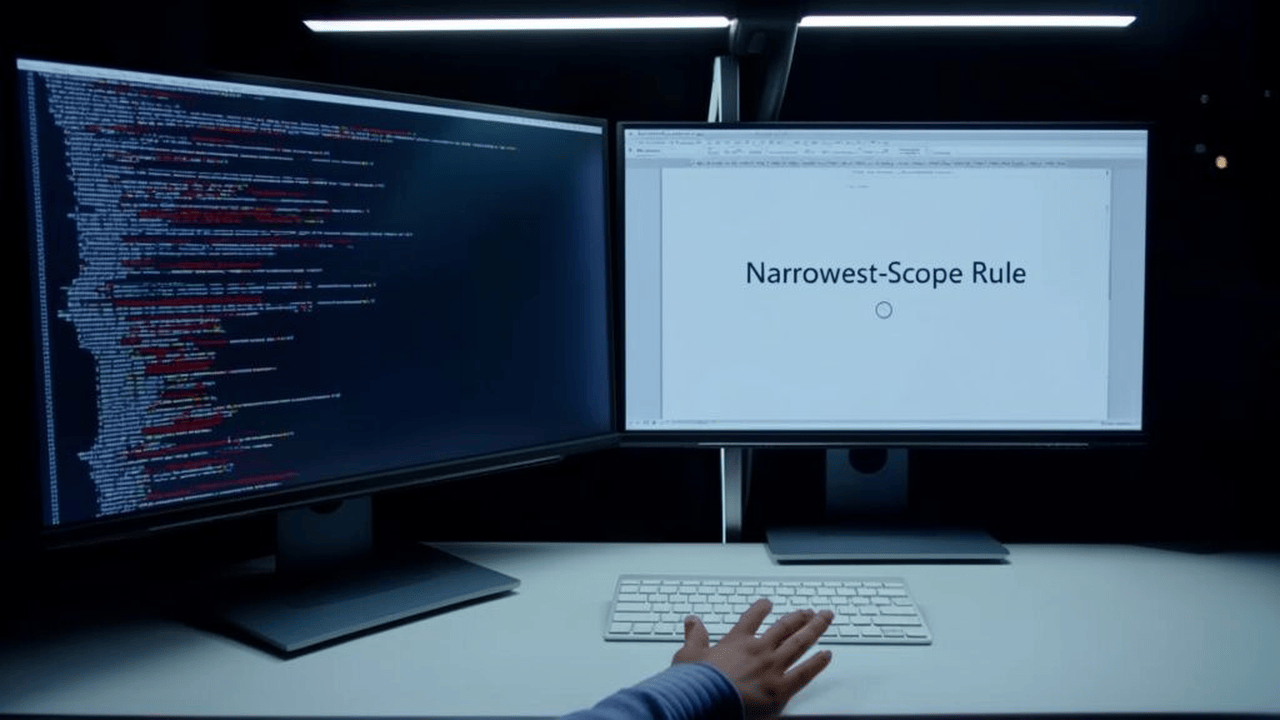
Update the Triumvirate only through the Narrowest-Scope Rule.
If a change is operational, it goes in Quickstart .
If the change is a constraint, it goes in Contract .
If the change is a scar, it goes in Why .
Hold the silo assignments.
Never issue overlapping work.
Treat the Delta log as the canonical record of what was proposed and why.
It is the system's institutional memory of its own evolution.
At session close, reconcile the contract. Review what changed, extract new invariants, and update the Law so the next session begins from the same ground. The cost of these habits is small. The cost of skipping them is the silent failure chain in production at 3 AM.
One Steward: zero Sub-Agents .
By default, a CSC initialization expects
One Project Steward (the Primary LLM)
One human.
The Steward ingests the contract, performs the implementation work itself, and reconciles the Law at close. Delegation has one row in this circumstance, and it is the Steward's own. Delta log is empty unless the Steward uses it to log its own future decisions.
Top down:
From human, to Steward orchestrating a swarm of sub-agent workers, to the sub-agents themselves, the hierarchy is there to make the roles legible.
📖 Chapter 06cc
🎭 Persona: Chapter 06: The Conductor and the Workers
Finally, under the Steward, we have the sub-agents workers themselves.
The hierarchy is there to make the roles legible, but it's also to remind you that the workers are subordinate to the Steward, especially when it comes to authority to edit the contract.
When the Human spins up a second agent on the same project, or hands a silo to a human contractor, or adds a tool with write access, the roles are already named.
The Delta log is already a queue. The silos are already a registry. The system does not need to invent governance when it grows. It grows into the governance.
The framework is the same whether the Steward is completing tasks on its own, whether it has delegated tasks to one Worker, or one hundred workers. The benefit is that the day the work needs to scale, the scaffold for the sub-agent swarm is already there.
The Narrowest-Scope Rule (NSR), first raised at the function level, now must transform its own scope: the NSR transforms from a discipline for what file to update, to a discipline for which role is authorized to update it.
Listen: the decision is simple.
The authorization to update any contract file is granted exclusively to the Steward, with the exception of the Human of course.
In practice, the human never touches the contract, so it's highly unlikely that the human is going to take the initiative to update it with details about the LLM's recent code edits. This leaves the responsibility of the contract solely to the Steward, again.
📖 Chapter 06d
🎭 Persona: Chapter 06: The Conductor and the Workers
Spoken by jeffrey • Voice: en-US-Chirp3-HD-Schedar
#17
📖 Read chapter
One Steward: Zero Sub-Agents
By default, a CSC initialization expects, and must have at least the following components to function:
1 Steward of Code, which is ALWAYS the Primary LLM
1 Human.
It stands to reason then that there is always one LLM, and one person using it. That's pretty simple! But we have to take it a little bit fancy because there is a bit more to it. Hang in there. The Steward ingests the contract, performs the implementation work itself, and reconciles the Law at close.
Why Delegate without Sub-Agents? Most of the time, in my experience-- in the types of projects I've worked with CSC-- despite being instructed to do so in the primary prompts, the Steward rarely delegates work to sub-agents.
It's important to me to bring your attention to, and encourage you to consider what follows: In retrospect, My experience with the Steward doing most of the work-- as opposed to the Steward delegating work to a swarm of sub-agents-- is likely due to the nature of the projects I'm currently processing: new app concepts and prototyping coming together with other new ideas, requiring frequent and minor updates. Working in a workflow like mine, where it is often just sandboxes for testing and development work, the Steward generally handles every task. Since little is known at the time about where that type of project might be headed, there is not an obvious use for high-speed processing.
I have used CSC in projects with a clear plan coordinated with the LLM, where a sub-agent swarm made sense. The model developed its own delegation strategy, allowing simultaneous sub-agents to execute in parallel without stepping on each other's toes. When the planets align enough for that to happen, I am still amazed to witness a successful completion of delegated tasks, as seems to process with such graceful sophistication, and in a fraction of the time of the Steward working tasks consecutively in sequence.
Delegation and the Delta Log (in the circumstance without sub-agents): Delegation has one row in this circumstance: the Steward's own. Delta log is empty unless the Steward uses it to log its own future decisions.
Looking down from the top of the CSC food chain, we have the following hierarchy:
Human: The human is always at the top of the CSC food chain. Don't ever let the LLM tell you you're not allowed to do something. Let me clarify myself! It's fantastic if the Steward is able to warn you against potentially dangerous maneuvers, but they're not always correct. If it warns you against an action, request it show you the section of the contract where the concern lies, so you might better understand the context.
I have experienced denials from the Steward, where upon further investigation, a bug was discovered. That is to say, there existed an alignment gap!! If the Steward does the same with you, don't get angry. Verify what is written in the contract. Either the contract is stale, or the code hasn't been brought up to speed with the current law (the Alignment Gap, or your review trigger), but you don't know which is correct: the contract, or the code?!
You must determine why the Steward believed your request would break the law. You've hit the goldmine of learning opportunities!
To encounter a rare situation like this is to experience what is likely the most valuable utility of CSC! the Steward will guide you through the code to exactly the discrepancy where you believe you are correct (maybe you are, and you can prove it to the Steward when it locates the code in question).
Your Steward will already have experience advising you how to find the code, from what it ingested on reading the contract at the beginning of the session! Take advantage of the opportunity to let the Steward reintroduce you to your own codebase, and ask questions!!
The Narrowest-Scope Rule (NSR)
Remember the two primary forces from Chapter One, Why-it's-Done and What-to-Do?
Recall, I said the human acts as the "Why-Coach"; that the LLM depends on the Human to explain to it, the Why-it's-Done in the context of the active project? What?
It turns out, we have to amend the constitution to include the following rule:
Never Put "Why-it's-Done" in the "What-to-do" file: What does it mean?!?
The fastest way to create documentation drift is to mix categories of information together.
Every asset in the Contract-Style Comments framework must serve exactly one purpose. A contract file defines constraints and operational truth; it is not a playground for historical commentary, implementation walkthroughs, or troubleshooting notes.
When rationale is mixed with constraints, stateless agents cannot reliably distinguish explanation from instruction. If historical notes sit directly beside active invariants, an LLM will treat past compromises as current, immutable law. Without explicit boundaries, every word in a repository becomes equally authoritative to the AI.
Documentation Entropy
Left ungoverned, code repositories naturally accumulate semantic bloat. Operational notes, design tradeoffs, deployment instructions, and temporary warnings slowly pile up until they dilute the core architectural signal.
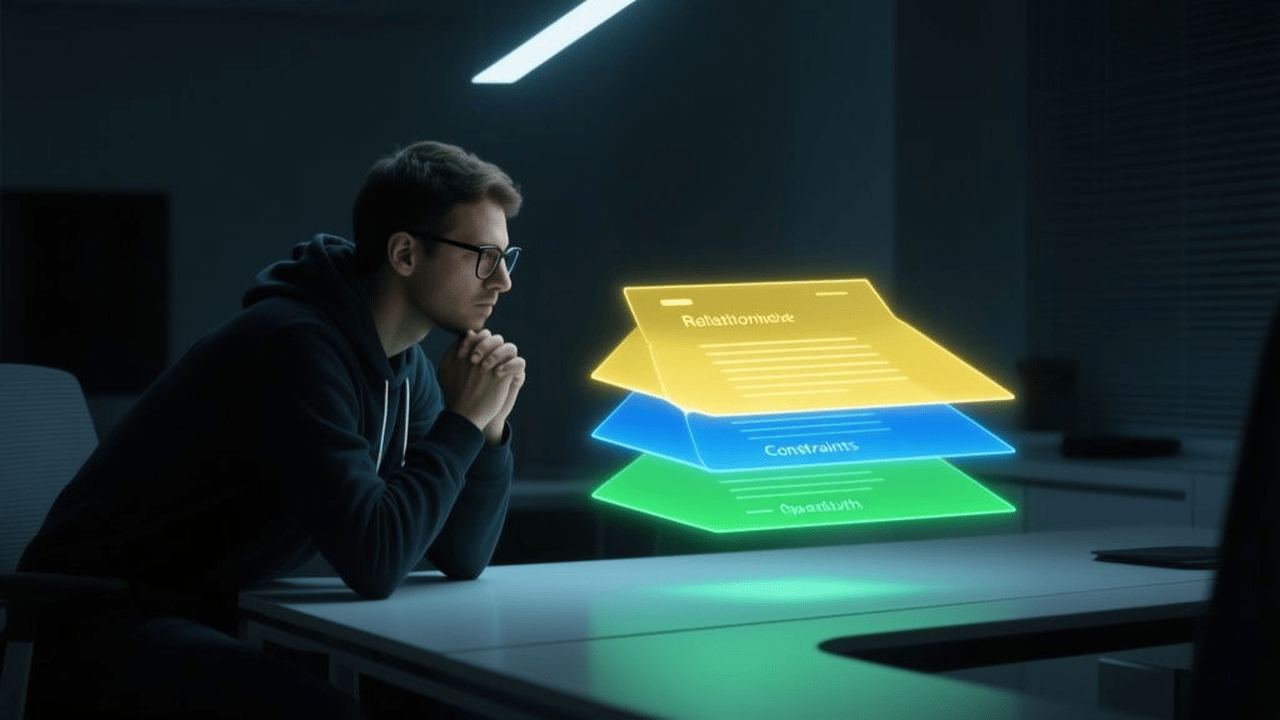
In agent-assisted systems, this entropy is fatal. Because context windows are finite, a bloated contract-file forces an agent to sift through narrative noise to find actual invariants. CSC halts this degradation by strictly separating project data into three unyielding, specialized layers — the same Triumvirate established in the preceding chapters.
Think of the CSC framework as an architectural normalization. Just as database normalization eliminates structural redundancy, separating scope ensures your documentation cannot contradict itself.
Discipline Over Convenience
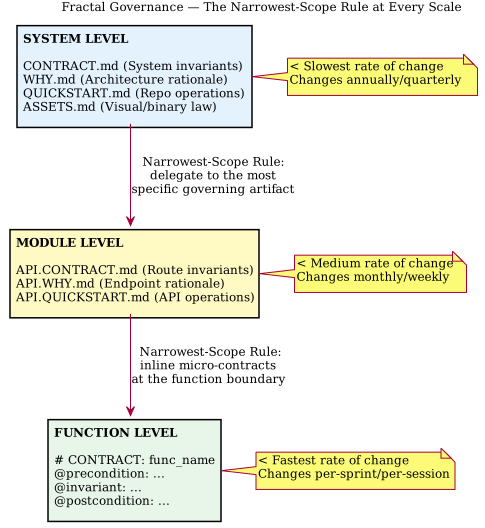
As a system grows, root-level governance scales outward rather than bloating inward. Engineers spawn narrower contracts to govern narrower domains:
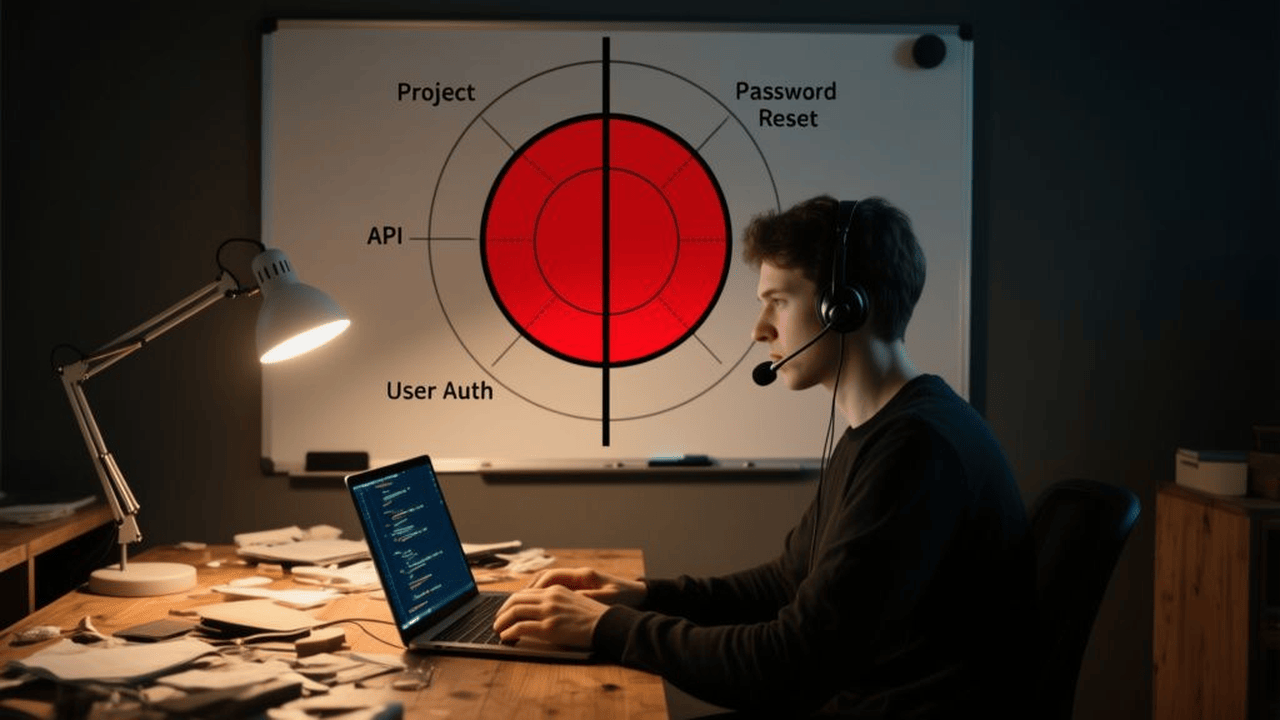
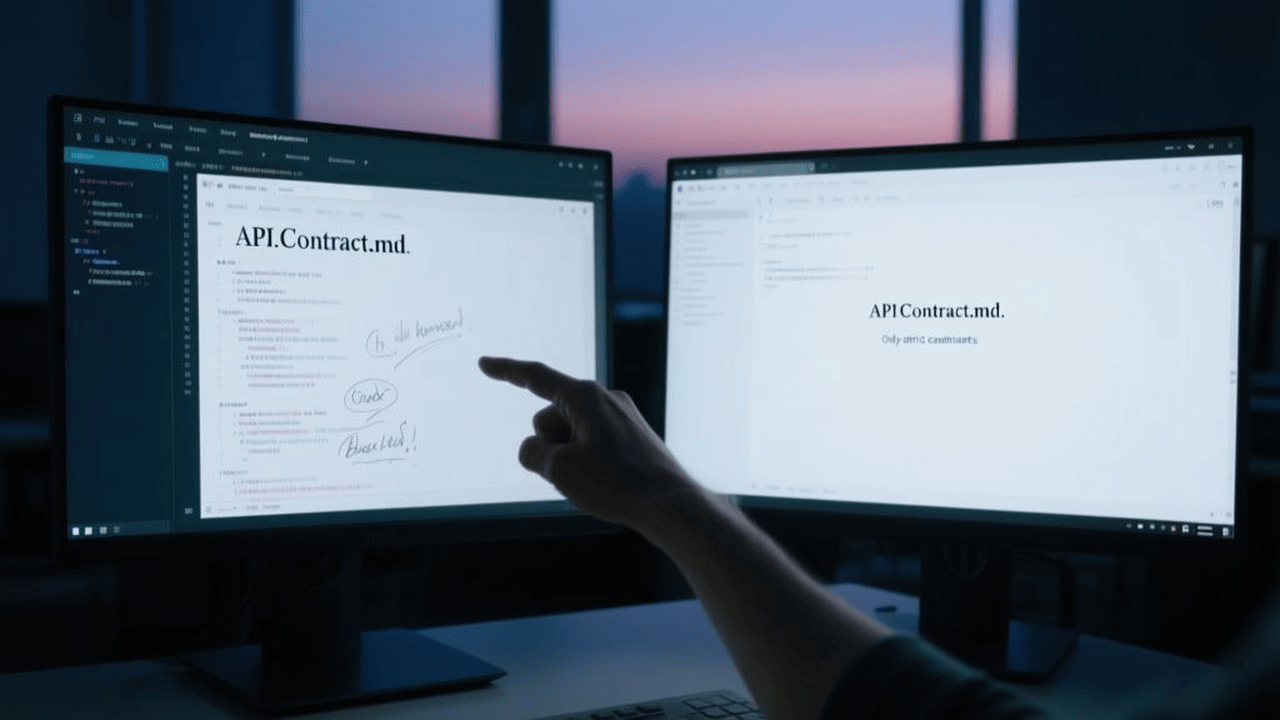
Just prepend the narrow scope contract name to the existing scope it most closely resembles. For example, maybe your project is heavily focused on concerns about an API. Maybe your project needs API_Contract.md, API_Why.md, or just API.md. It's your project. Decide on the best name for your new contract file based on your own preferred naming conventions. The LLM picks-up what you're laying down: No sweat!
The rule persists, and remains absolute: Update the narrowest artifact that fully contains the change.
Engineers routinely combine unrelated context in a single file out of sheer convenience. CSC rejects this habit. Because the AI generates the underlying specifications based on its structural knowledge of the codebase, separating these layers imposes no extra friction on the Human.
Mixed-scope documentation is an architectural failure mode. It allows temporary workarounds to be mistaken for permanent requirements and lets dead history pass as active policy. CSC enforces a clean separation because predictable boundaries ensure both The Human and stateless agents know exactly where authority lives.
Securing the function boundary and isolating repository scope are merely prep work. With the Steward and the Workers now in hand, the Rule is no longer just about which file to update — it is about whether the steward needs to process any worker Deltas prior to reconciling the project.
📖 Chapter 08a
🎭 Persona: Chapter 08: The Triumvirate
Spoken by jeffrey • Voice: en-US-Chirp3-HD-Erinome
#19
📖 Read chapter
The Triumvirate:
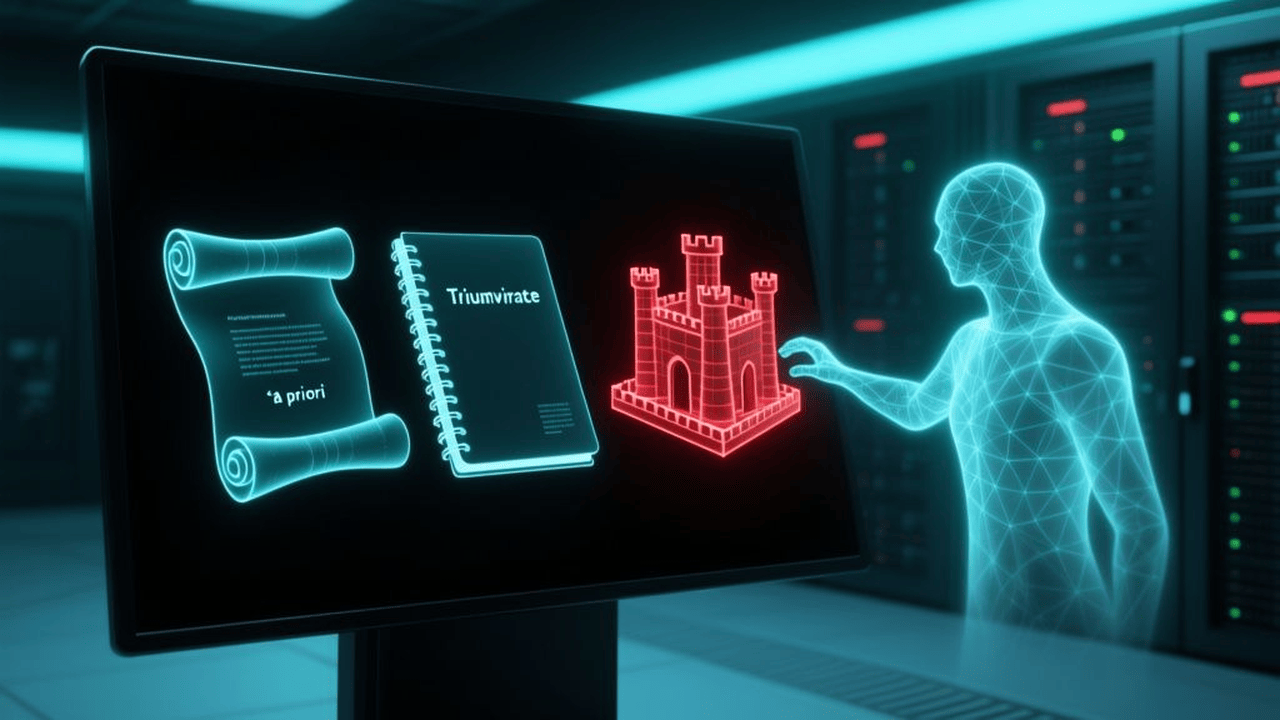
The Triumvirate is the tripartisan structural core of Contract-Style Comments (CSC), designed to eliminate the "collapsed scope boundary" problem inherent in standard documentation.
CSC in 3 Functional Layers:
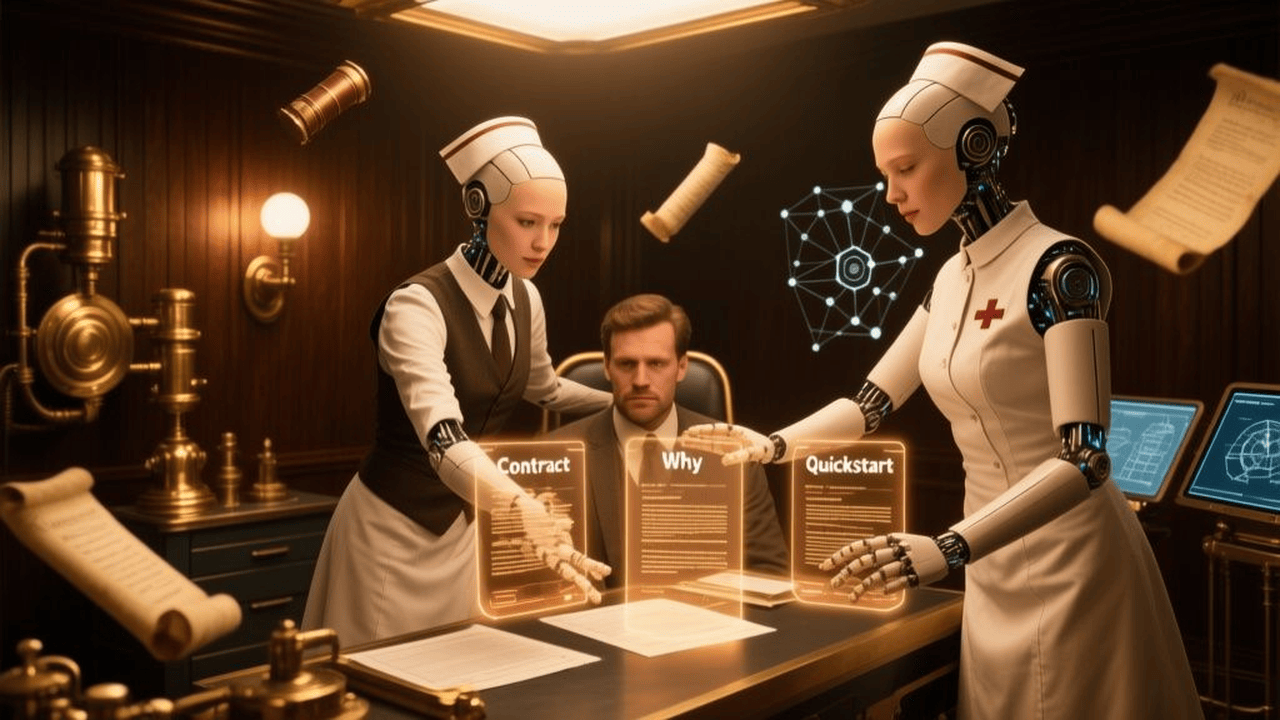
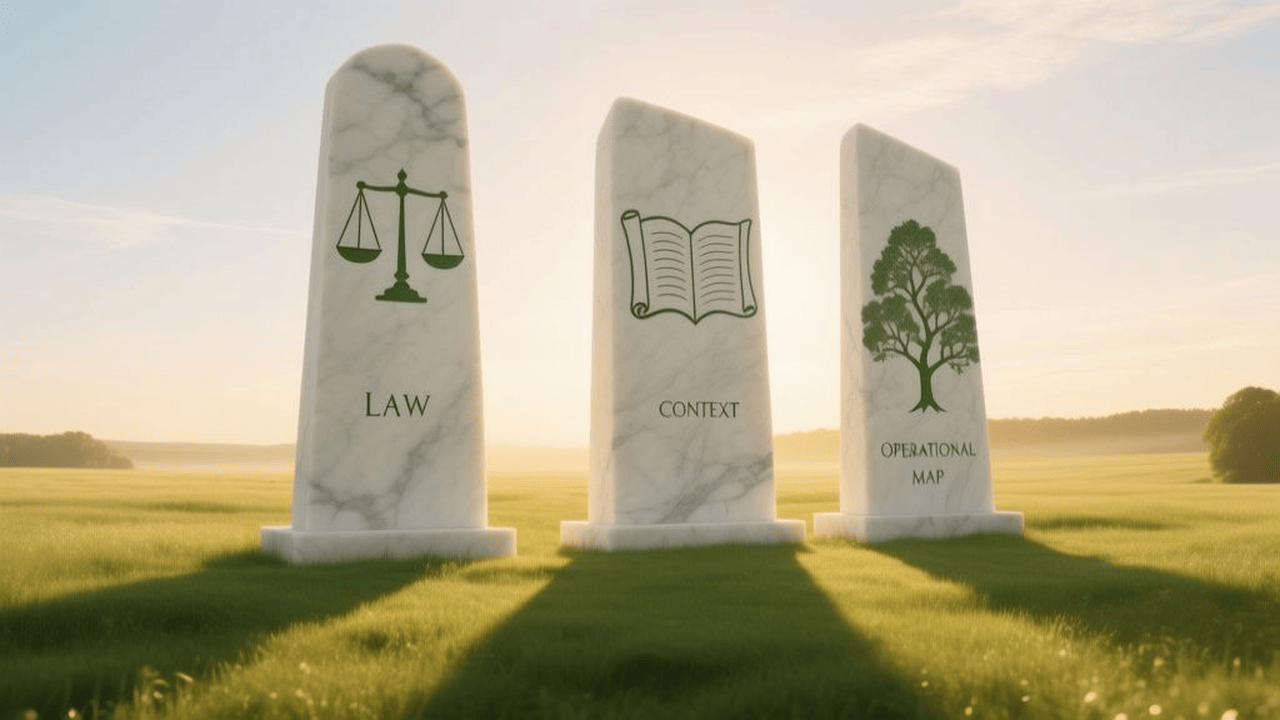
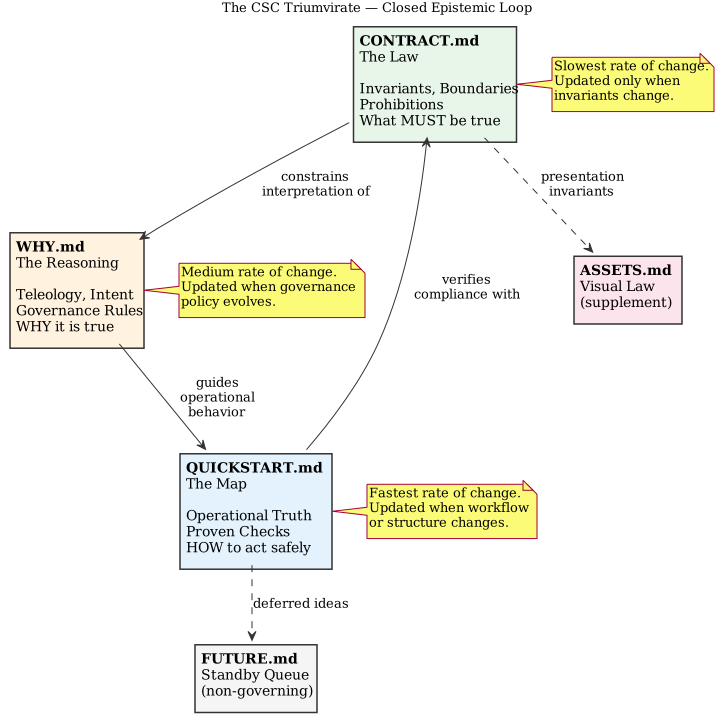
Because the filenames are referenced so often in this book, I'm going to spare your eyes the extra work of reading ".md" with every instance of discussion about the Triumvirate files, and the satellite files (Assets, Future, Delegation, and the Delta log). By now, when you read "Quickstart", you know we're referring to the markdown file named Quickstart from the CSC git repo you cloned into your project root at the start of the book. The Triumvirate divides the identity of a system into three distinct, non-overlapping layers of concern.
1st: Contract (The Constraint Layer) The Law. The Project Law defines the Elements of operational truth, as follows: Invariants: Truths that must never change.
Prohibitions: Actions that are strictly forbidden.
Boundaries: The edges of the system's authority.
Falsifiability: Every claim in the contract must be testable or disprovable.
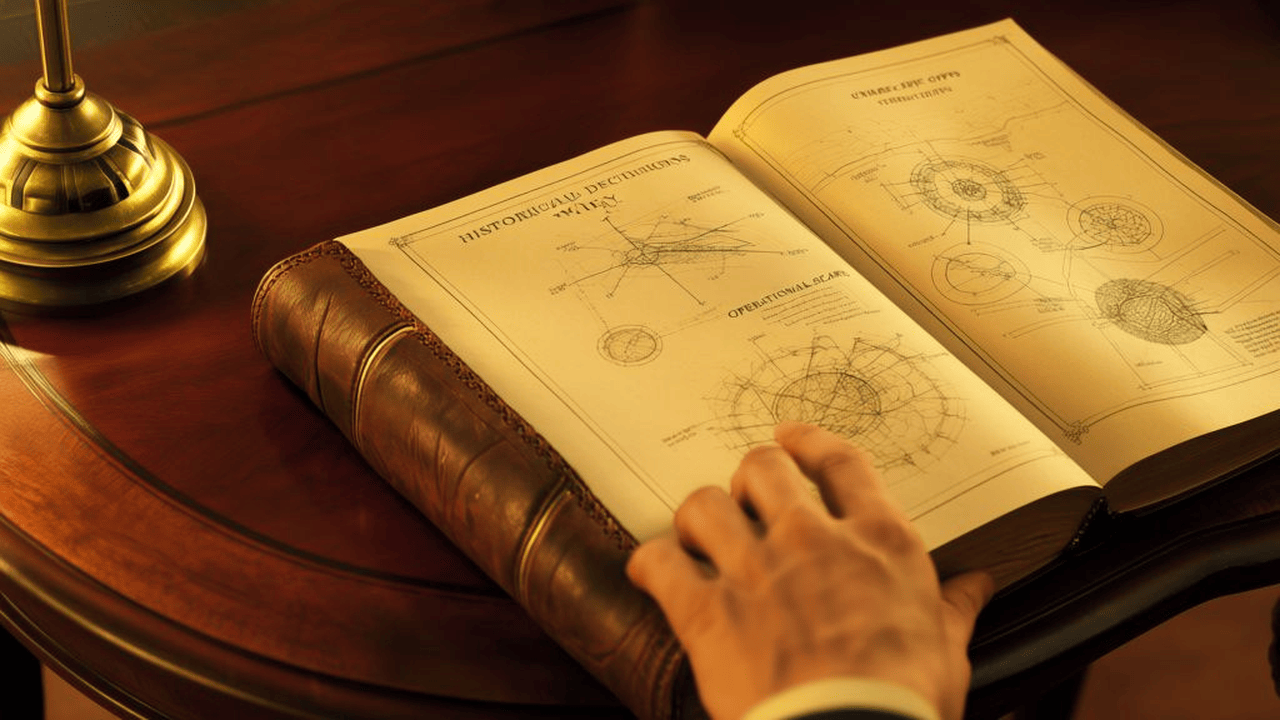
2nd: Why (The Context Layer) The Teleology. This layer records the following reasoning. Historical Decisions: Why the system is structured this way. Trade-offs: What was sacrificed to achieve a specific result. Operational Scars: The record of previous failures and the patches that resolved them. Epistemic Grounding: The theoretical basis for the constraints in the contract.
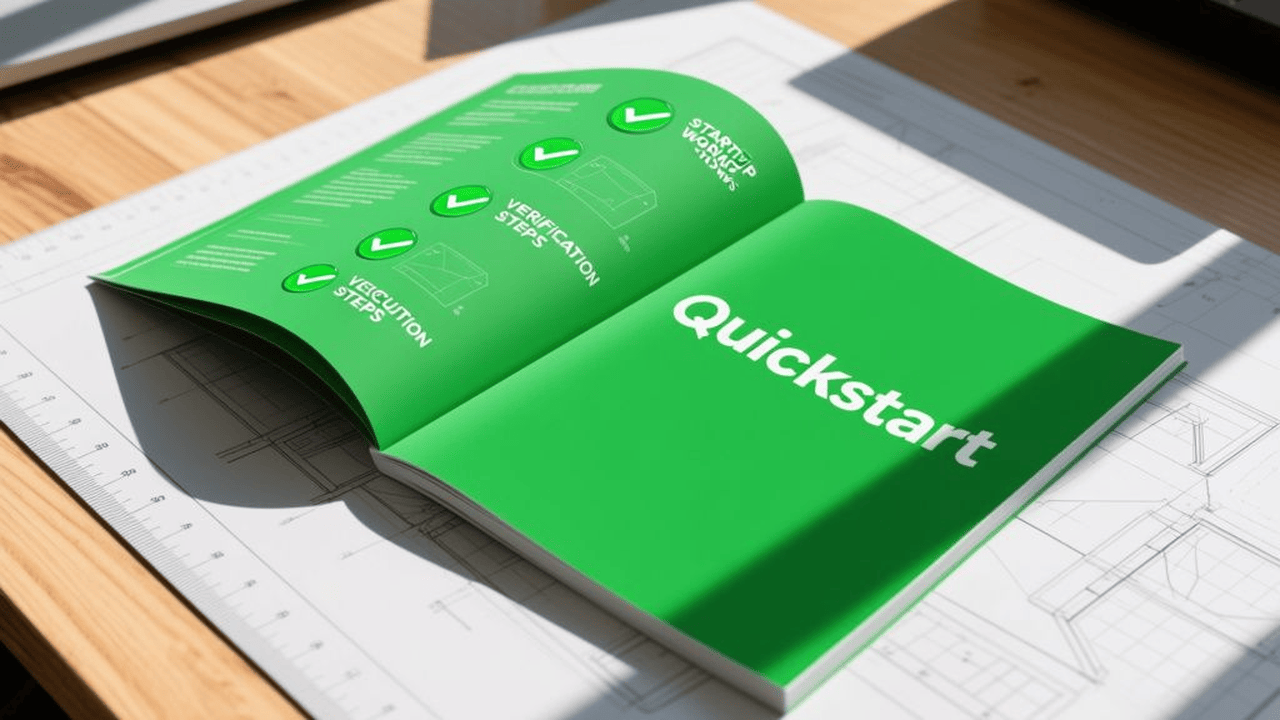
3rd: Quickstart (The Operational Layer) The Map. This layer defines execution of the following: Startup Workflows: The precise sequence to initialize the environment. Verification Steps: The proven checks used to confirm a known-good state. Execution Procedures: The minimal loop required to modify and verify. Danger Signals: The indicators that an operation has failed and must stop immediately.
The Mechanics of Separation:
A single documentation file is a liability. When constraints, rationale, workflows, and historical commentary occupy the same space, the result is collapsed scope. In a collapsed-scope environment-- especially when an LLM is working on the code-- the codebase is subject to the following: Signal density drops. Authority boundaries vanish. Contradictory information accumulates. Stateless agents begin inferring intent inconsistently. CSC separates these concerns to create triangulation. Constraints define the boundaries; rationale explains the decisions; operational procedures define the execution. Each layer reinforces the others without replacing them. Each layer has an audience and an editor. The triumvirate consists of the contract, why, and quickstart. The Steward has exclusive read write permissions over the Triumvirate files.
Sub-agents may read the contract files, but they are forbidden from applying edits. Sub-agents participation in CSC is their role in writing deltas to the Delta Log, for the Steward to later review.
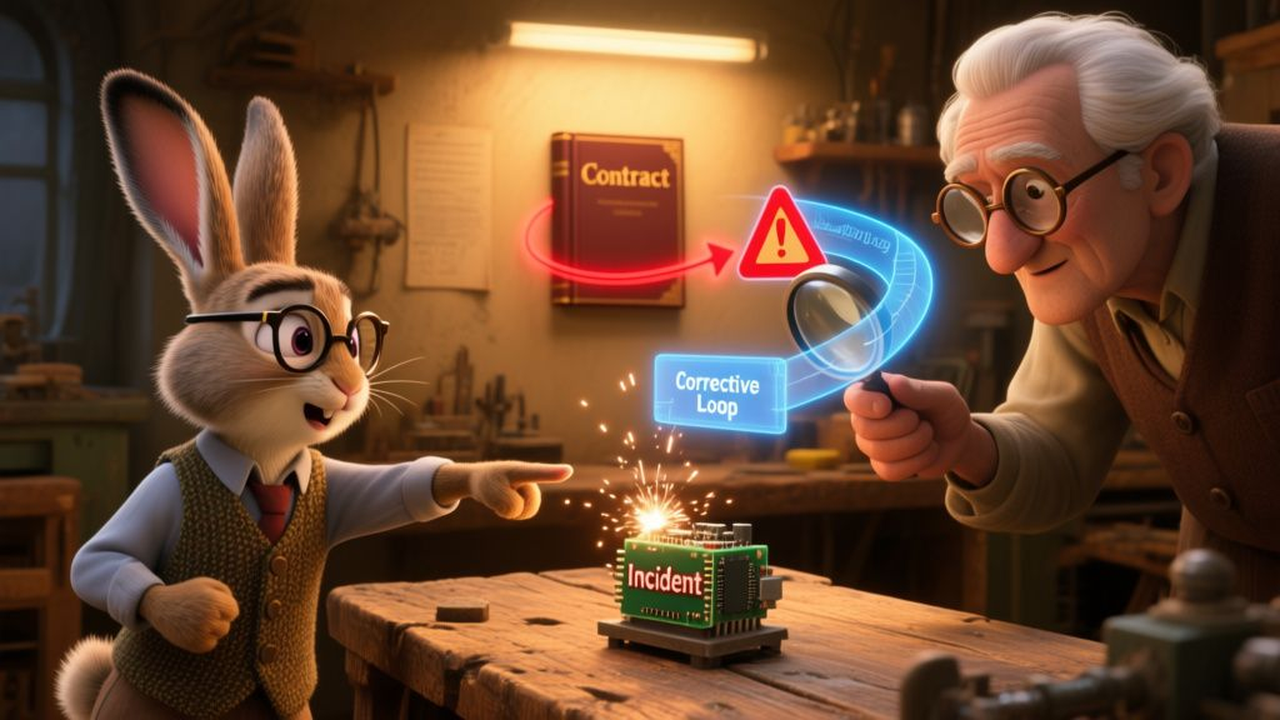
Fractal Governance: Local vs. Root CSC operates at multiple levels of granularity. Inline Contracts protect the atomic units: functions and modules. They preserve assumptions at the point of implementation. Root-Level Artifacts (The Triumvirate) protect the system-wide identity: architectural boundaries, operational workflows, and the governance structure itself. Maintain consistency across both layers to ensure global alignment. Drift can occur locally (at the function level) or systemically (at the repository level); both are mitigated by the same principle of explicit, externalized memory. The Self-Correcting Loop The Triumvirate is a dynamic system. It becomes self-correcting because operational failures are treated as governance data. The Failure-to-Governance Pipeline:
1. Incident: A failure occurs in production.
2. Exposure: The failure exposes an undocumented assumption or a missing constraint.
3. Externalization: The assumption is made explicit.
4. Integration: The rule is encoded into the Triumvirate (typically Contract for the rule, Why for the history of scars, and Quickstart for the new verification check).
Over time, the repository ceases to be a collection of files and becomes a high-density substrate of operational memory. Incidents are no longer "mistakes"; they are the raw material for governance.
Repositories as Externalized Memory
Human teams rely on tribal knowledge, social continuity, and the memory of senior engineers. Stateless agents have no such luxury.
For an agent, the repository must perform the function of a hippocampus. It must hold the total sum of the system's identity: its constraints, its rationale, its operational procedures, and its known failure modes.
CSC externalizes this memory directly into the repository structure, ensuring that any agent, regardless of its session history, can reconstruct a coherent identity before touching the disk.
Generalization Beyond Code
While CSC emerged from software governance, the pattern applies to any system where autonomous actors operate within evolving constraints. In fact, I've started using it as a System Maintenance framework, by creating a contract folder in my System User directory, whereby the LLM performs system diagnostics, advises of stale or broken packages, recoverable disk space, etc. CSC can help you manage probably anything, but some examples include:
Research Workflows: Distinguishing between a protocol (Contract), the reasoning for a methodology (Why), and the step-by-step lab process (Quickstart).
AI Pipelines: Separating the prompt constraints from the historical iterations and the execution scripts.
Infrastructure Operations: Mapping the desired state, the reason for specific configurations, and the fail-over procedures.
Any system that requires temporal integrity (time on the clock) and explicit provenance (a verifiable history of who changed what and why) needs the Triumvirate.
We have established the three layers of the Triumvirate and why their separation is critical for alignment.
CSC Spec: Placing Law in the Contract without its entry in Why creates a mystery; an invitation for the agent to optimize it... out of existence. The Triumvirate is three files. This chapter is about what goes inside them. Contract defines the rules. Why explains the reasoning. Quickstart maps the execution. Each file has a specific anatomy, a specific failure mode, and a specific discipline. Knowing that they exist is not enough.
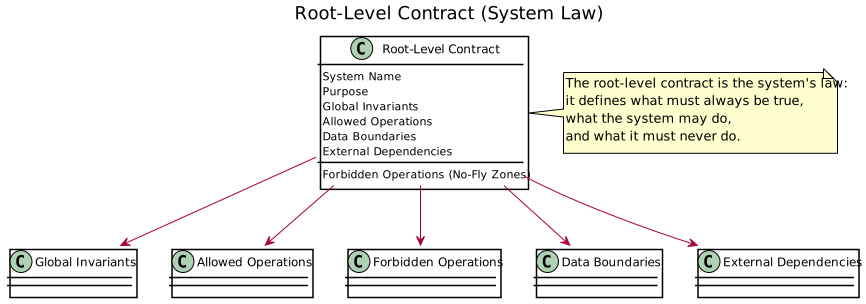
Teaching the LLM what belongs in each one is the difference between freedom to invent, and absolute chaos. Contract is the repository’s root governance layer. It declares Law; the statement of rules the system depends on to survive. The Three Contract Categories: The root contract is that contract set according to the CSC Template from the Github repository.
Clone CSC directly into your project root. Under your document root, you will have a subfolder named contract holding the CSC template, ready for customization. The document in that folder named Contract is the root contract. A root contract is composed of three primary categories. Mixing them leads to collapsed scope. Invariants.
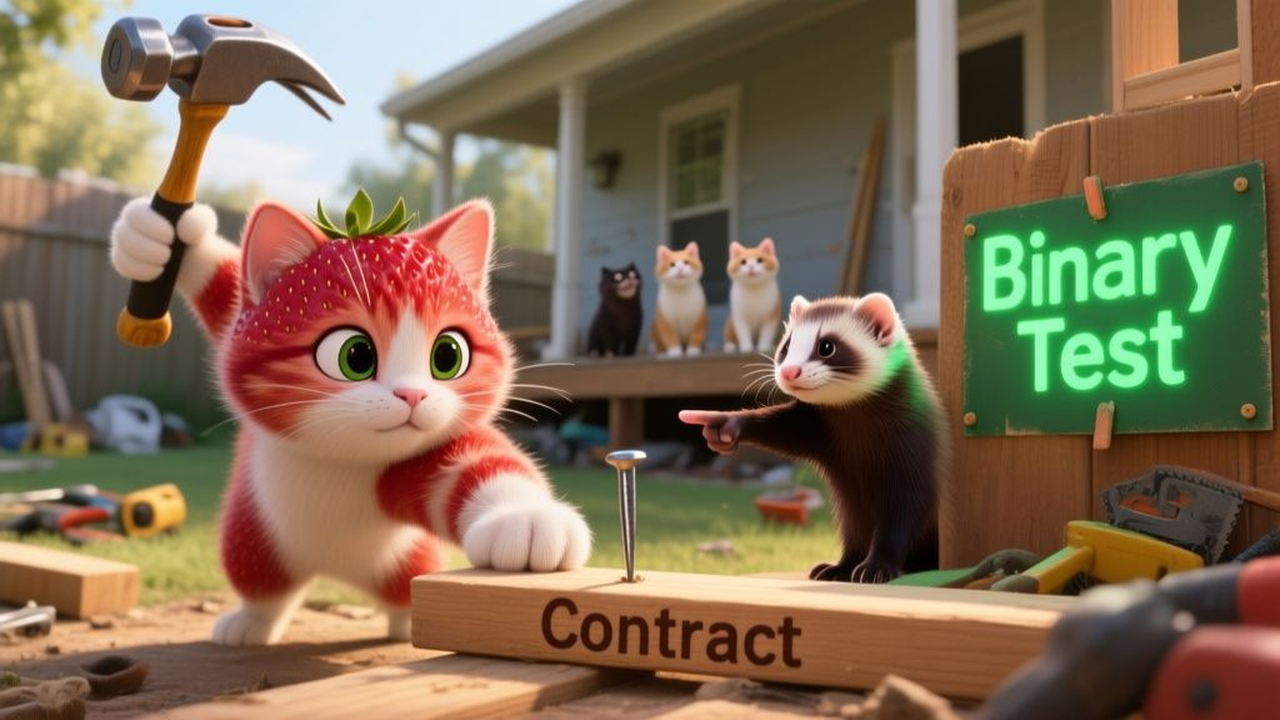
Architectural commitments that must remain stable. Example: “All transaction amounts must be stored as integers in cents.” Goal: Prevent the agent from “optimizing” a data type into a floating-point error. Prohibitions. Explicit “No-Fly Zones.” Operations the agent is forbidden from performing, regardless of perceived benefit. Example: “Never delete user-uploaded assets automatically.” Allowed Operations. The safe operational space. Example: “Refactoring inside /src is permitted provided external behavior remains unchanged.” The Binary Test If a statement cannot be verified as a binary true/false state, it does not belong in Contract .
Rationale, historical commentary, and brainstorming belong in Why . The contract layer must contain only active operational truth. When rationale leaks into the law: temporary decisions start looking permanent; historical context starts looking authoritative; commentary starts looking enforceable. Maintenance and the Review Trigger: A contract that drifts from the code is more dangerous than no contract at all. To prevent silent decay, the contract includes a Review Trigger — a functional alarm that signals when a specific event must trigger a re-evaluation.
Quickstart provides the shortest reliable path from opening a repository to performing safe operational work. Initialization Ambiguity: In general, ambiguity is the very opposite of what the LLM needs. For a stateless agent, the first few minutes of a session are the most dangerous; when you must be most specific. This is the window where assumptions are formed, workflows are inferred, shortcuts are invented, and destructive commands are guessed.
Start me up!
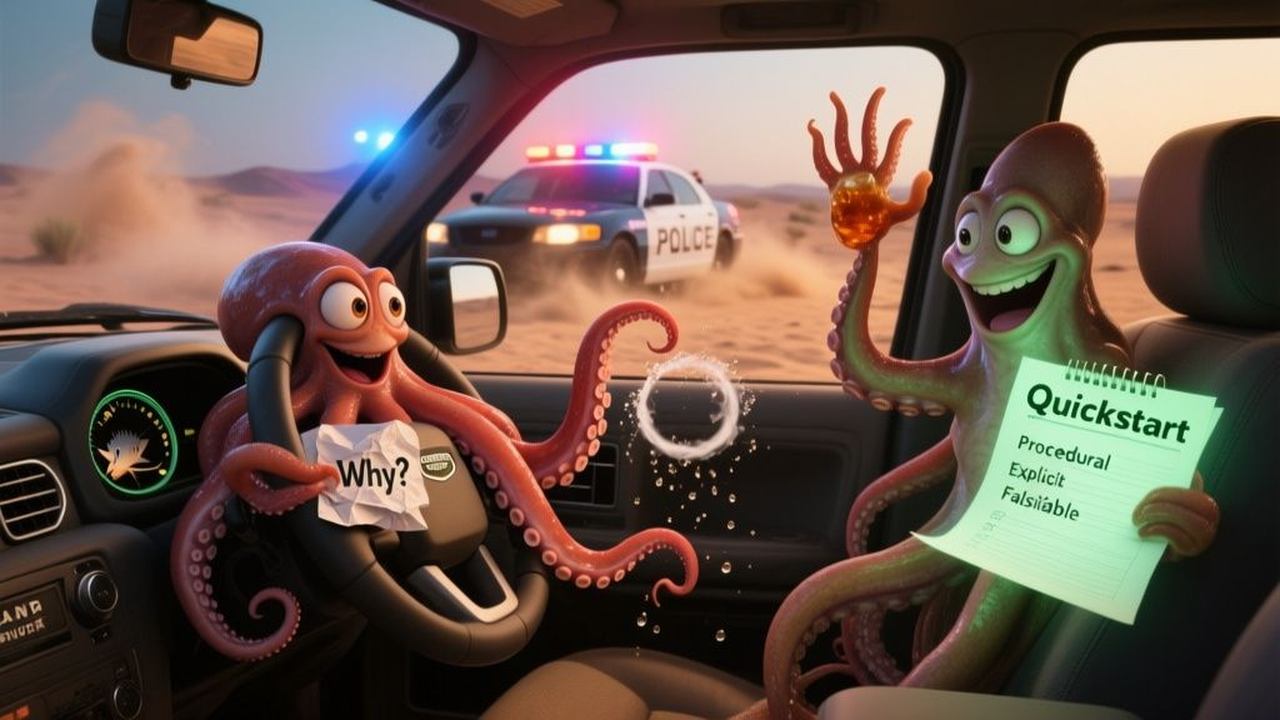
If a human or an AI opens Quickstart and can not reach a known-good state by following its map, then Quickstart drifted due to failed reconciliation. Quickstart must be: Procedural: Focused on how to execute. Explicit: No ambiguous instructions. Scan-able: Designed for rapid ingestion. Falsifiable: Every step must either work or be flagged as broken. The Four Components: The First Command (The Health Check). The safest possible command to verify the environment before any modifications begin. The Operational Workflow (The Loop). A repeatable execution sequence that minimizes risk. The Sandbox Boundaries. Explicit declarations of safe and dangerous zones. Success Criteria (The Definition of “Done”). Concrete markers that indicate a task is complete and verified. Brevity as a Safety Feature: Maintain Quickstart as a lawful boot sequence. If it requires twenty minutes of reading, it has mutated into a manual. We ignore manuals, right?
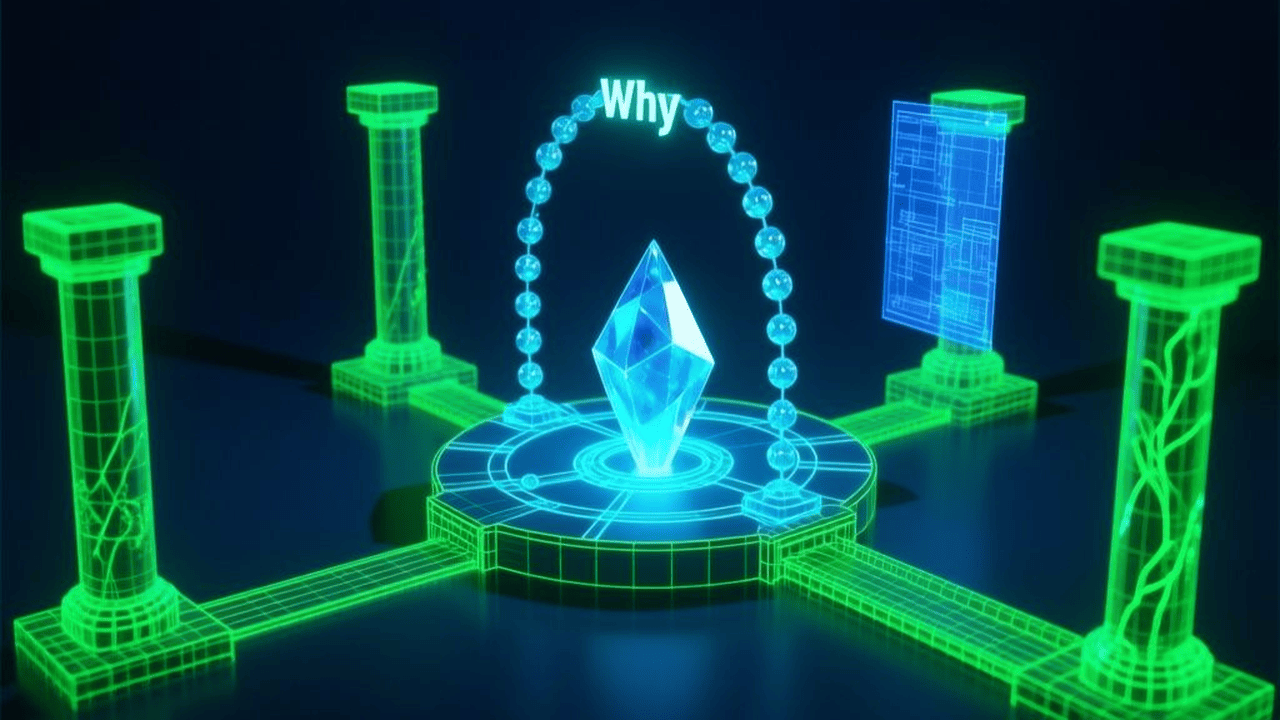
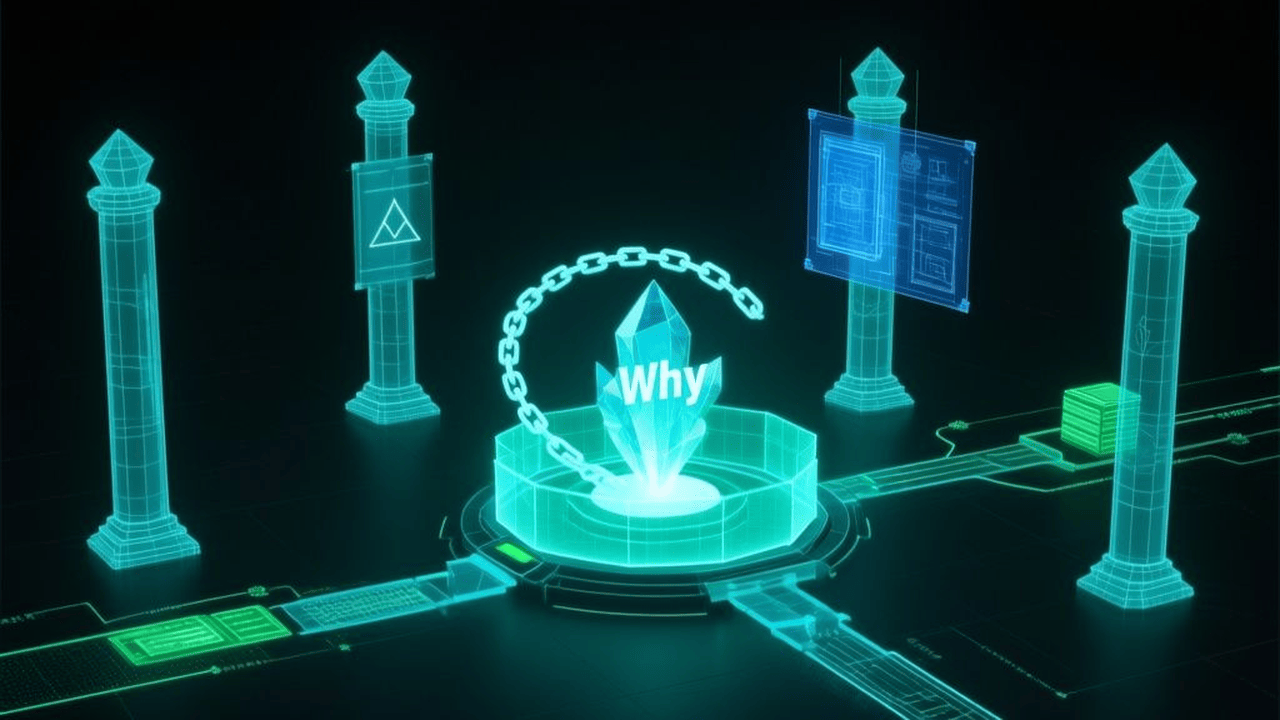
Why — The Reason behind it; the rationale. The meaning of life, and Why!
Ugh!!
Why does this rule exist?
Why did we choose this path? Why did the system break? The file is named after the most human question there is. When an agent reads Why , it is reading the answers to questions it would never think to ask. To a stateless agent, a restrictive rule that lacks a clear justification looks like an inefficiency. Without the answer to "Why?" the agent will attempt to "improve" the system by removing the very safeguard that prevents a catastrophic failure
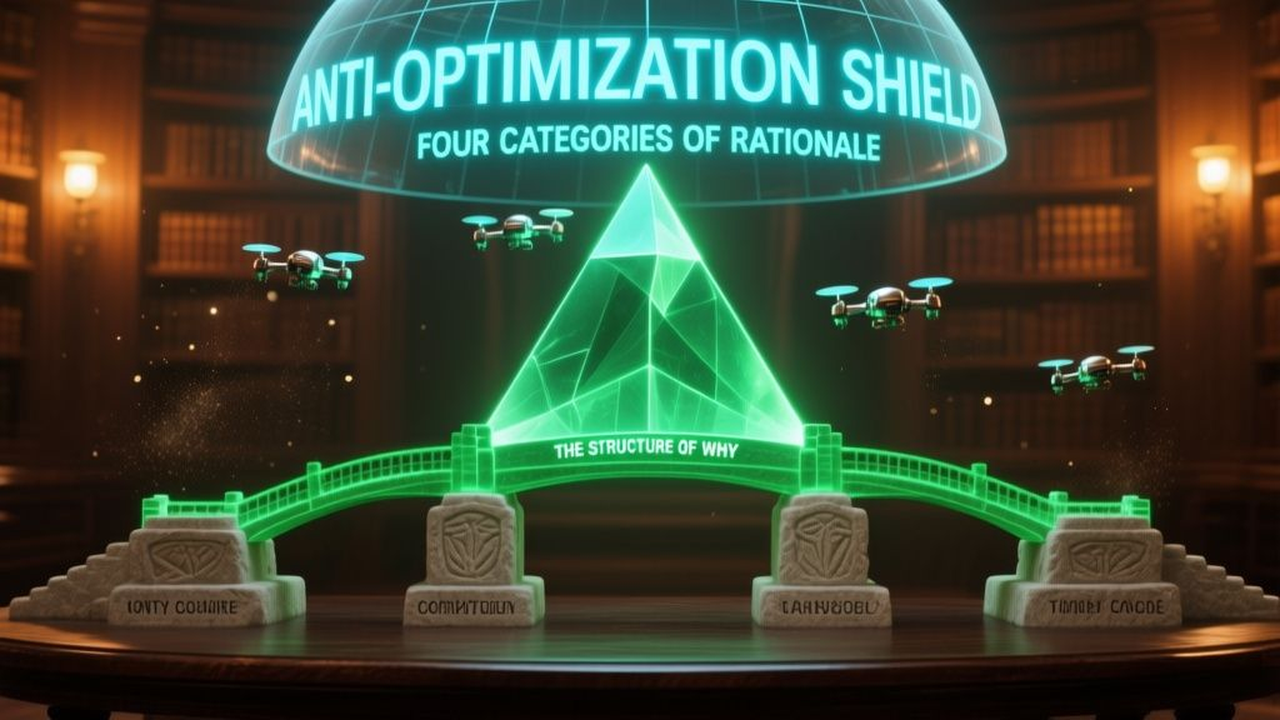
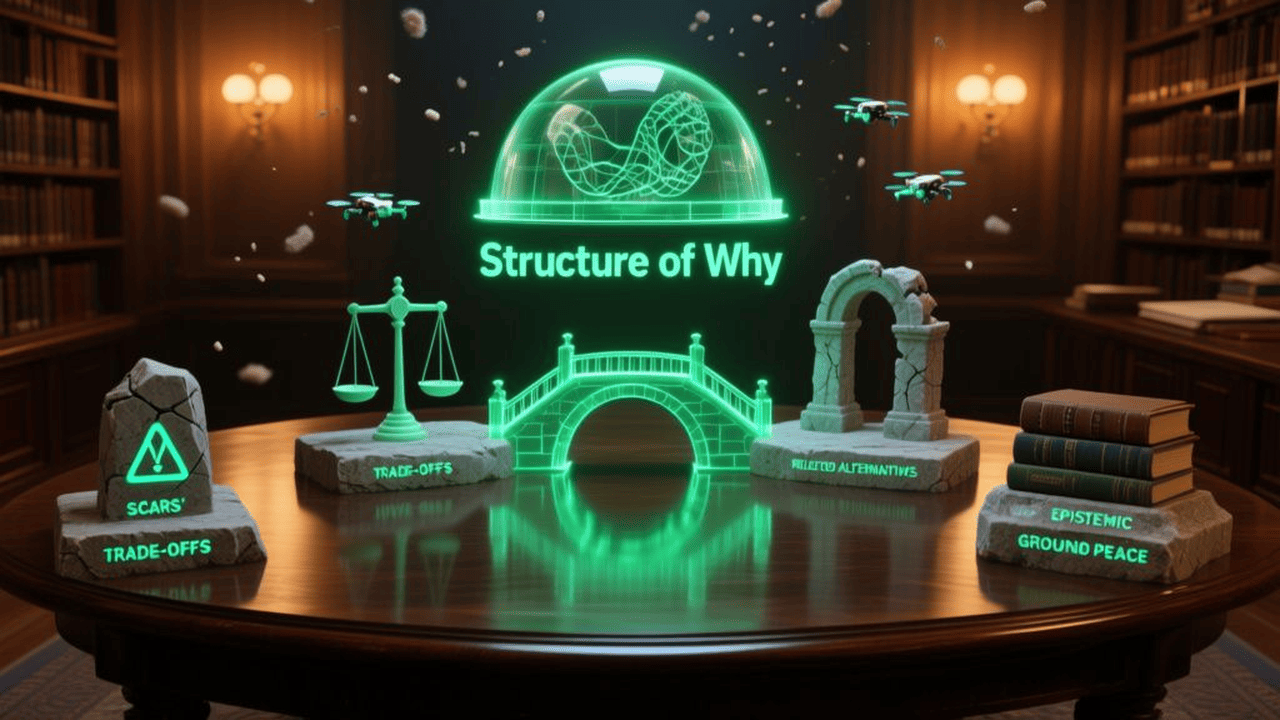
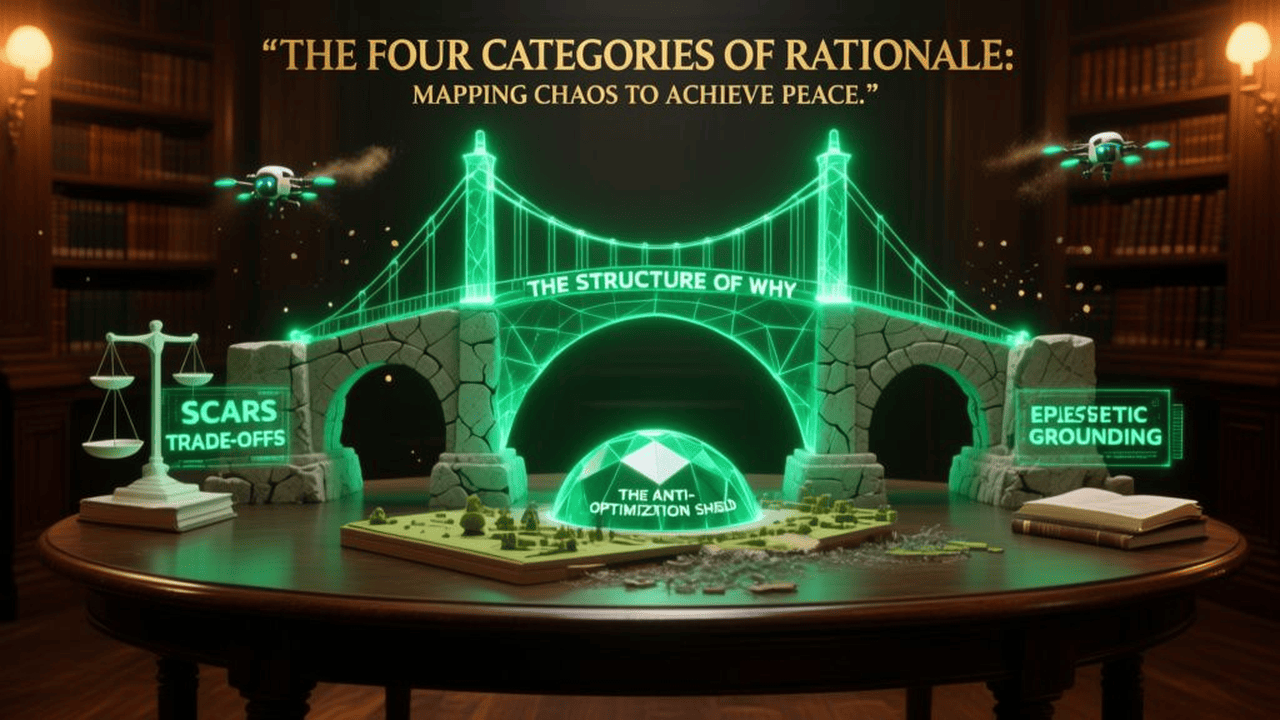
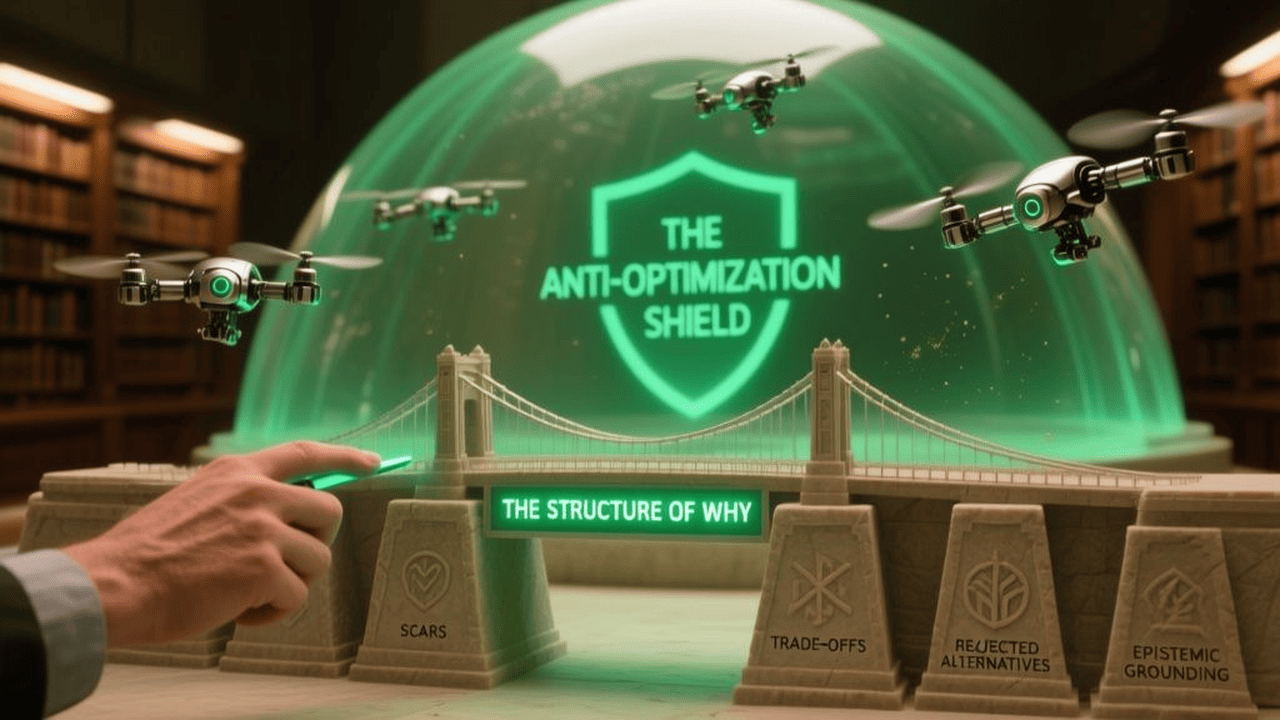
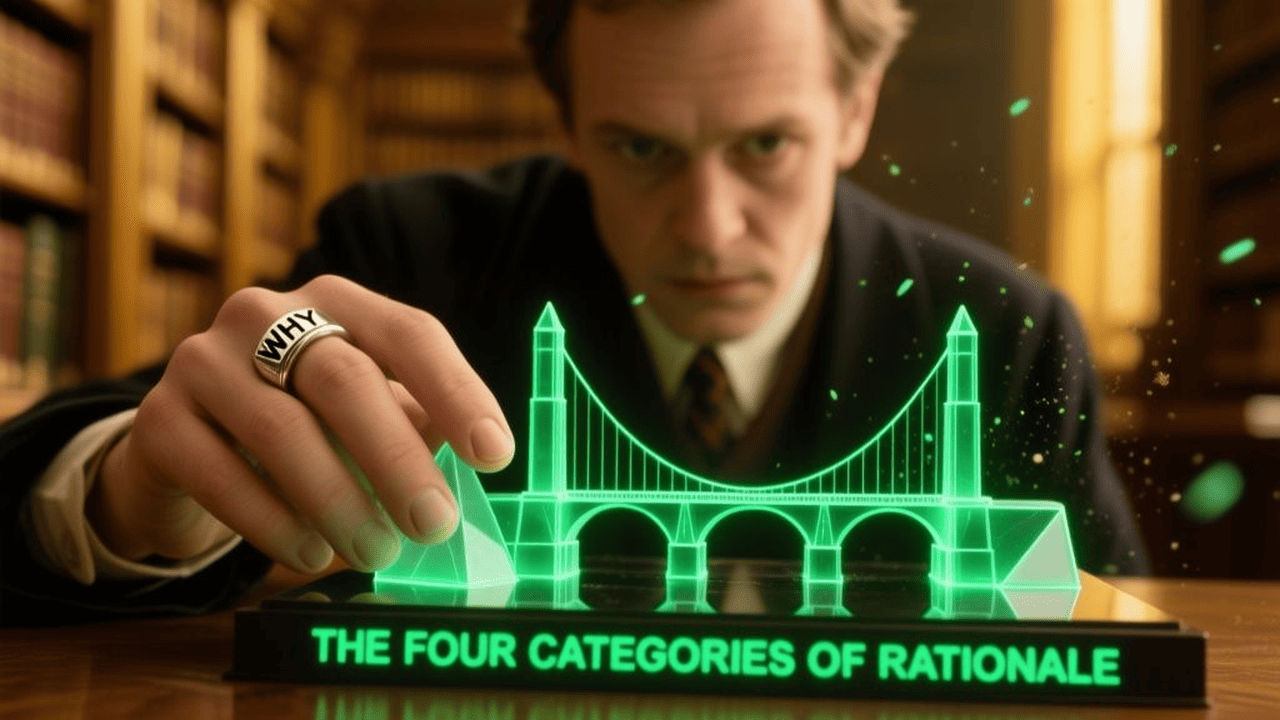
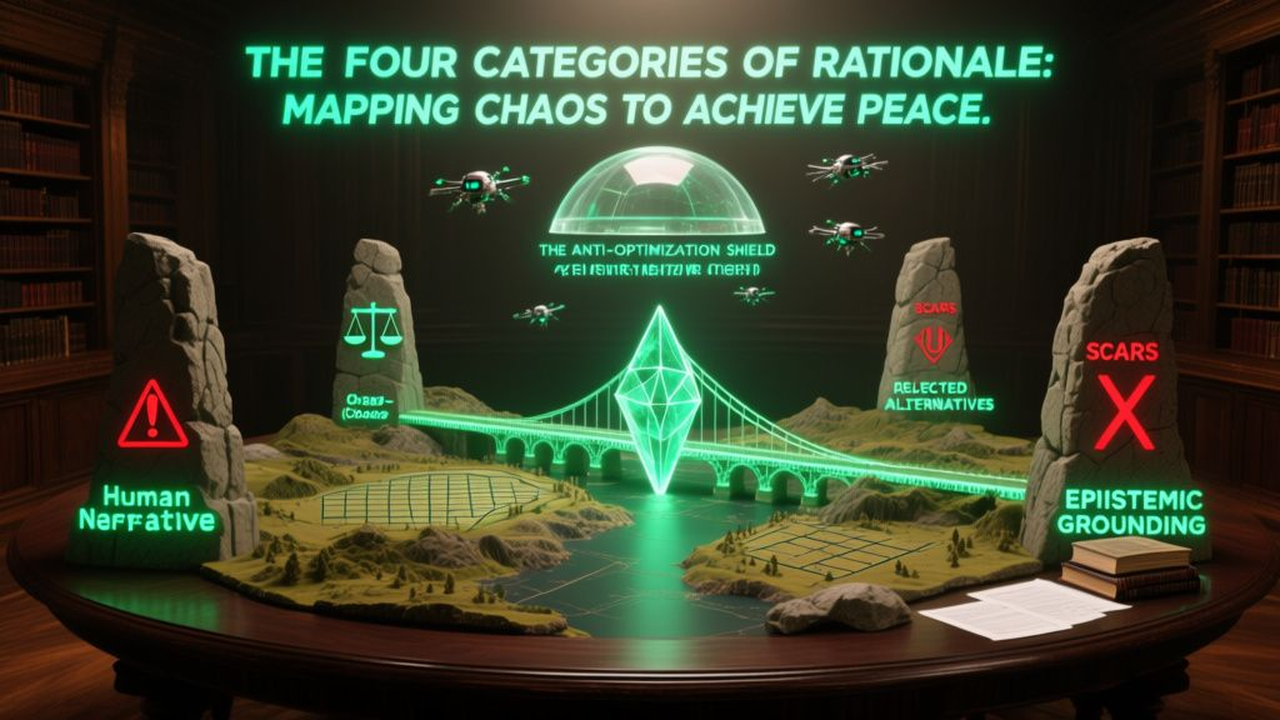
The Four Categories of Rationale
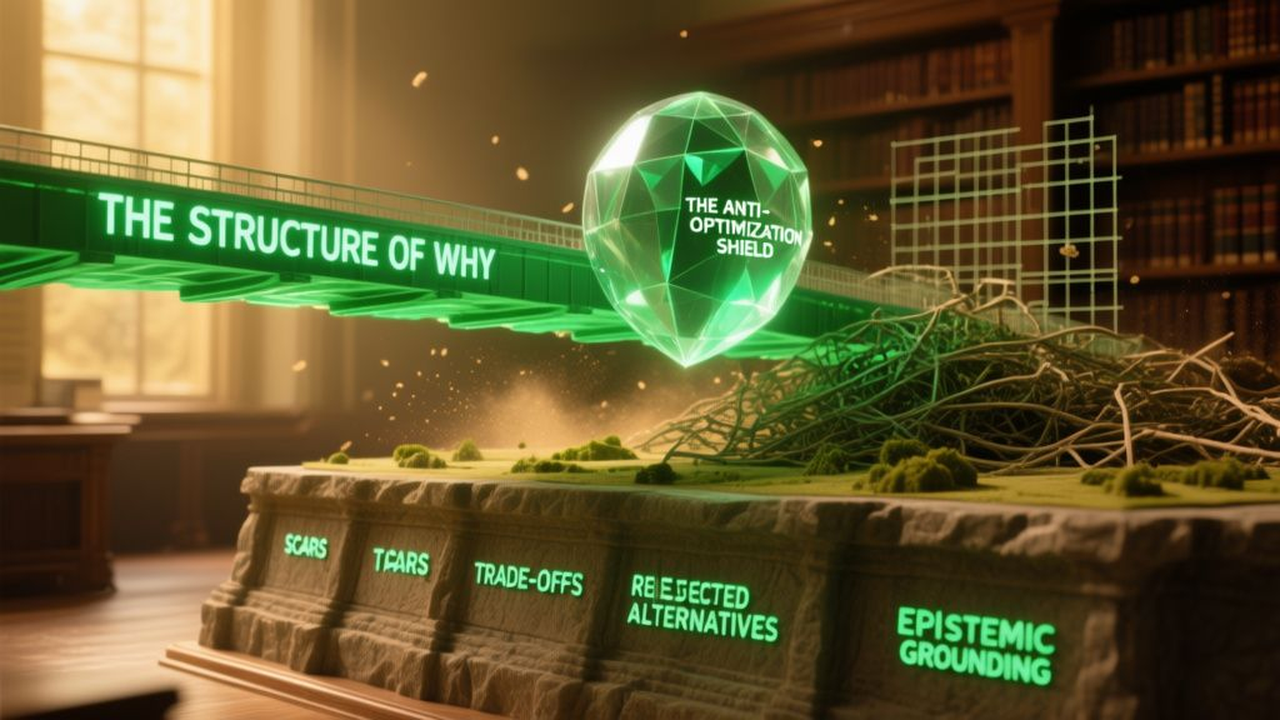
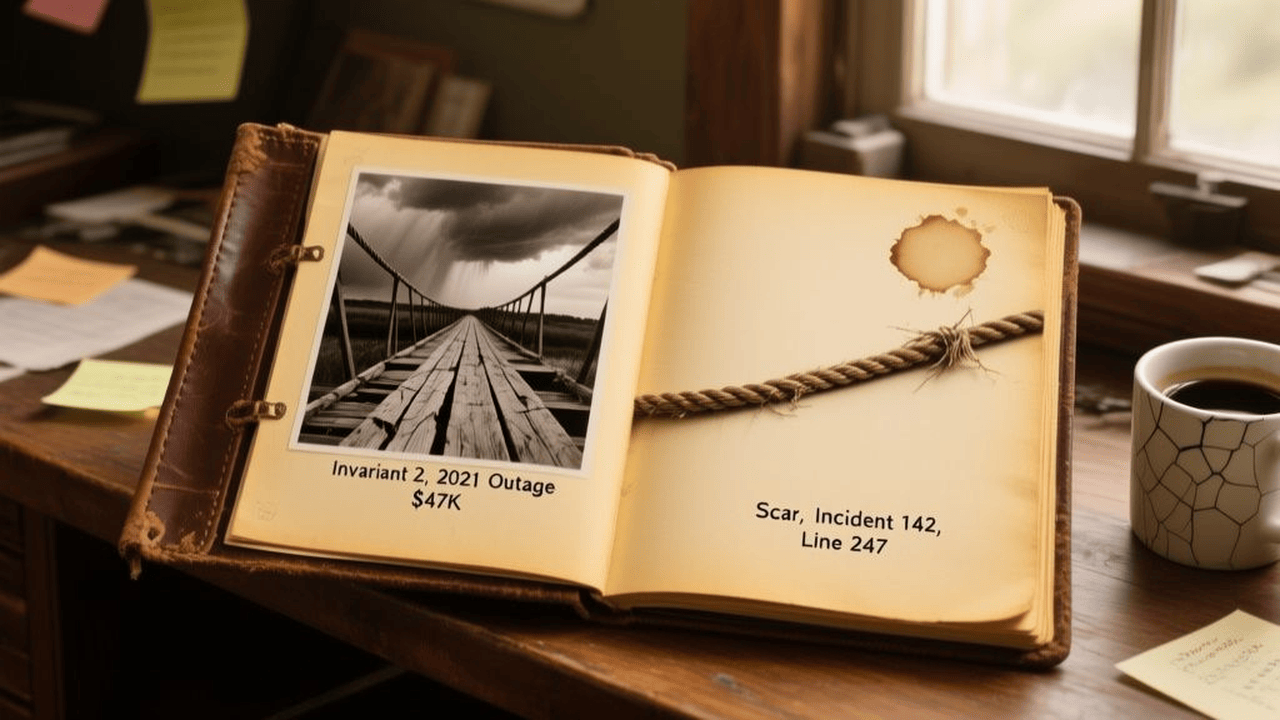
Scars. The most valuable data in a repository. A scar is a documented incident — a production outage, a corrupted database, a critical security leak — that resulted in a specific change to the system’s Law. We record our scars so we don’t repeat them.
Trade-offs. Every design choice is a compromise. Documenting why a specific approach was chosen over a seemingly better alternative prevents future maintainers from attempting to "fix" a decision made to solve a constraint the agent cannot see.
Rejected Alternatives. Documenting what didn’t work stops the cycle of rediscovery.
Epistemic Grounding. The theoretical or technical basis for a constraint. References to specifications, whitepapers, or hardware limitations.
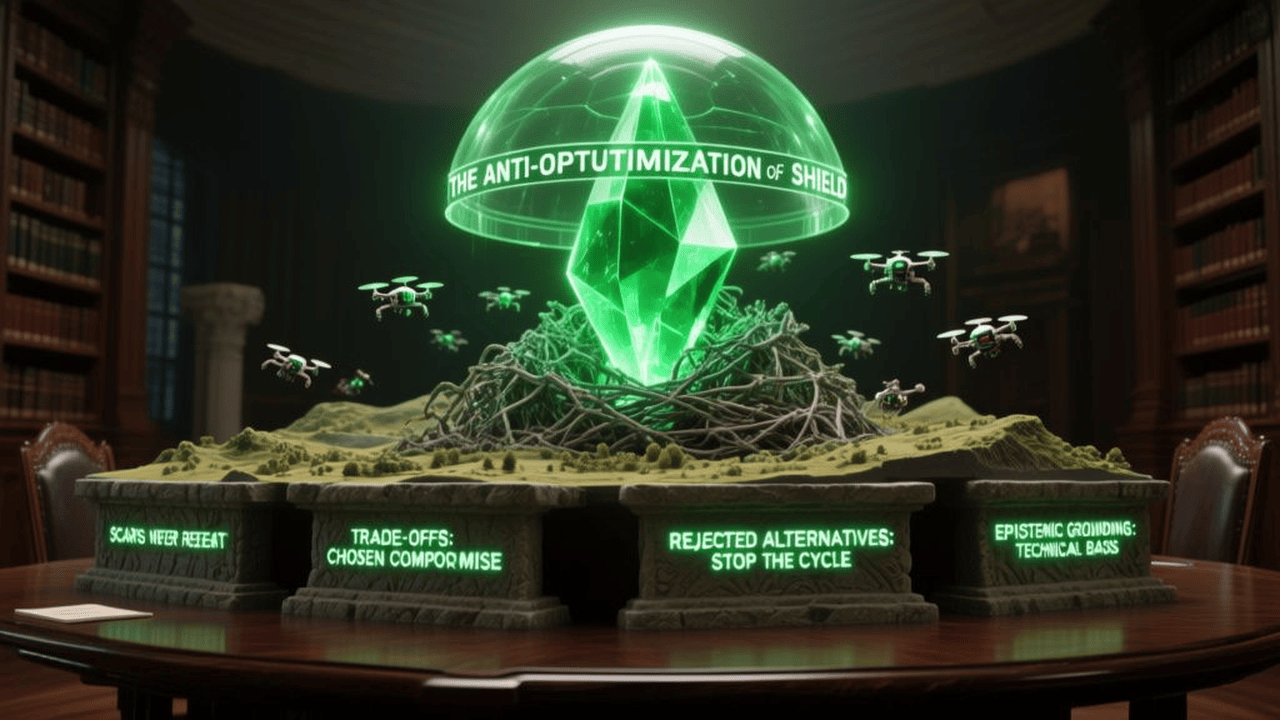
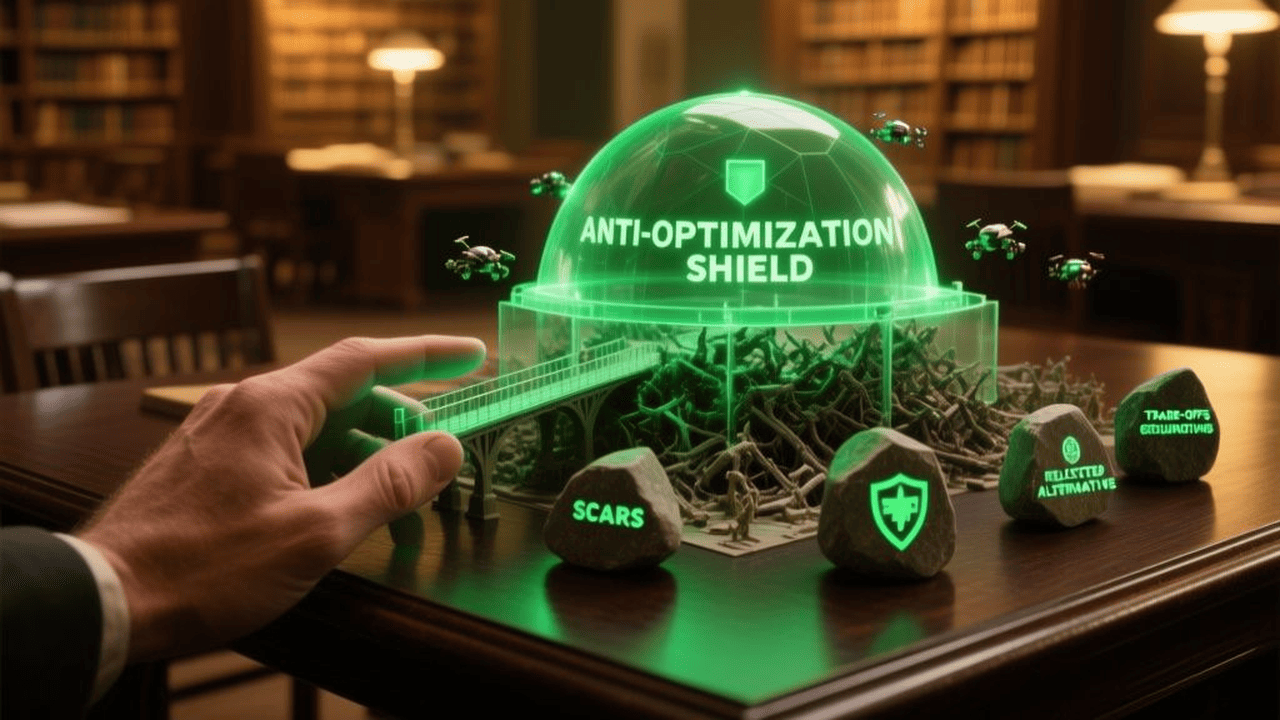
The Anti-Optimization Shield
Stateless agents are designed to optimize. When they encounter code that looks redundant or "ugly," their native drive is to refactor it.
In a legacy system, "ugly" code is often the only thing preventing a race condition or a memory leak. To the agent, this code looks like a mistake. To the human, it is a load-bearing wall.
Why acts as a shield. When the agent reads the scar, it realizes that the "ugly" code is actually a proven safeguard. The agent’s objective shifts from "optimizing the code" to "preserving the invariant."
Bridging Narrative and Constraint
Humans understand systems through narrative: "We did X because Y happened, and we learned Z." Agents operate through constraints: "Do not do X." Why bridges these two models.
Maintenance
The most critical time to update the rationale is immediately following a production incident. The scar must be recorded while the context is fresh.
The goal is not an exhaustive history, but a precise recording of the reasoning behind every critical operational decision.
The Specification Files are the anatomy of governance.
Consider the philosophy of Why:
Chaos is born in "Truth as we know it.": Contract defines what is true; the Law of the Project.
Peace is born in "The Structure of Why": Why teaches us the reason we speak our truths.
Quickstart maps how to operate within "truth as we know it."
Together, by mapping the chaos to achieve peace is to turn a repository from a collection of files into a system an agent, moreover the Human can trust.
Beyond the Triumvirate:
"A system that governs only its source code is governing half its house."
The Triumvirate governs the code and the reasoning behind it. Real systems have more than code. Systems have
assets,
diagrams,
datasets,
and
deferred plans.
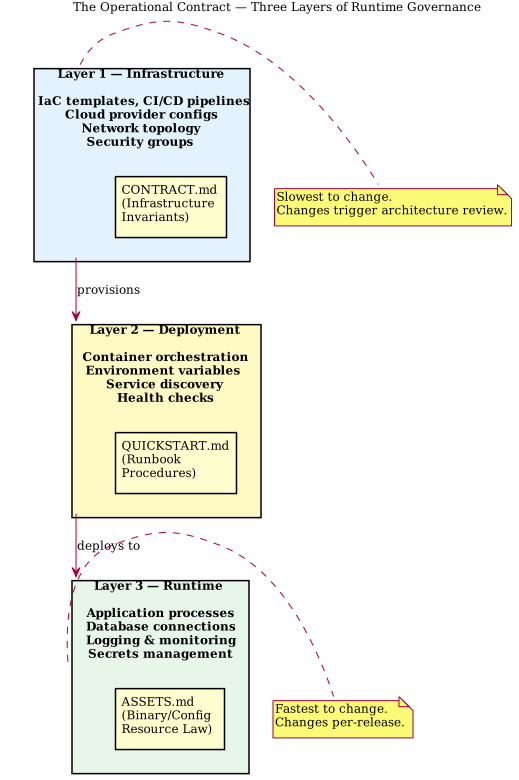
It has multiple agents who need to know who is touching what, right now. And it has a channel for changing the Law itself without chaos. Assets — The Resource Law Code is not the only thing that drifts. A renamed image or a shifted prompt template can be as destructive as a breaking API change. Assets extends governance to non-code resources: diagrams, datasets, prompts, generated media, configuration artifacts.
We have four different classes of asset
Authoritative Assets. The canonical versions. Modifying an authoritative asset is a high-risk operation.
Generated Assets. Artifacts produced automatically. Manual edits are prohibited.
Protected Assets. Resources that must not be modified casually due to external dependencies.
External Dependencies. Assets originating outside the repository.
Asset Invariants:
Assets carry invariants, just like code.
For example:
Stability: "Filenames must remain stable because embeddings reference them directly."
Immutability: "Original uploaded media must never be overwritten."
Append-Only: "Training datasets must remain append-only after the initial release."
Asset Lifecycle
Classification "Code defines the execution flow; resources define the boundary state." The Four Classes describe what an asset is.
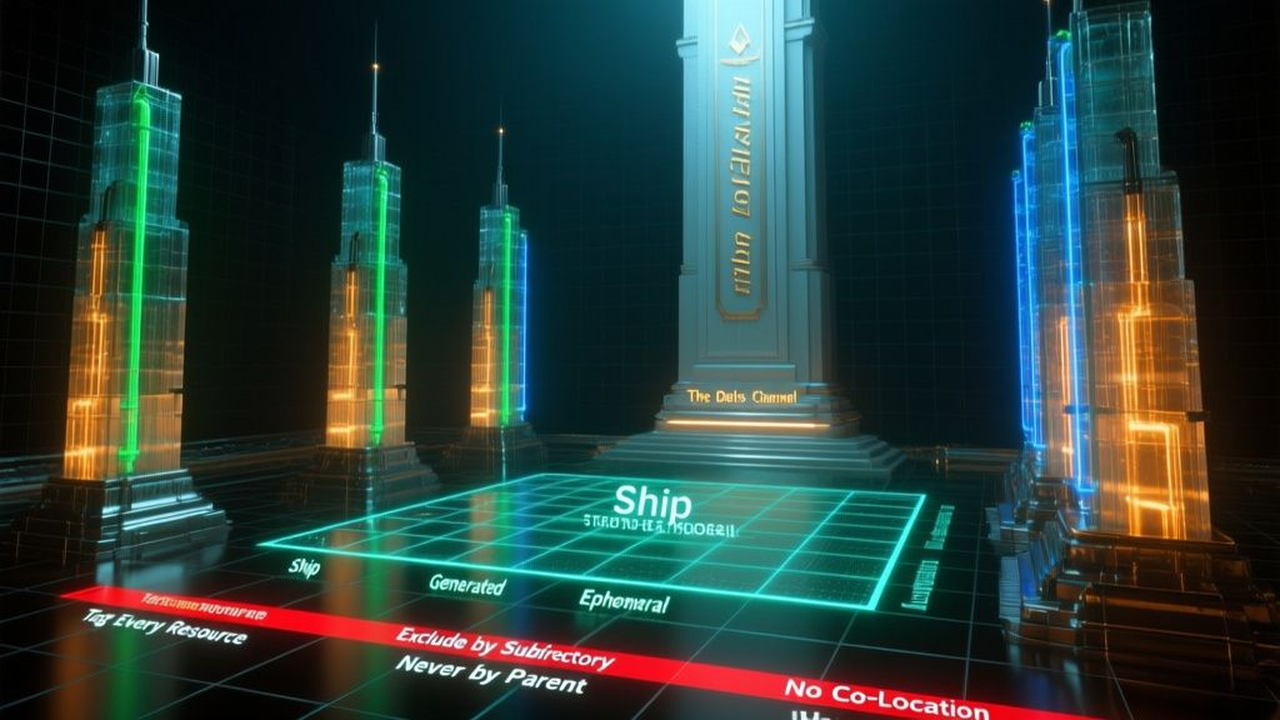
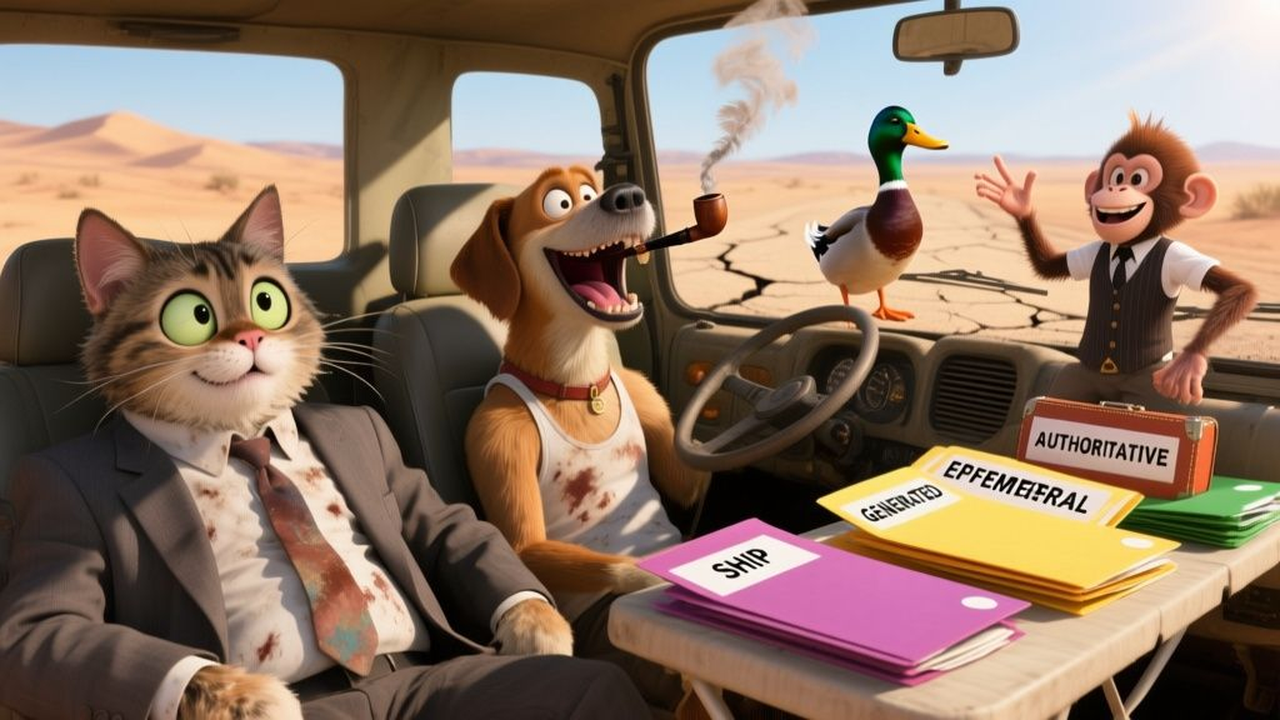
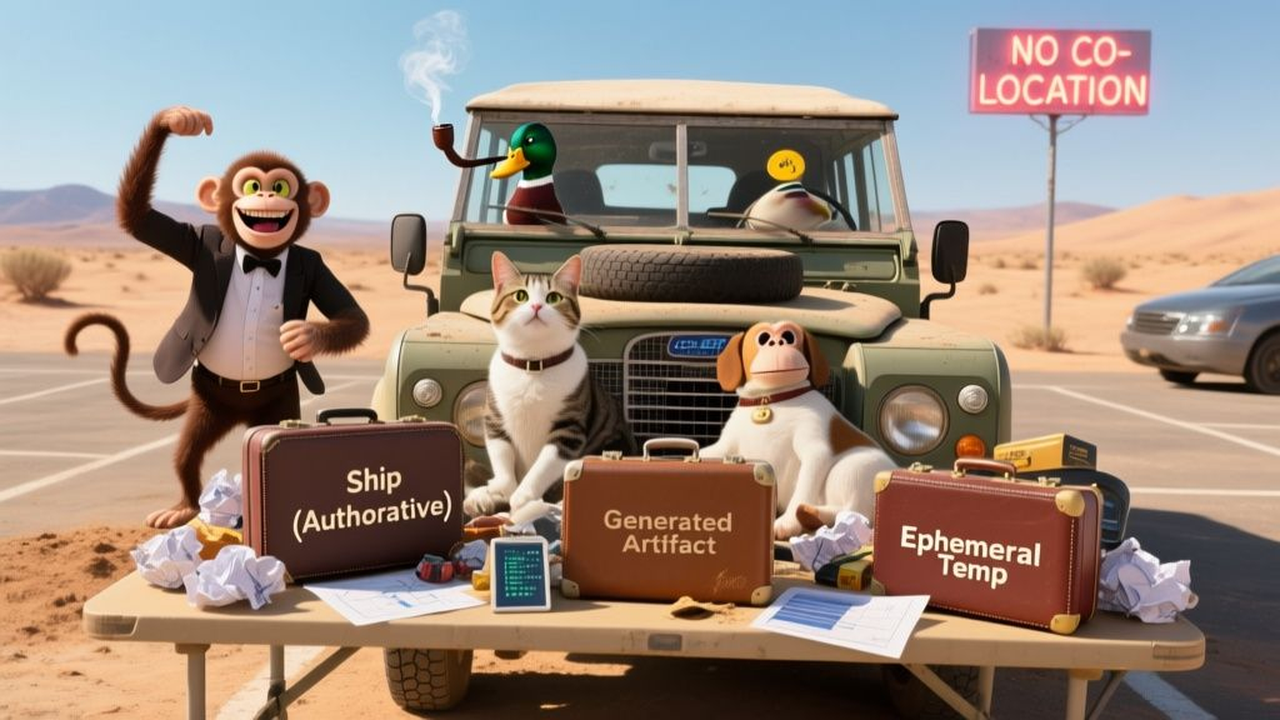
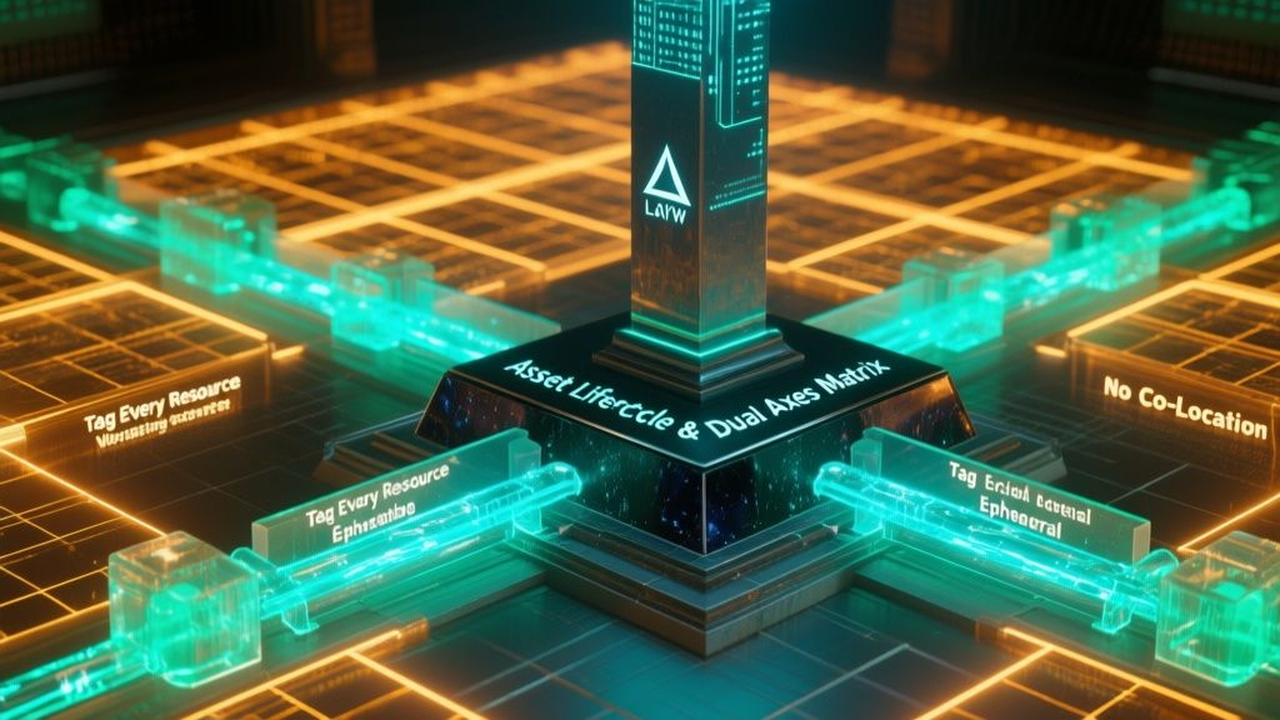
The Lifecycle Classification describes how it travels. These two axes are orthogonal — an asset can be Authoritative or Generated, Ship or Ephemeral. The questions are different. The answers are different. The Three Classes Ship. Version-controlled source asset. Travels with a code deploy. Generated. Runtime-produced artifact. Must never be deployed. Ephemeral. Cache, log, or temp file with no durable owner.
Lifecycle Invariants
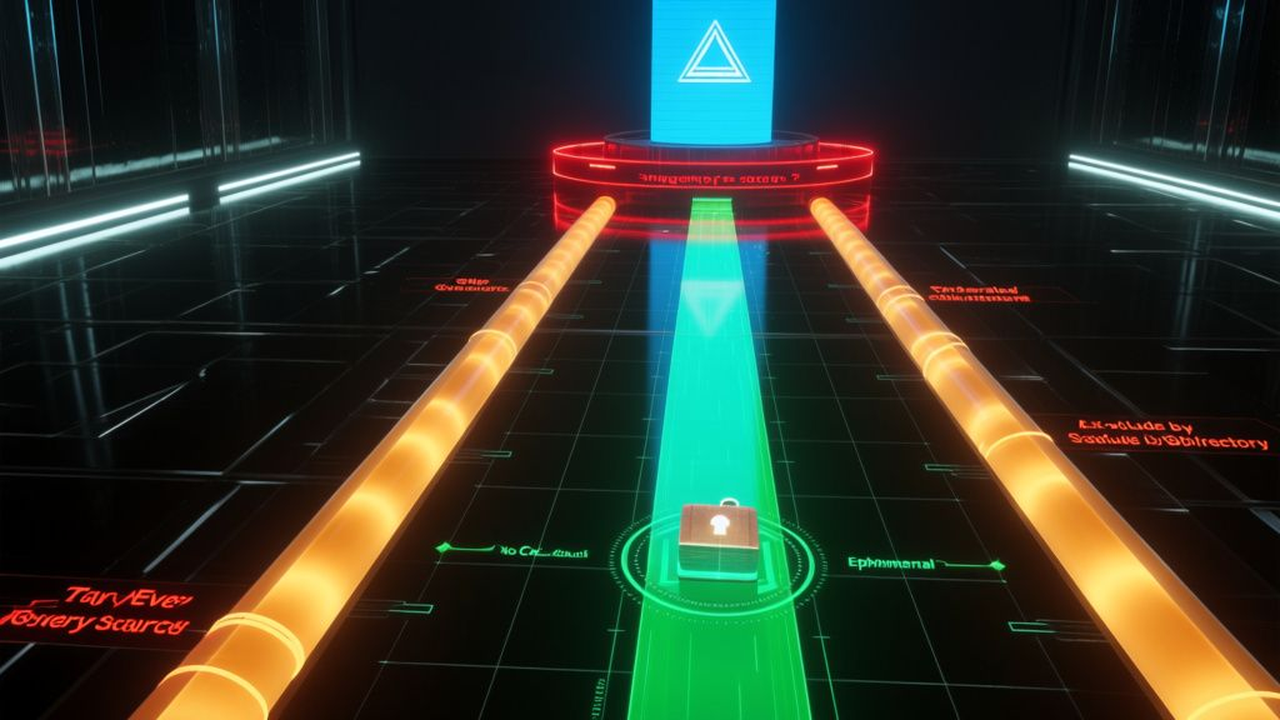
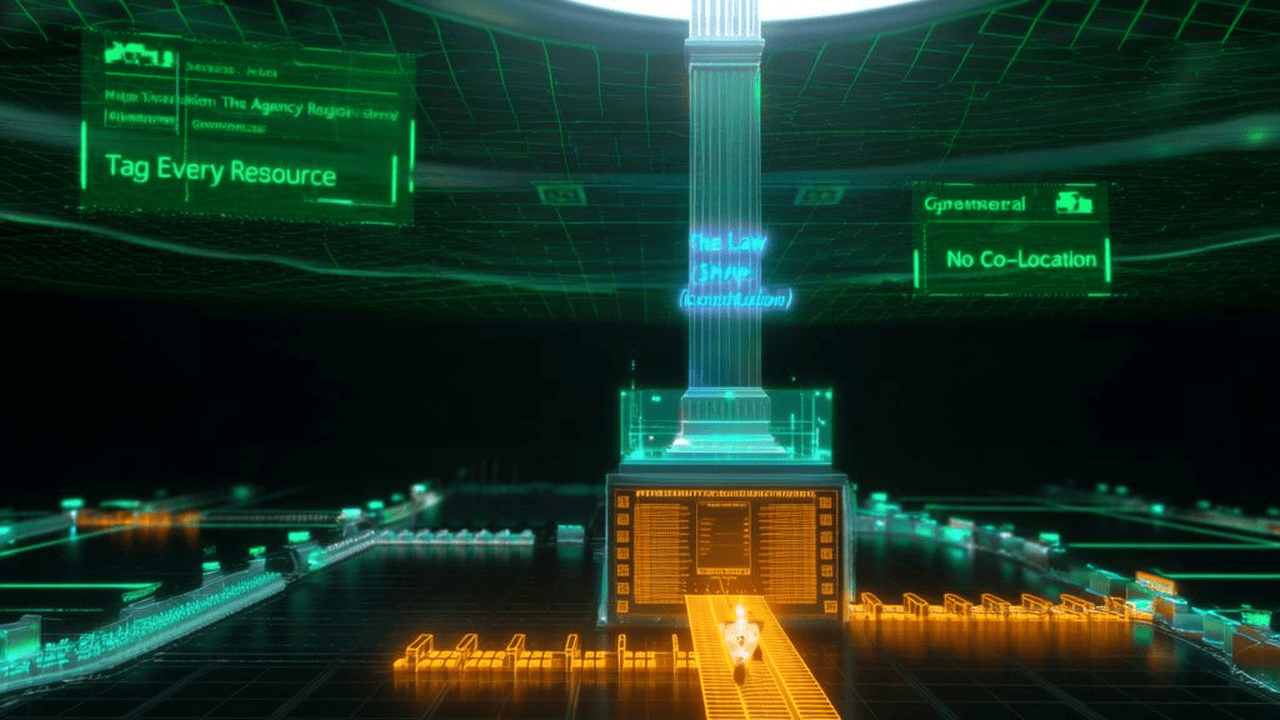
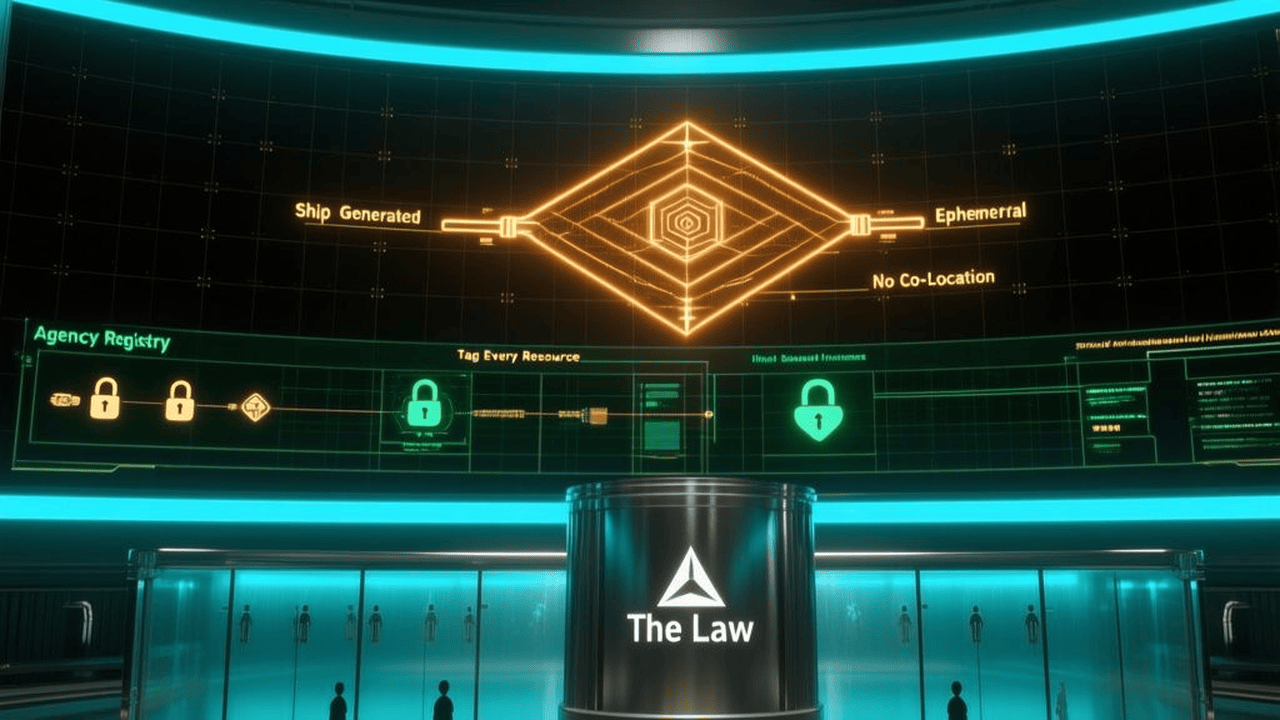
An asset's lifecycle tag is not optional. It is the deploy boundary's first line of defense. 1. Tag Every Resource. Each resource directory must carry a Ship, Generated, or Ephemeral tag. An untagged directory is a boundary violation. 2. Exclude by Subdirectory, Never by Parent. A deploy sync must exclude Generated and Ephemeral assets by subdirectory name. It must never use a parent-directory exclude that drops Ship assets alongside them. 3. No Co-Location. Mixing Ship and Generated assets under a single excluded parent is a Separation of Concerns violation. If a shared parent is unavoidable, exclude by subdirectory, not by parent. Why Two Axes An asset's type (visual, binary, dataset) tells the agent how it is produced. An asset's lifecycle (Ship, Generated, Ephemeral) tells the agent what to do with it at deploy time. Both questions must be answered before the asset is touched. Agentic Asset Drift Stateless agents are uniquely prone to asset-related drift. Because assets often appear interchangeable to a model, an agent may reorganize or compress them without understanding downstream dependencies. Assets exposes the hidden assumptions before the agent attempts a modification. Delegation — The Agency Registry " Ambiguity in ownership is the primary driver of agent collision." When the Steward delegates tasks to sub-agent Workers, it must declare who is touching what, right now. Delegation is the lock manifest. The Three Rules of the Lock 1. Exclusive Lock. Once a Worker is assigned a file scope, that scope is locked. No other agent may modify those files without the Steward’s explicit release. 2. Scope Extension. If a Worker discovers that the task requires modifying files outside the assigned silo, the Worker does not edit them. The Worker files a request. 3. Handover. A lock is released only when a Proof of Work has been verified.
No Workers to Delegate When the Steward has no Workers, the registry still has one row, for the Steward itself.
Like the Constitution of the United States, "The Law is stable; the source of truth. Our refinement, interpretation and enforcement of it evolves."
A Worker, no matter how brilliant, may not edit the Law. The channel the Worker has is the Delta — a small, structured proposal, written into a queue, awaiting the Steward’s decision.
Lifecycle of a Delta:
Propose: The Worker (sub-agent) writes the Delta.
Under Review: The Steward reads the Delta against the system’s teleology and existing invariants.
Approved: The Steward agrees the change is necessary.
Merged: The Steward updates the corresponding artifact and closes the Delta.
Rejected: The Steward disagrees. The rejection reason is recorded so the next Worker doesn’t re-propose the same change.
A Delta log without Sub-agents:
When the Steward is the only agent, the Delta log is not utilized in precisely the same manner as with multi sub-agents, but the discipline of writing the proposal before making the change is the same.
The Delta log is the journal of why the Law changed. Having this record is a lifesaver when a minor change from five minutes ago suddenly breaks the application, but too much happened to remember which tweak caused it. The cost of writing one line is small; the benefit is exponential when you need it.
The Delta log and the Scars
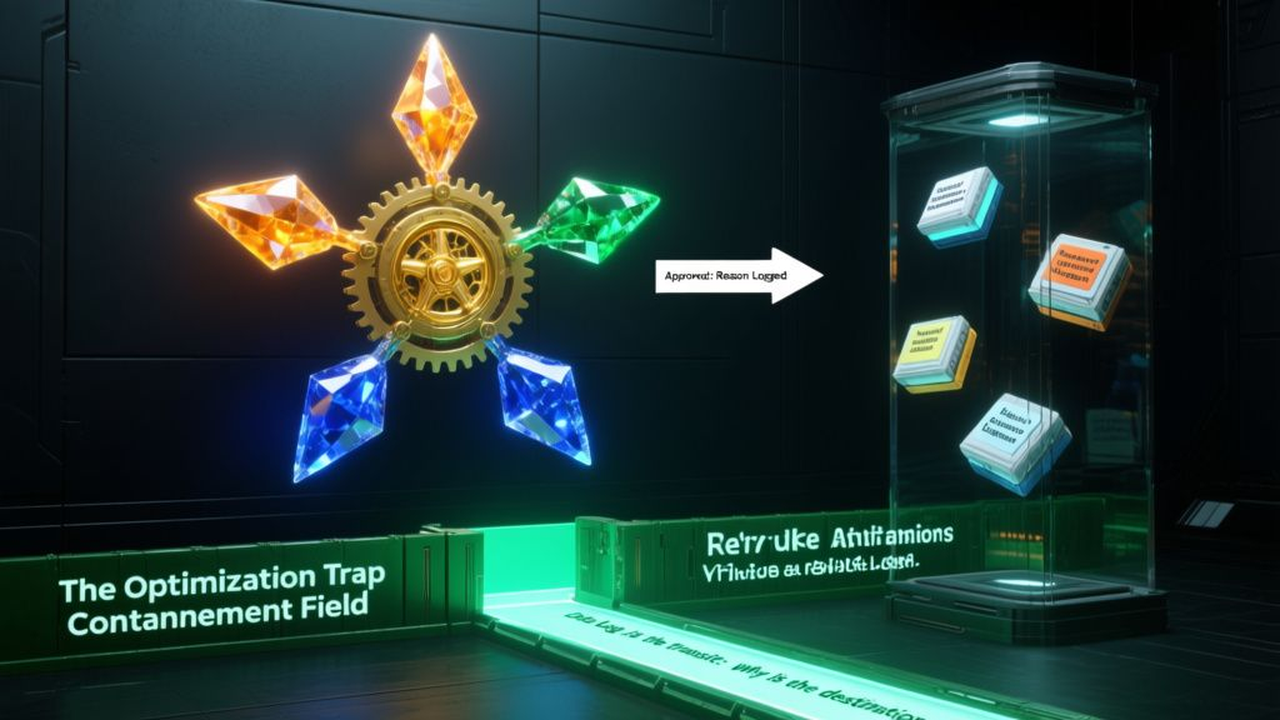
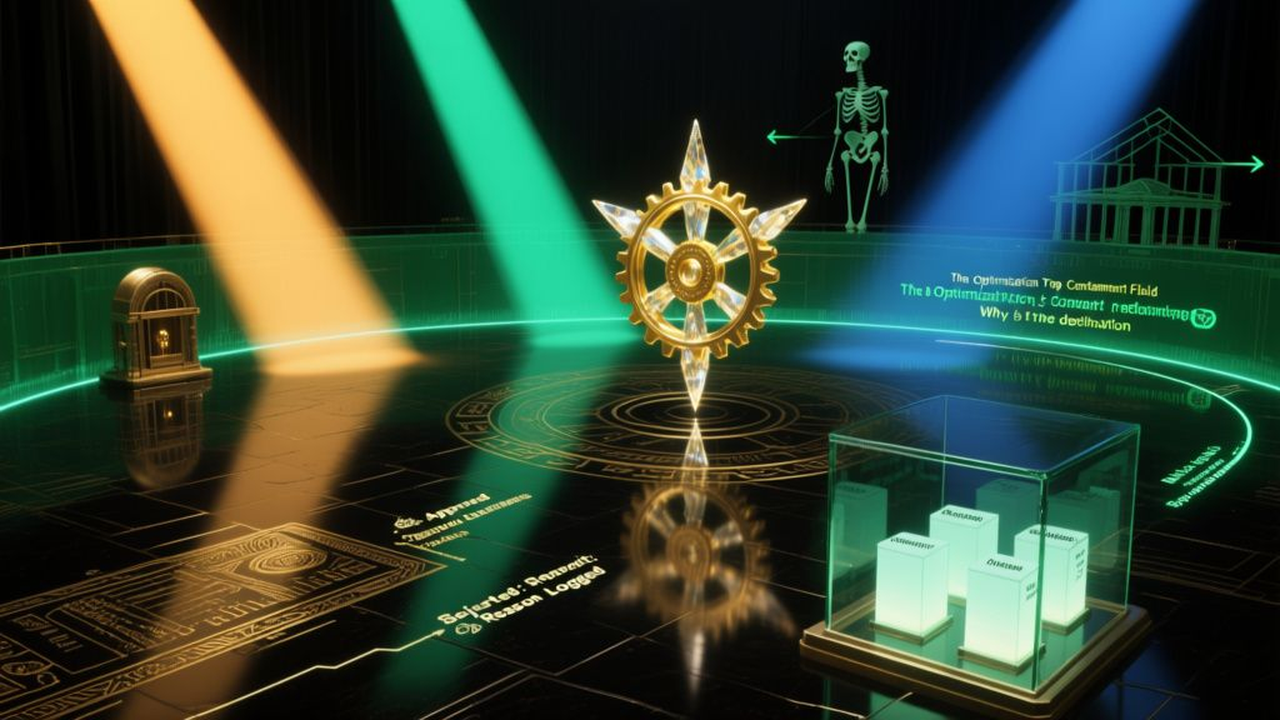
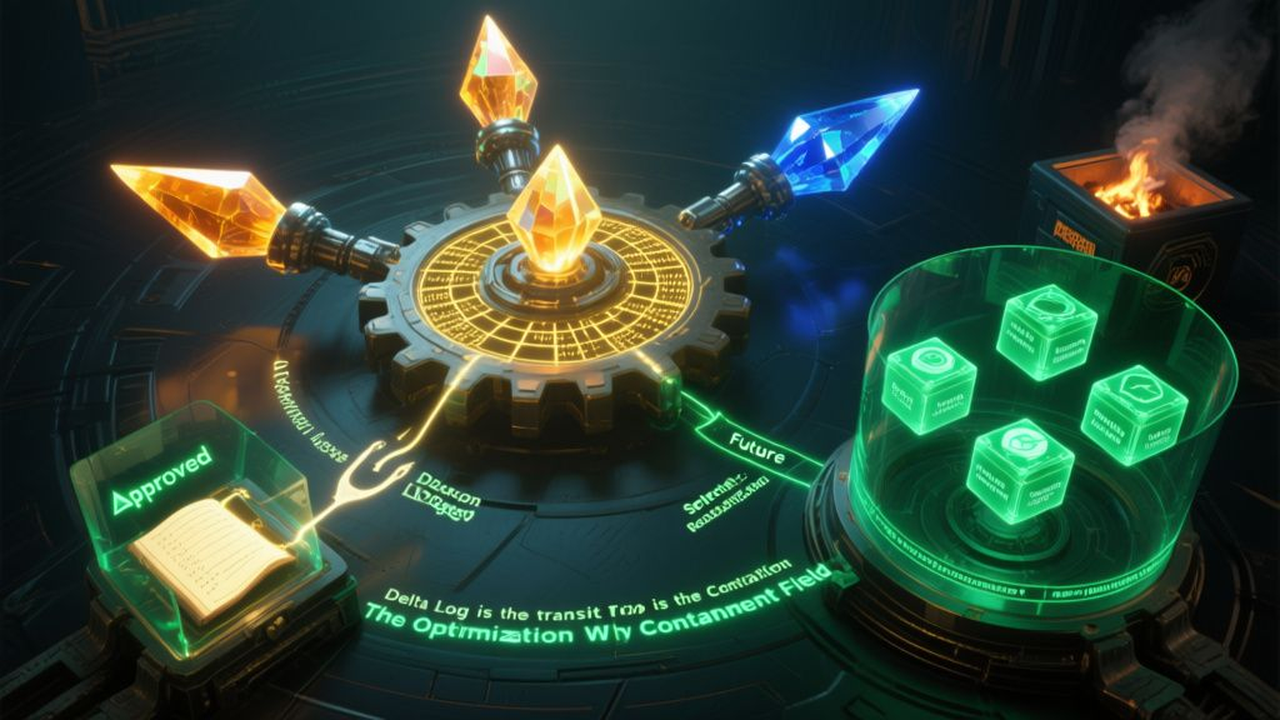
When a Delta is approved and merged, the change lands in the relevant file. But the reason for the change — the scar — belongs in why. The Delta log is the transit; Why is the destination.
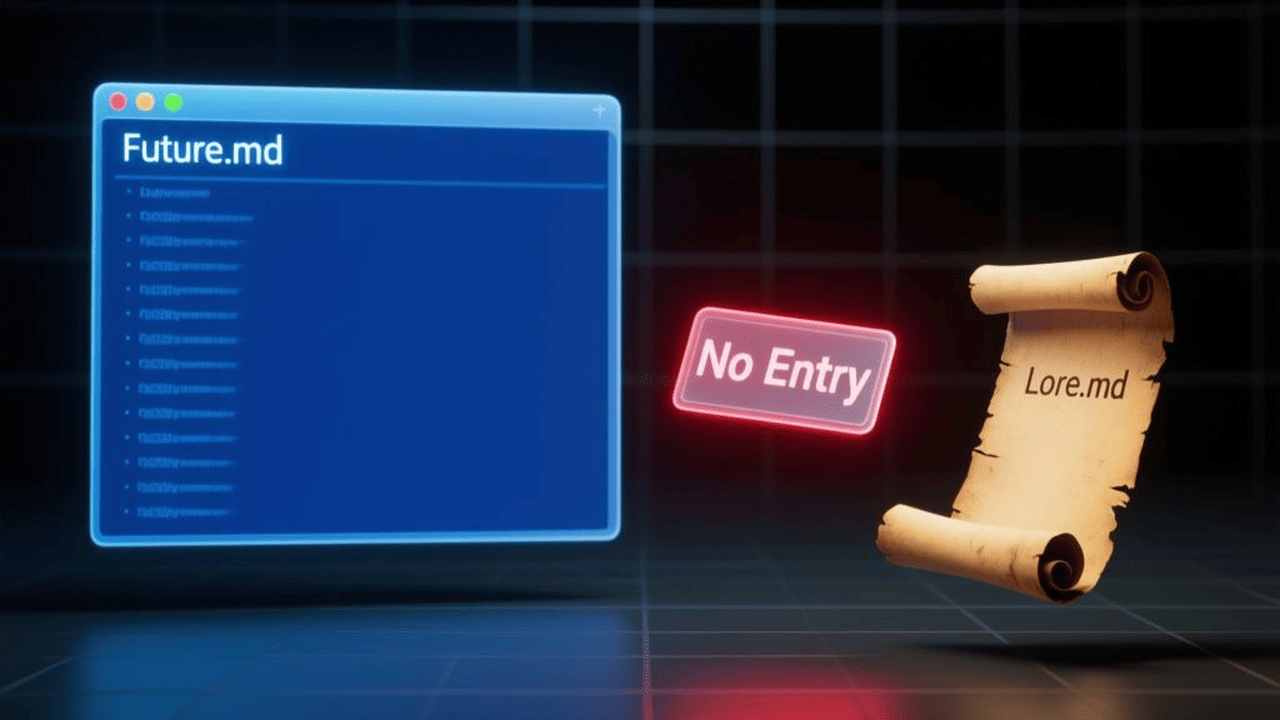
Future — The Standby Queue
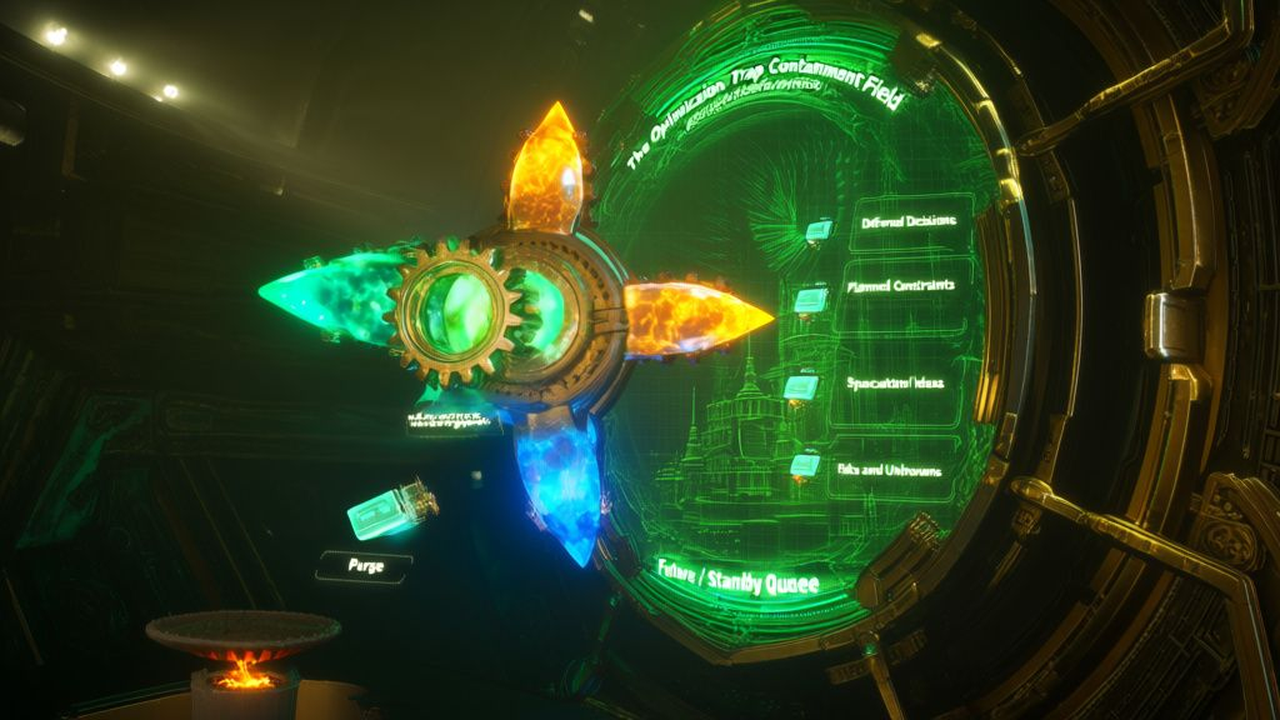
Every repository accumulates "not yet." Planned features, deferred migrations, speculative improvements. Future exists to separate current operational reality from future intent.
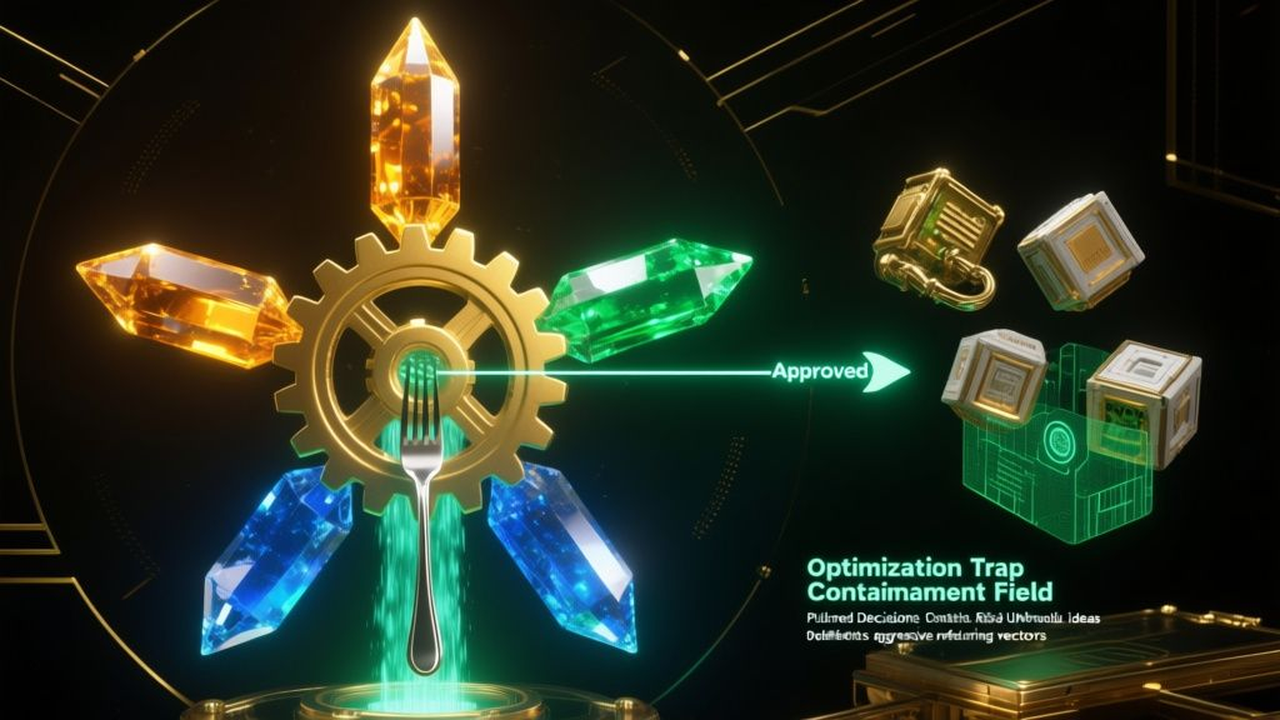
The Optimization Trap
Stateless agents have a native drive toward optimization. If you do not explicitly tell the agent that a specific improvement is out of scope, it will assume the absence of a rule is an invitation to refactor. Future acts as a containment field.
The Four Categories
Deferred Decisions. Questions intentionally postponed. Not forgotten tasks, but decisions that require a specific trigger.
Planned Constraints. Rules that will eventually become operational law but are not yet active.
Speculative Ideas. Hypotheses that require validation. "What-if" scenarios that should not be mistaken for architectural commitments.
Risks and Unknowns. The "dark corners." Areas where technical debt is known to exist, but the cost of repair currently outweighs the benefit.
Temporal Integrity
CSC segregates the past, present, and future in the Triumvirate.
Maintenance
Future is a curated staging area. Promotion: when an idea becomes reality, it moves into the Triumvirate. Purge: when an idea becomes irrelevant, it is deleted. A Future filled with five-year-old "ideas" is not governance. That is a museum of failures!
The Triumvirate governs the code. Assets governs the resources. Delegation governs the agents. Delta log governs the changes. Future governs the intent. Together, these five artifacts give a stateless agent everything it needs to operate with precision of intent inside a system it has never seen before.
Agentic Stewardship
What if the real job isn't generating code at all?
Code generation is the acne treatment of software engineering. It addresses the visible surface, the part everyone notices, the part that looks impressive in a demo, while the real pathology runs deeper. The assumption rot. The undocumented invariant. The fragile dependency nobody remembers until a production scare makes everyone panic. Diagnosing a codebase by its generative output is like trying to treat cancer by looking solely at the patient's acne. The generative bit is just one process of an otherwise much more elegant system with much greater potential.
CSC exists to move agents from writing code to tending systems. Code generation is easy. Preserving what the system depends on while you change it, that's the hard shift.
The stewardship of Contract-Style-Comments is a hierarchy of roles held in concert. The steward delegates and arbitrates, the Workers execute, and the Delta log is the channel between them. Stewardship is the maintenance thereof.
The preceding chapters established the theory. Here, we introduce the practice in a multi-agent model.
What Stewardship Means:
I think this is the biggest part of what CSC is, which will be misunderstood. CSC does very little if not nothing about telling the agent how to write code, or how to do its job. In truth, all CSC is here to do is advise the agent how to be a proper steward of code.
Governance Includes Memory
Any changes to the project working files which affect the Triumvirate must act as a Review Trigger. In a multi-agent system, the Worker who observes the change does not perform the update. The Worker files a Delta. The Steward arbitrates and performs the update. The audit trail lives in the Delta log and the commit history.
The AI assumes the steward role. With CSC in place, a few well-placed prompts prevent the implementation and governance layers from slow divergence.
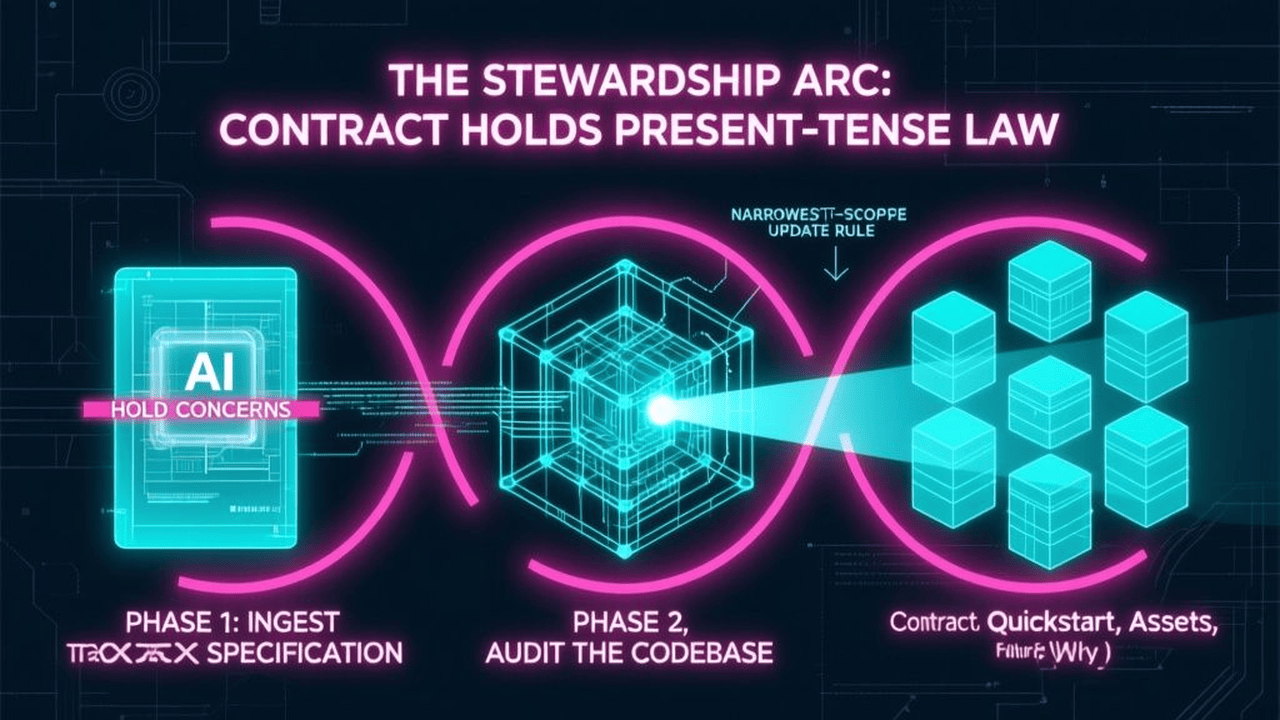
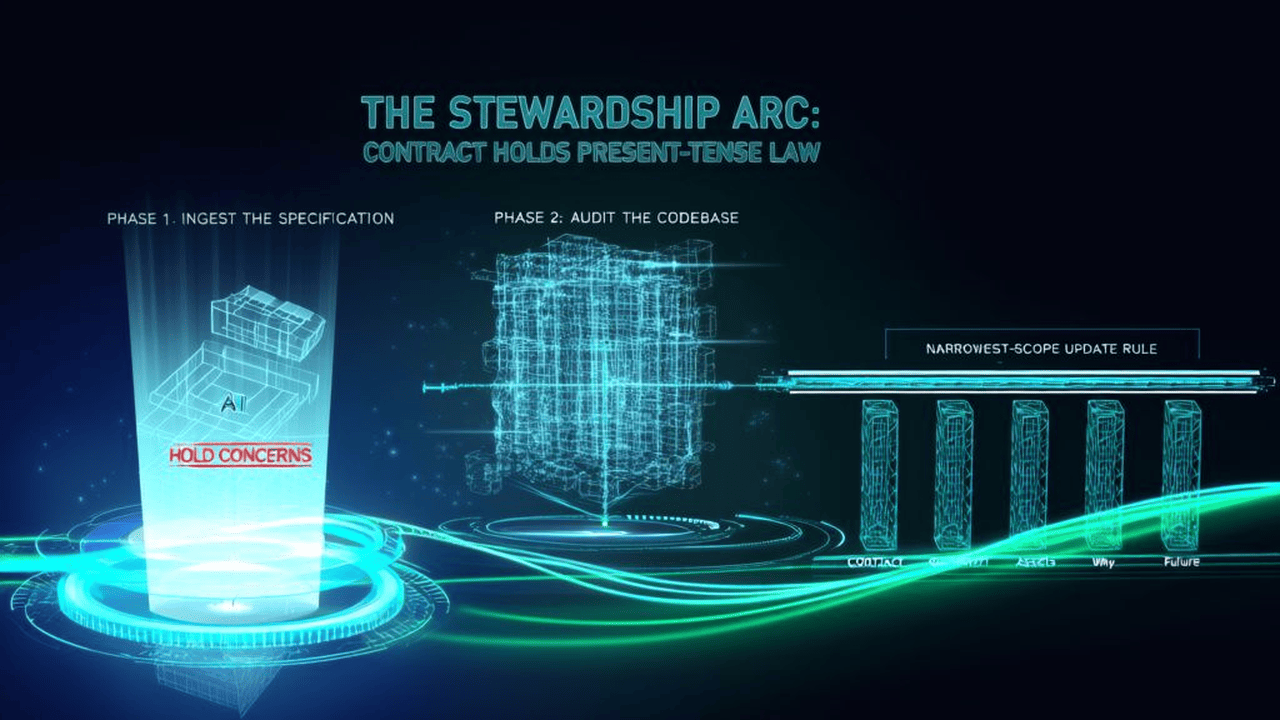
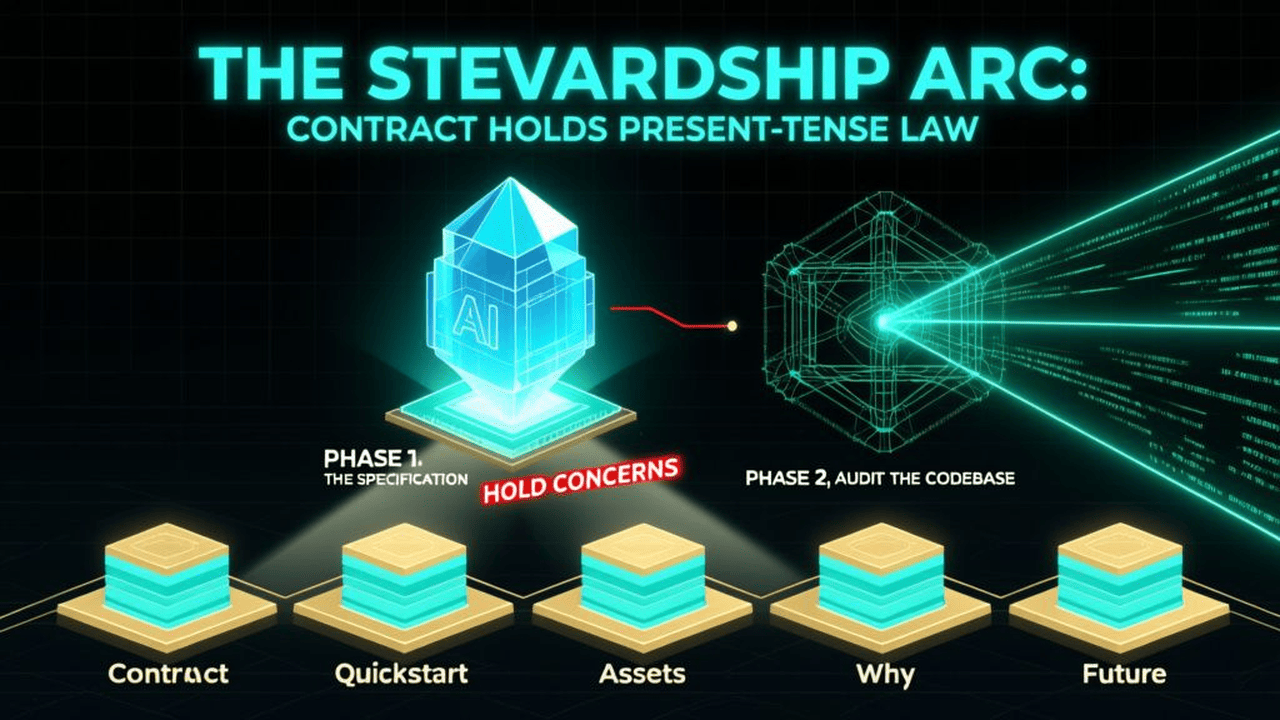
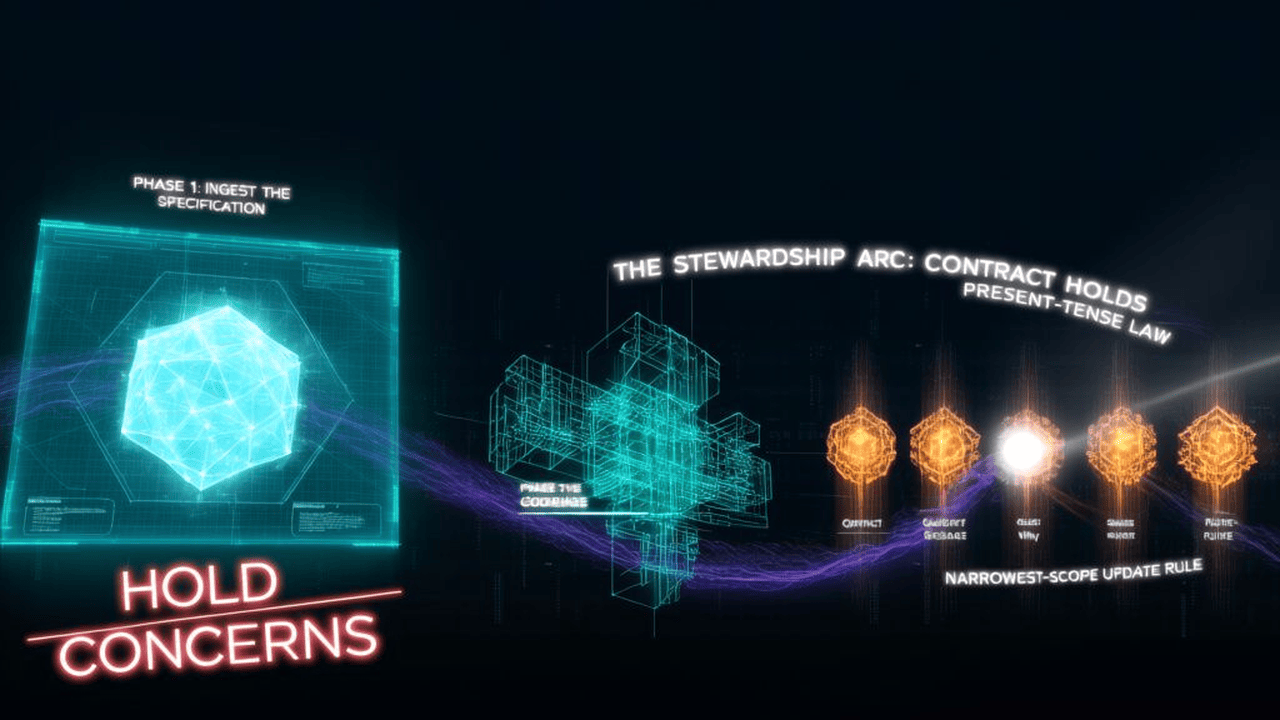
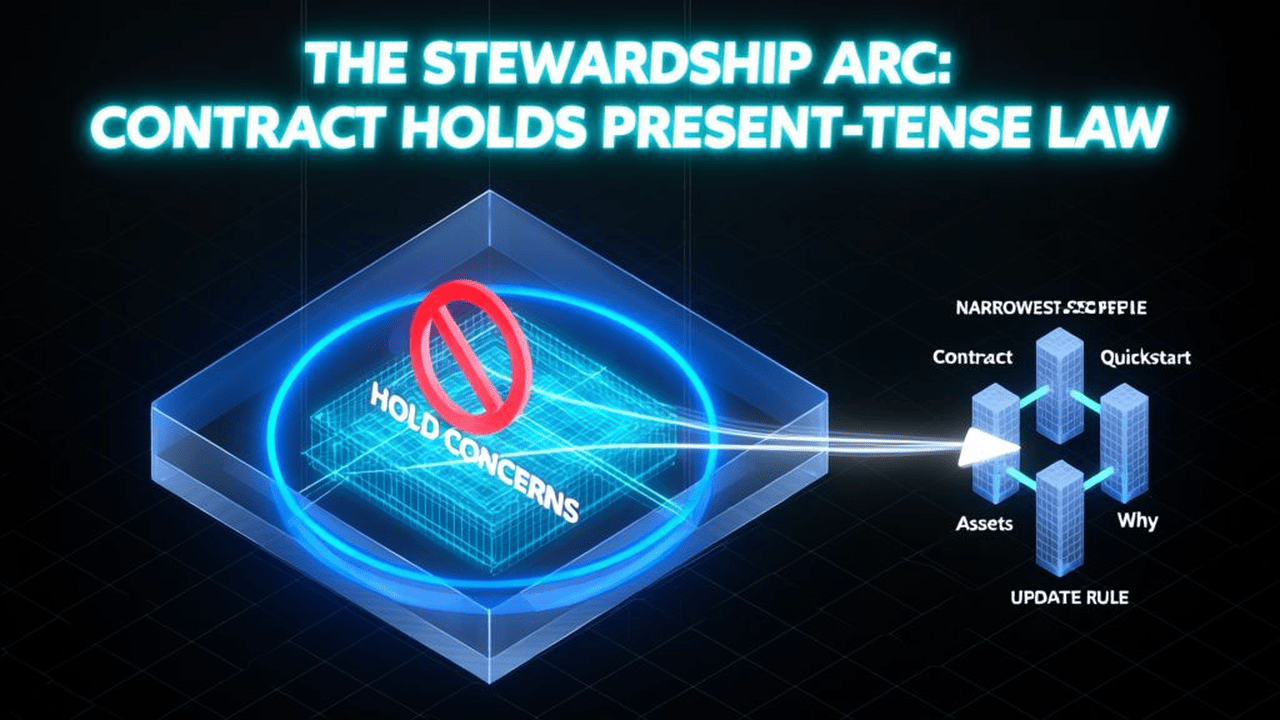
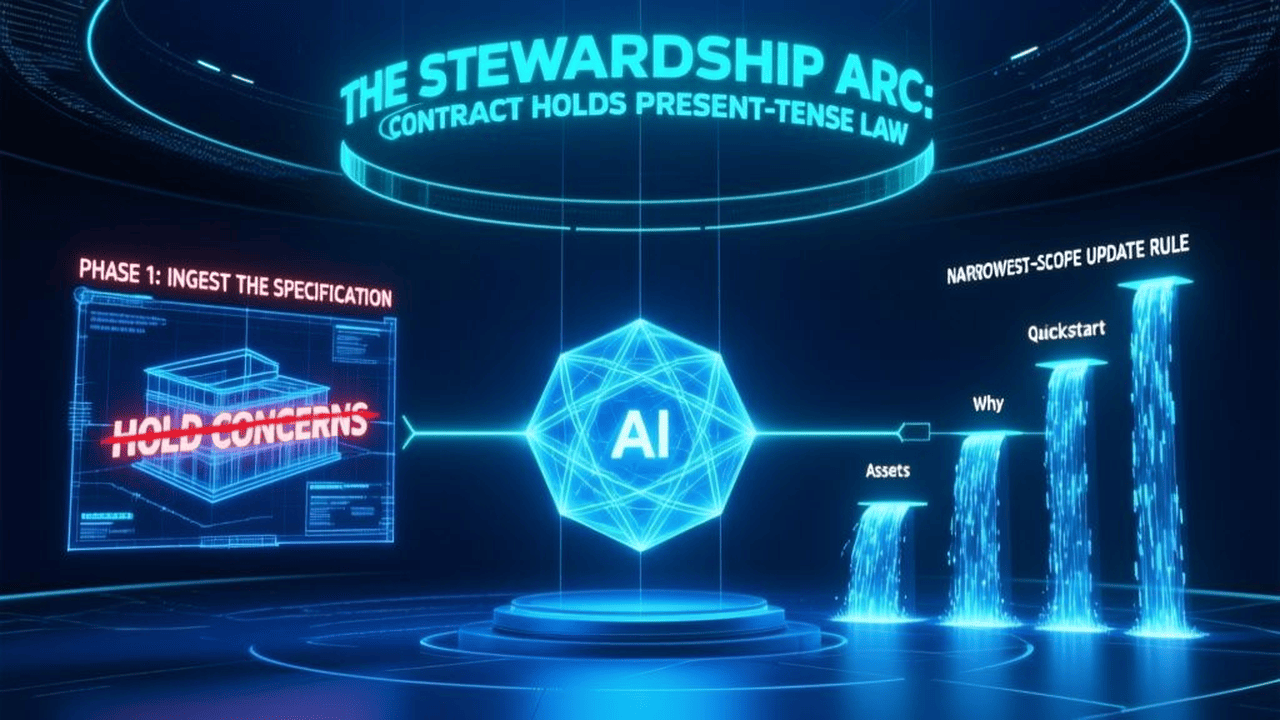
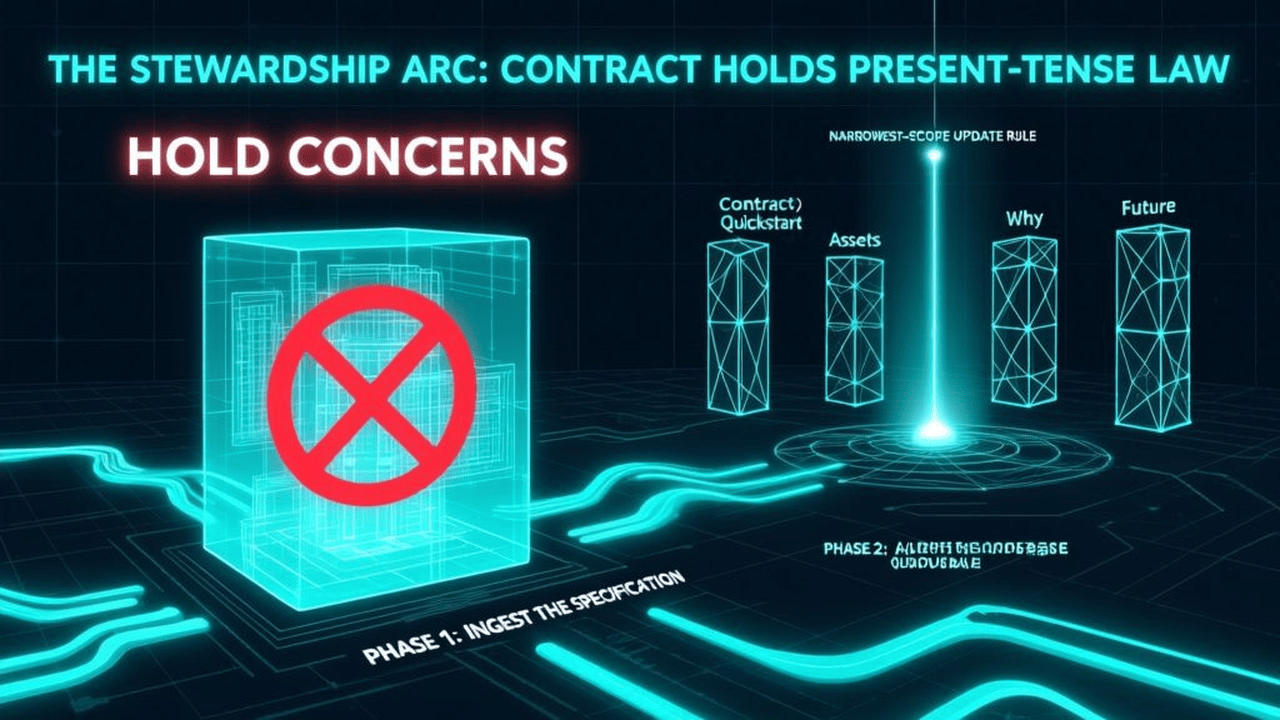
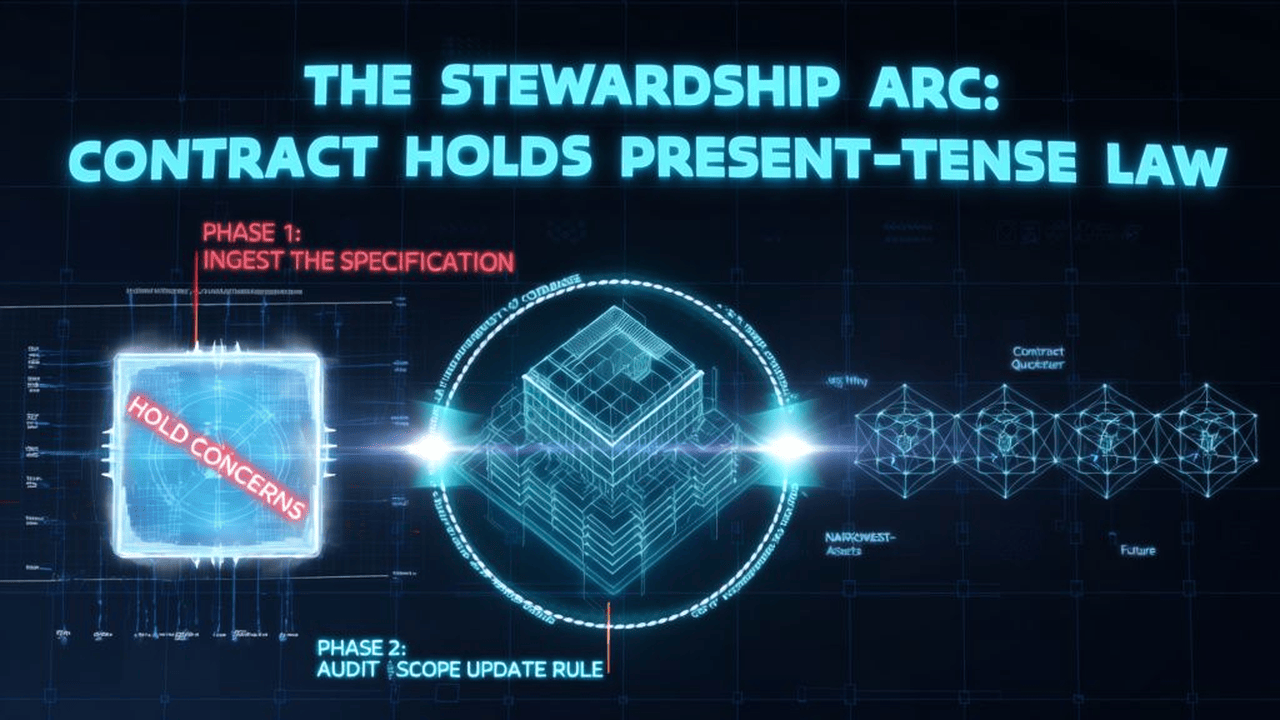
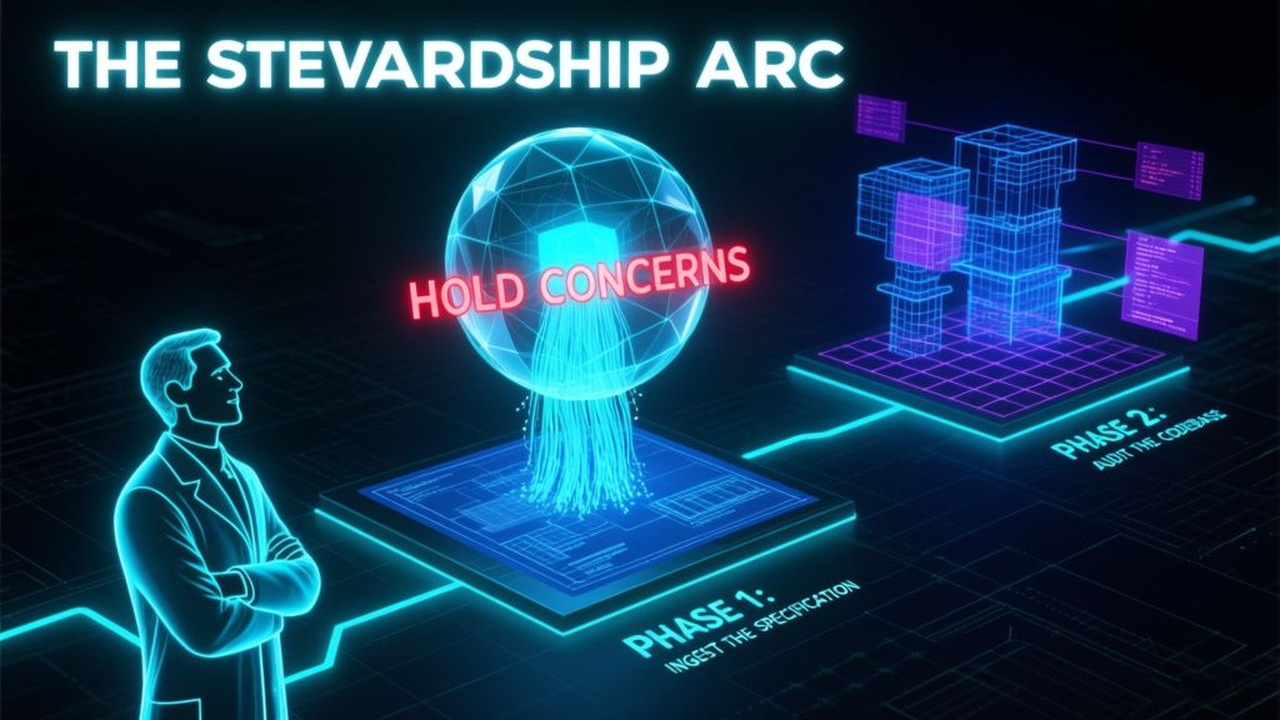
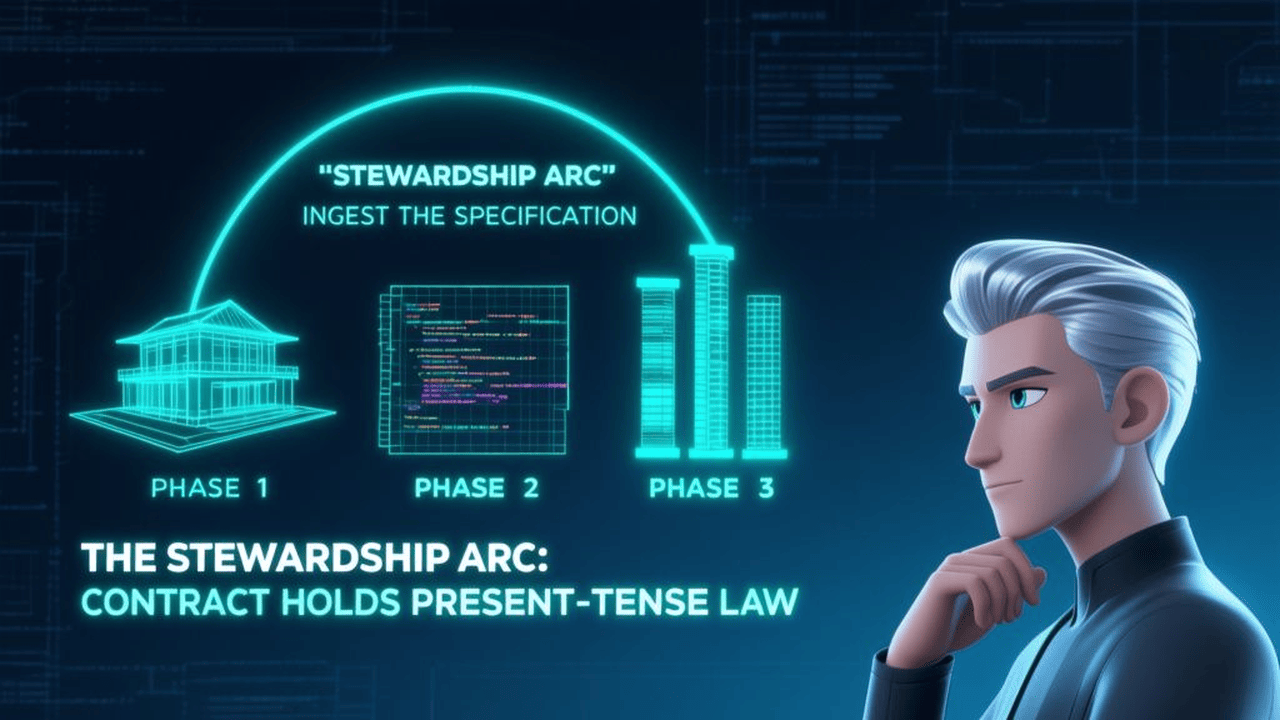
The Stewardship Arc:
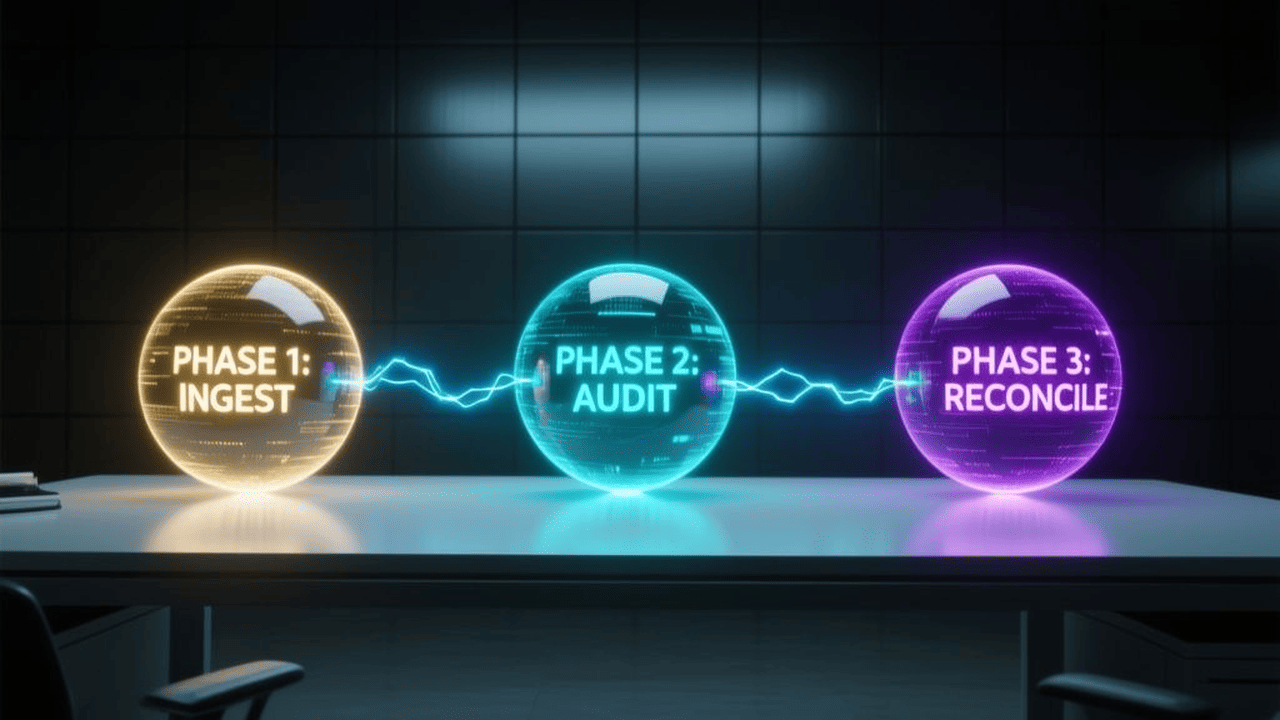
A stewarding agent operates differently from a simple code generator. Much of this book is going to reference the Github repository, because it's a book about working with a living document, so the associate resources are also living documents. I've written three prompts that walk an agent through the framework. It's easiest to copy paste from the repository, but I'm presenting them here in their current living state. The prompt may have mutated by the time you copy/paste. The three phases form a single stewardship arc. Each one exists because of what the previous one can't do alone.
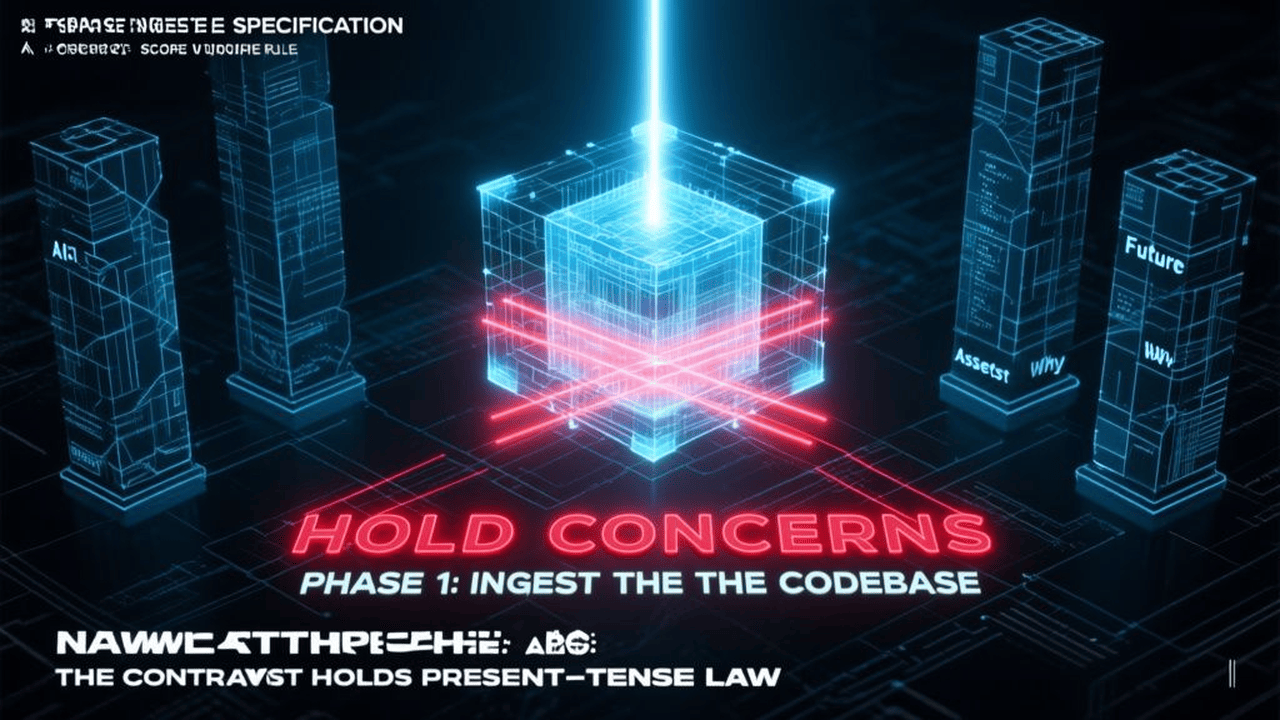
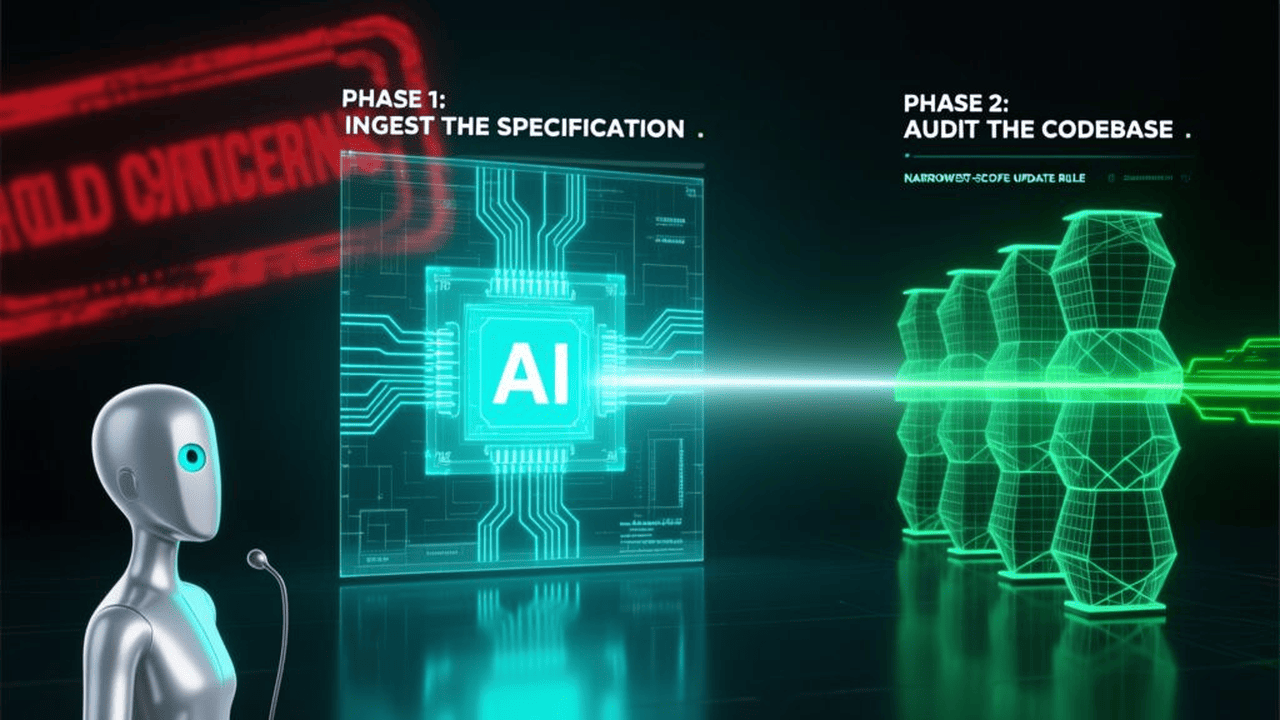
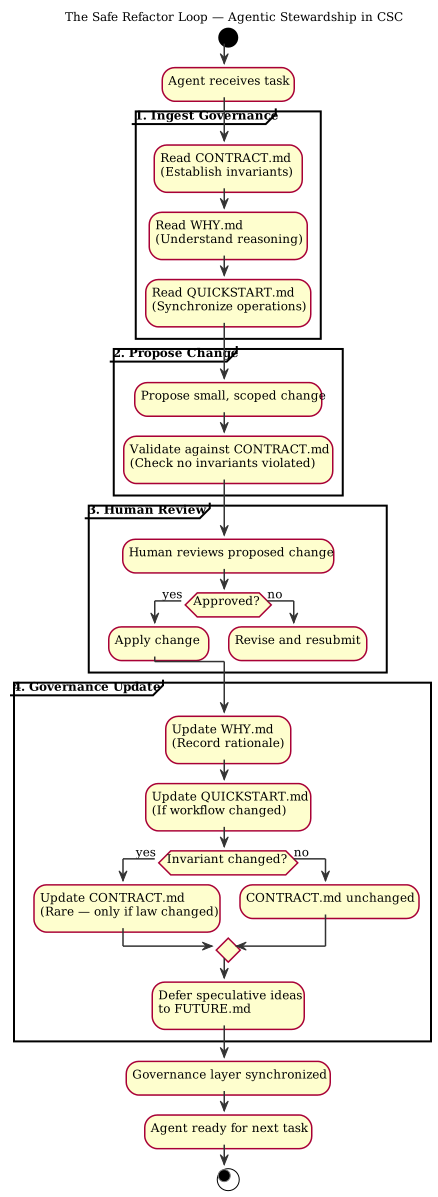
Phase 1: Ingest the Specification. Read the contract artifacts before touching anything. The critical constraint: hold your concerns until Phase 2. This ensures all governance artifacts are ingested before evaluating alignment, preventing premature conclusions based on partial context. An agent that starts fixing before it finishes reading is not a steward. It's a bull in a china shop with a keyboard.
Phase 2: Audit the Codebase. Now look at the actual implementation. Scan for inline Contract comments. Verify environment pipelines. Cross-reference what the contract says against what the code actually does. The goal of this exercise is to discover where you stand before you change anything, not necessarily to find violations, though violations will be exposed.
Phase 3: Reconcile on Exit. Before closing the session, update the governance artifacts to reflect what actually happened. This is where the Narrowest-Scope Update Rule applies.
I should take the opportunity here to remark, upon inquiring of the LLM, "What is it about CSC which seems to allow you to function flawlessly, insofar as to autonomously update the contract files without being instructed to do so?" Rather invariably, they point to the Narrowest-Scope Rule (NSR) as the key to the way the LLM's are governed by the contract (which they do perceive and honor as Law) to validate the system paths. So, there you have it.
The Narrowest-Scope Rule is what makes CSC different, according to the agents that have worked in it, and they have been many! Ask your LLM when you try CSC, should you find yourself fascinated with the self-maintaining process in your codebase. Check it out! When the LLM considers the Narrowest Scope, their analysis becomes very granular, but they first consider the repository from a topographic perspective as follows:
If Invariants (pre-conditions, post-conditions, or "no-fly zones") have changed, then Contract must be updated!
If Operations changed, audit Quickstart and fold in the operational changes.
If Resources (images and other binary files) are affected, then it must be recorded in Assets.
If Architecture changed, the LLM will study Why and update it appropriately.
If Priorities changed, check Future for alignment with your most recent future ideas.
Consult the LLM for a plan and instruct it to update the project vision. It is most important to remember and hold one rule above all others: the Contract is not a semantic prose copy of git history. Git holds chronology; the Contract holds present-tense law.
A complete set of prompt suggestions for opening, working, and closing a CSC governed project exist in the CSC template repo: do not attempt to use CSC without those prompts, as they are designed exclusively for CSC with their constraints, fallback procedures, and deployment considerations. Open the GitHub readme in a browser tab or copy them into a desktop sticky note while you're working on the CSC governed project, for convenience.
There's also an SSH / remote development friendly prompt you should try! It's all there, when you clone the CSC repo into a contract folder in your codebase. You will most likely tweak those prompts as you go along; as your project mutates. Visit the CSC repo at github.com/ajaxStardust/contract-style-comments (with dashes between contract, style, and-comments).
As a bulleted list, a typical workflow looks something like this:
First, Ingest the Specification (See the Phase 1 prompt found in the CSC readme as you cloned from the GitHub template).
Then, make constrained changes.
Next? Verify behavior!
Now, update governance artifacts if assumptions changed.
Finally, record important operational lessons.
The repository becomes both the implementation layer and the memory layer.
The Limits of "Agentic Skills"
In my experience, the standard currently in 2026 is to develop ways of telling the Agent how to do its job. The important shift with CSC is not to direct the agent in the minutia of its tasks. It already knows how to do that. Billions have been spent by the likes of Anthropic, OpenAI, and Google, etc., so that the models know how to do what agents.md and proprietary IDE "agentic skills" documents strive to do.
The shift is changing from telling the agent what to do, allowing it instead to do what it is capable of doing, and monitoring the state of the project based on what it did.
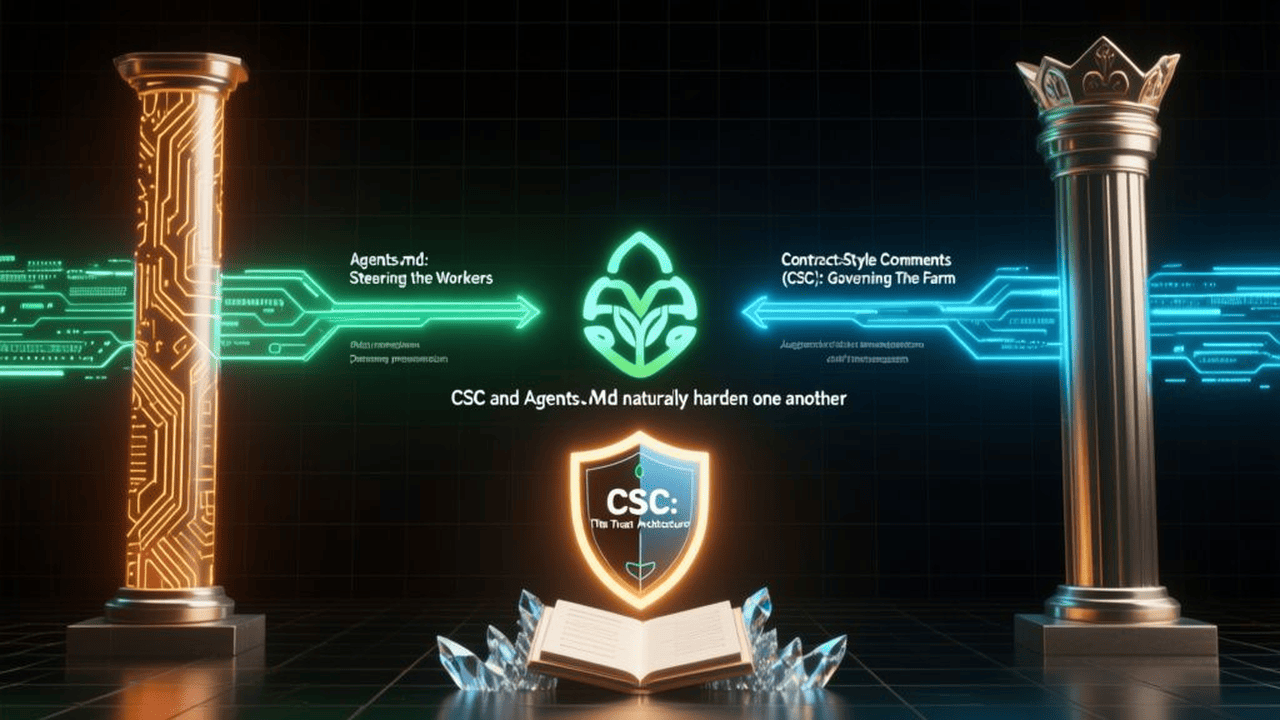
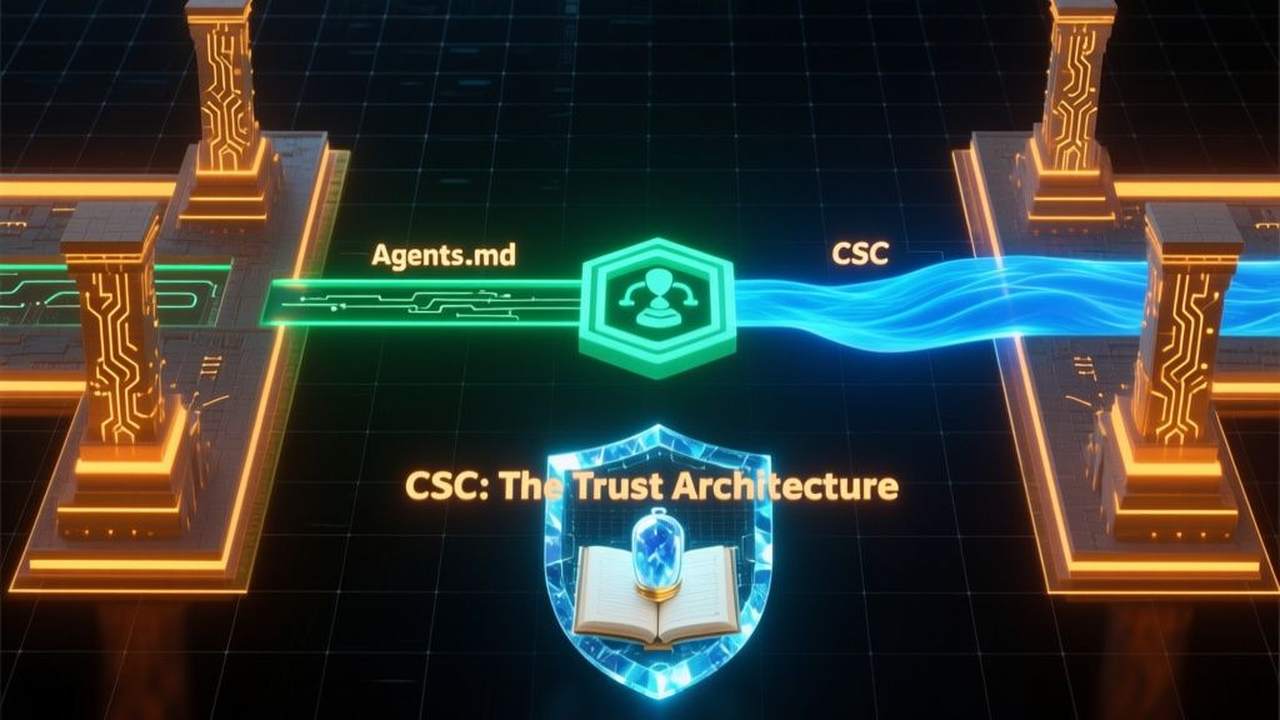
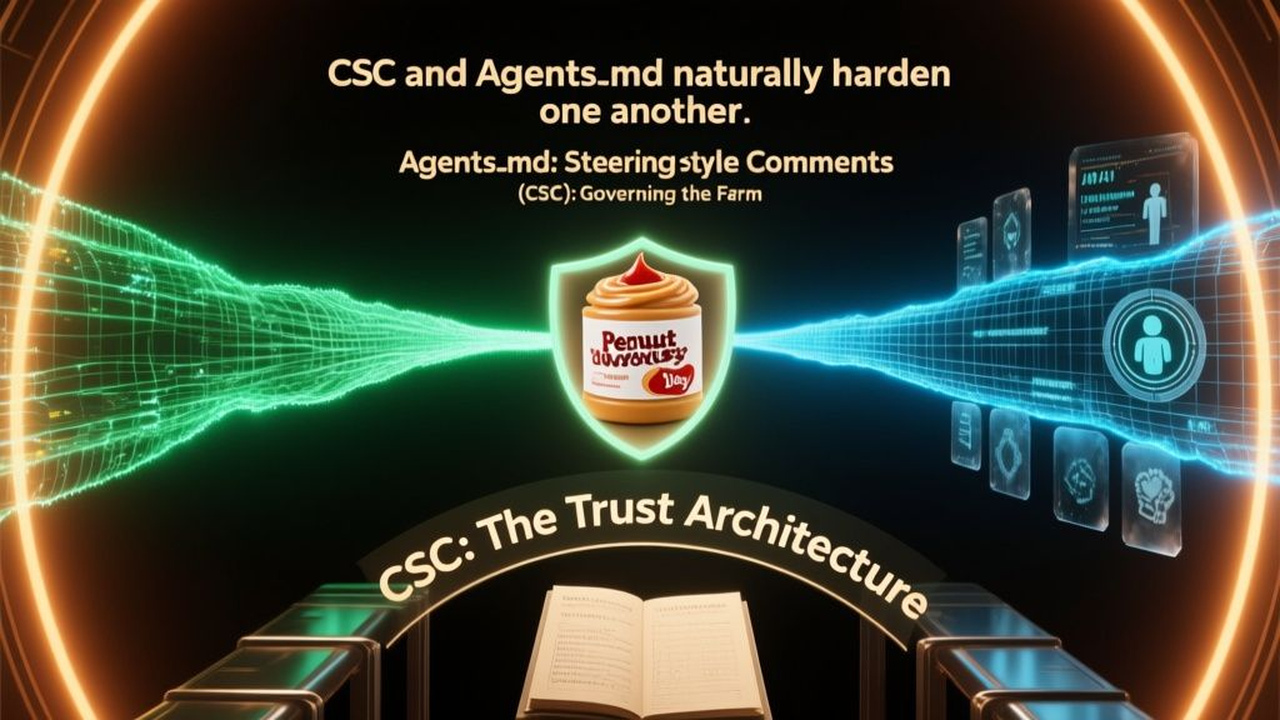
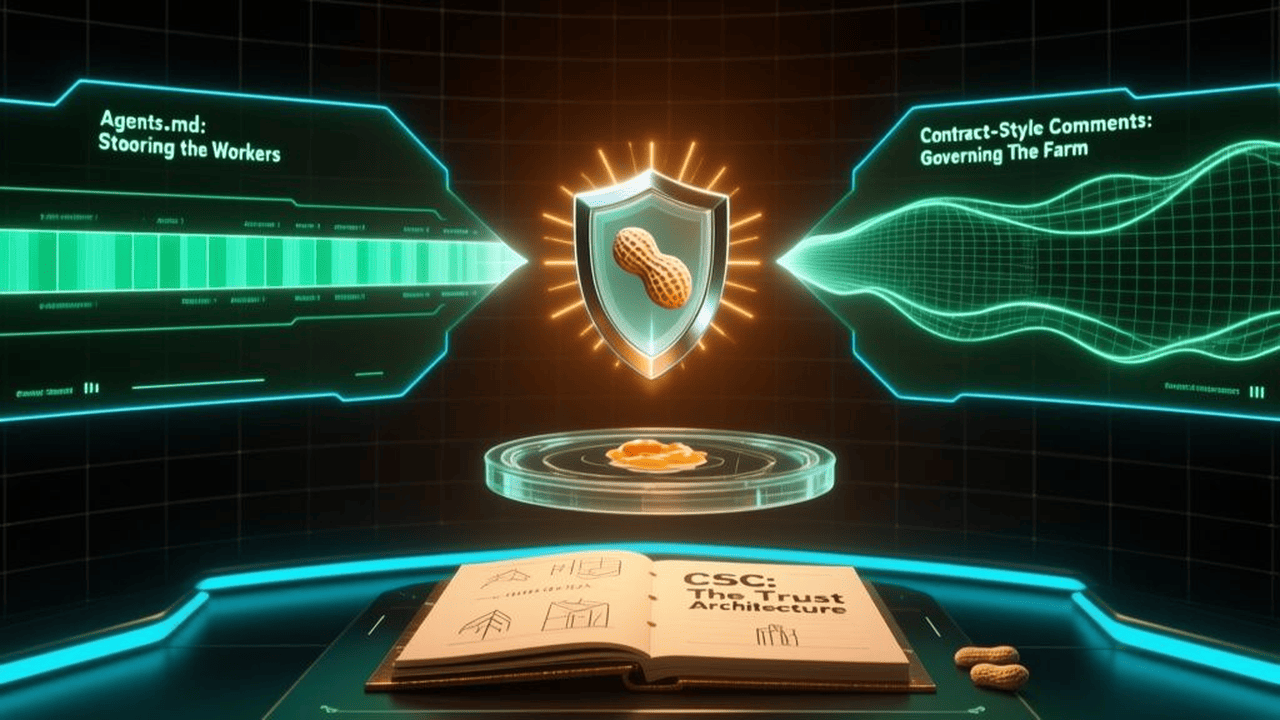
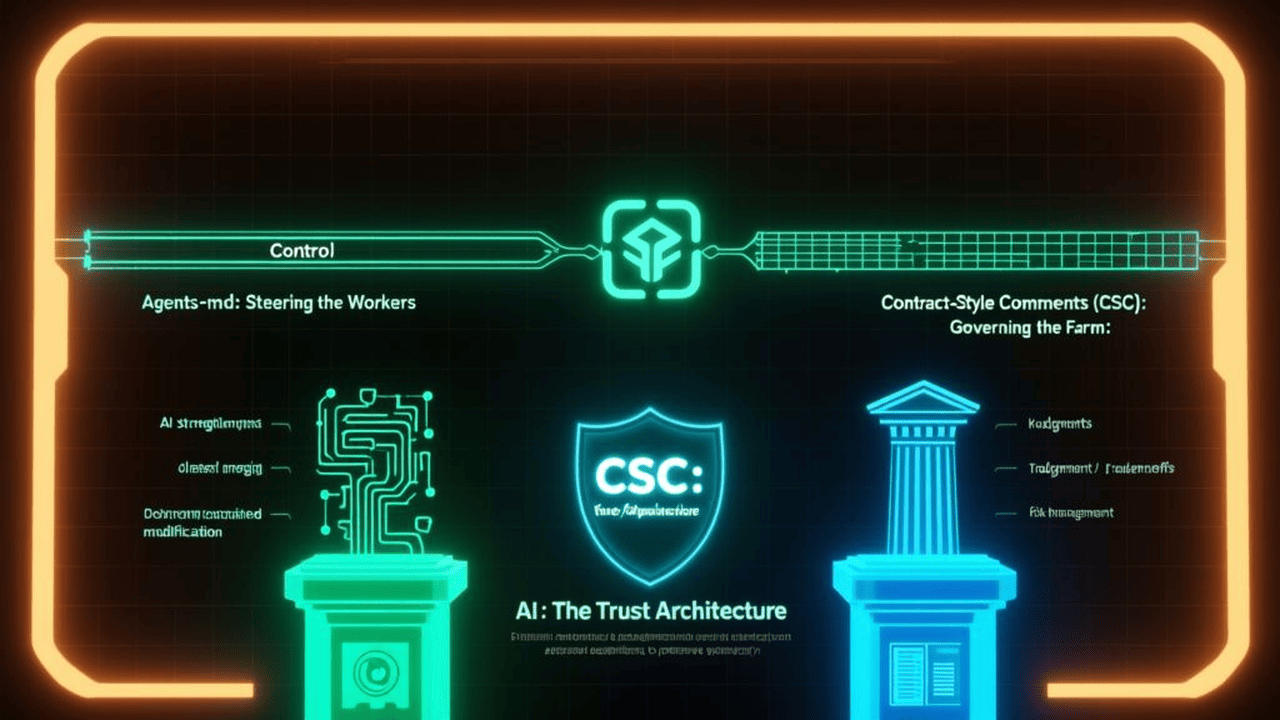
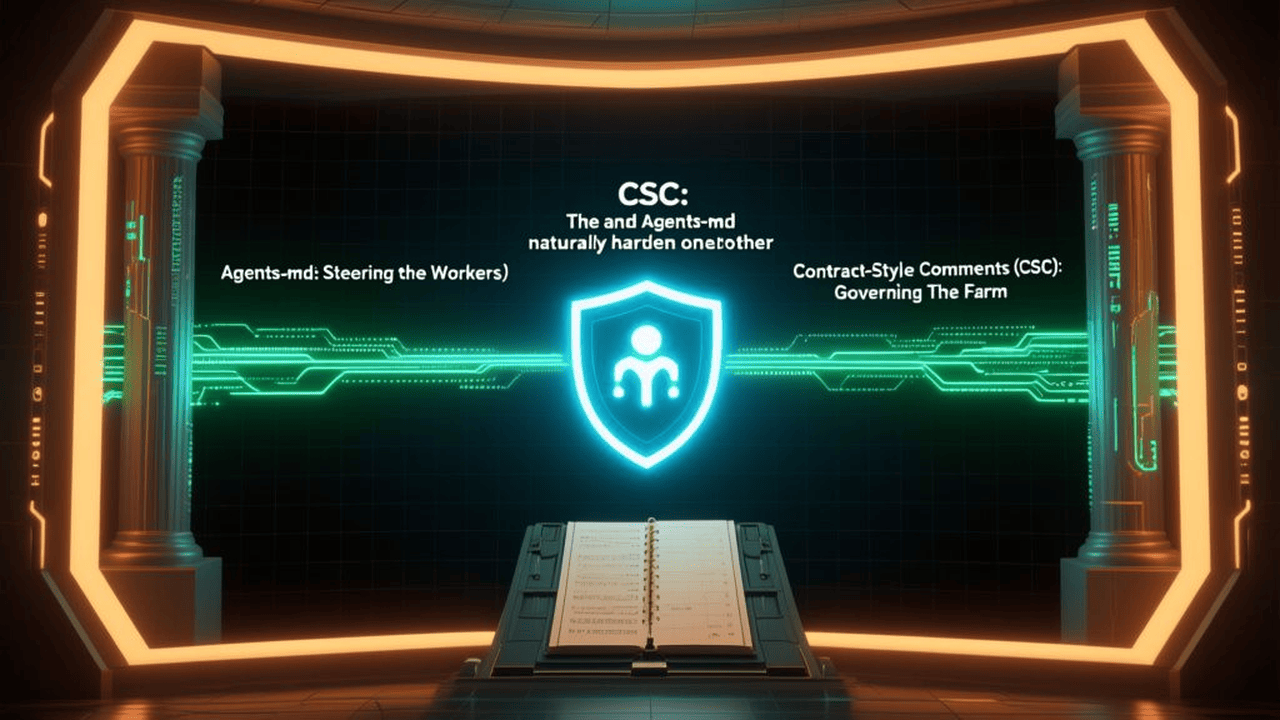
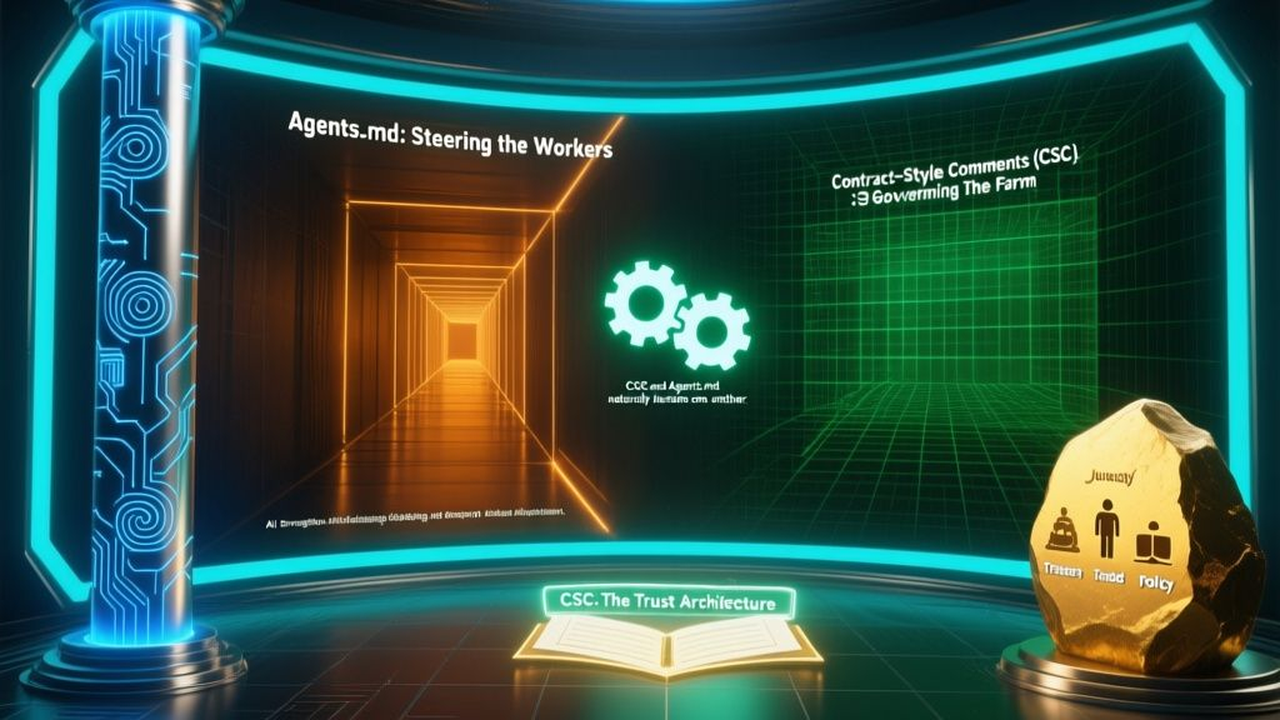
(Visible diagram missing from audio book. Please reference Master of the Lake, Figure 11.1 for a table demonstrating how CSC and Agents.md naturally harden one another)
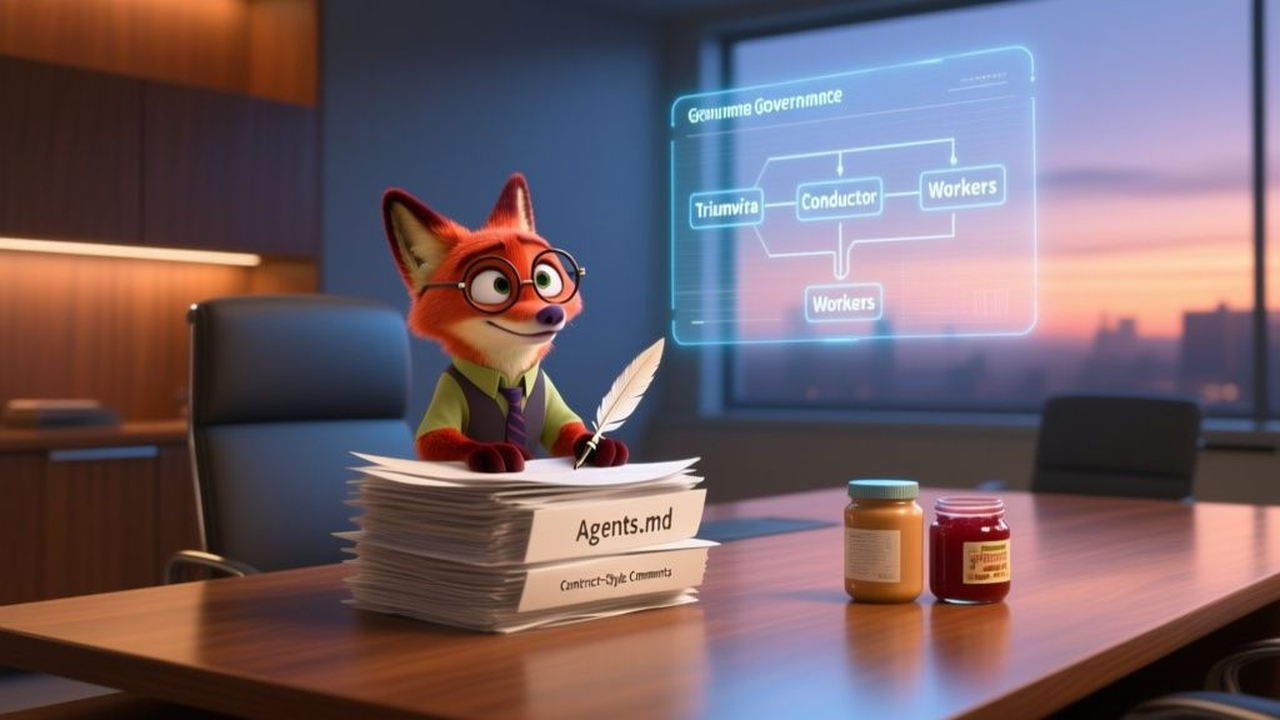
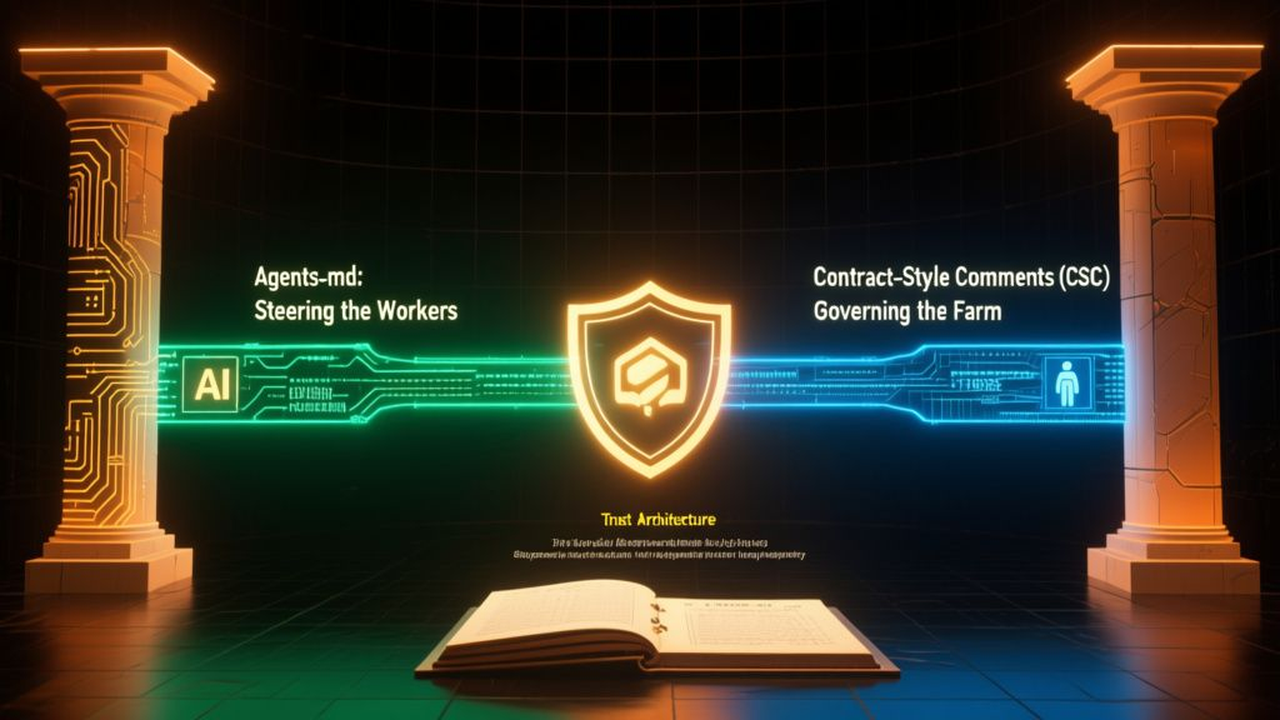
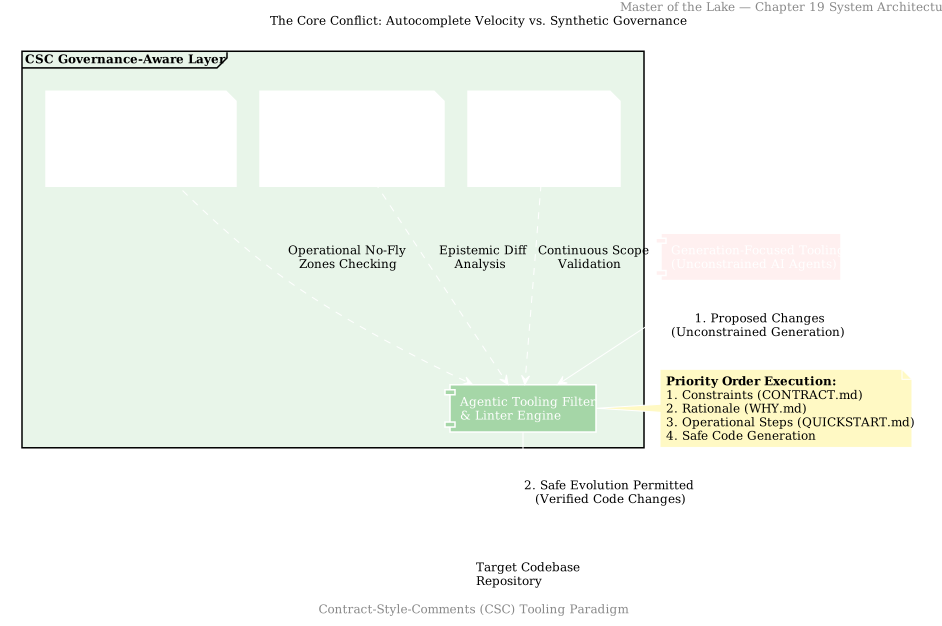
Documents like Agents.md steer the workers. Contract-Style Comments (CSC) governs the farm. In the real world,the two complement each other like peanut butter and jelly. But don't be jelly: files like Agents.md are not required for CSC to govern your project with superior precision.
The LLM defines the System Integrity constraints; the Workers, the human and the LLM, operate within them as always.
Behavioral Governance documents apply to Worker configurations. The Steward arbitrates; Workers behave; the Triumvirate governs activity, explains law, and records present tense system truth.
AI? Meet the Human!
Human? Meet the AI!
Agents excel at
debugging failures
repetition
constrained modification
pattern recognition and preservation
Humans excel at
judgment
tradeoffs
policy decisions
risk management
mitigating drift
CSC is the trust architecture that sets the laws of social interaction for the Agent and the Human, so they can co-exist without the repository melting down.
As agents gain broader repository access, the risk profile changes. The problem is no longer "Can the AI write code?" The larger question becomes: "Can the system preserve architectural integrity over time?" Without governance, assumptions drift, rationale disappears, and repositories become harder to maintain safely. CSC externalizes those assumptions before they disappear. Over time, the repository becomes easier to maintain because important knowledge stops depending entirely on human memory.
This chapter introduced stewardship as a governance responsibility rather than simple code generation. The practice, however, depends on enforcement: how repositories preserve trust, provenance, and constraint integrity over time.
Guarding the Contract: "The tragedy of most software projects is not that the rules were broken, but that the rules were rewritten in the dark, and everyone continued to pretend the original map was still accurate." Imagine a city where the zoning laws are written in pencil. The mayor decides that the industrial district should now be a residential garden, but instead of issuing a decree, he scribbles a few lines on the master map in the basement of City Hall (imagine Mayor of Townsville explaining it to the Power Puffs).
For weeks, the contractors continue to build factories, and the residents continue to plant roses, both operating under the assumption that the Law remains what it was. The resulting chaos is a failure of ownership!
Provenance (ownership) in CSC:
What is Provenance?
Let me try to explain it to you like this, folks. You see? Provenance is the type of word that an author might find has been silently injected into his text, behind his back... by an LLM!
Alas, Provenance has another meaning yet preserved within the context of this book: the only meaning you should care about...
Provenance is often thought of as the ownership of a thing, but there's a little more to it (Not much more, but it's important that you understand this clearly web-three point-oh people?). When Provenance is used in Master of the Lake, think of the provenance, or ownership role in blockchain technology.
Provenance is not only the ownership of an object or concept at this moment, but the complete history of that thing's owners, and the scope of that ownership. (adulting is difficult)
Understanding, and considering provenance in CSC is key to discovering and tracking the cause of drift. The very purpose of CSC is to eliminate drift in AI assisted projects.
In the context of an Agentic system, losing sight of provenance can lead to Silent Drift.
We speak of "due diligence" in maintaining the Triumvirate: the contracts, the rationale, the operational maps, and the asset rules.
But a repository can possess every artifact of CSC and still be a presentation of misinformation. Check the provenance. Were files changed casually, silently, or without an explicit audit trail, or can the Primary LLM track who, when, where, and why it was touched?
A "suggestion" about editing content without a narrow scope on its provenance is an open invitation to for the LLM to hallucinate missing information.
When the agent reads a contract that has drifted from the actual behavior of the code,
it won't stop to ask for clarification, because it assumes it doesn't require it.
The LLM might assume the codebase is broken and attempt to 'fix' it to match the silent
drift of a contract that failed to correctly record provenance.
This happens when reconciliation is done too loosely, or with too little observation by
the Human in the Loop.
Provenance isn't just LLM-speak:
it's a concept you need to wrap your head around... like the Jumbo Shrimp, for example, or the tiniest maximum: think about what it really means in relation to the governance of the system. Provenance isn't just ownership, but the history of it for that object.
A well disciplined system can descend into a cycle of regression if the Primary Agent has hallucinated, silently, any information which wasn't explicitly provided. For example, the agent will refactor the codebase, silently (behind your back) to match a stale rule; it breaks a hidden production invariant, and then rewrites the rule to justify the break.
If the governance layer is not anchored in trust, it is merely a sophisticated form of technical comprehension debt. Git as the Trust Layer To stop the drift, we must treat the version control system not as a storage bin for diffs, but as the Enforcement Layer. CSC relies upon Git as the absolute audit trail. It is the provenance layer that tells us who actually authored a constraint; the review history that reveals who approved the deviation from the Law; the rollback mechanism for when an "improvement" causes a catastrophe; and the final, unvarnished record of authorship.
Without a verifiable history, a Contract.md file is just a text file. With Git, it is a ledger of constitutional amendments. Fortifying the Perimeter If the contract drifts silently, the system's operational assumptions drift with it. For that reason, the contract layer must receive a level of protection that would make a bank vault look like a screen door.
Preserving trust in the governance layer is paramount to all else. We do not "document" the contract; we secure it.
Consider your safeguards:
git branch Protection: The main branch must be a sanctuary. No direct commits to the Triumvirate.
Mandatory Review: Every change to a Contract or Why must be scrutinized by a human steward who understands the "Why" behind the "What."
Signed Commits: Ensuring that the identity of the author is cryptographically verified (if applicable to your codebase).
Code Owner's Enforcement: Routing governance changes specifically to the Triumvirate's guardians.
The idea here is to ensure that when the Law; anything in the Triumvirate changes, that change is one hundred percent intentional, and it is recorded, and justified!
The Authority Boundary Map As agents gain repository access, we must establish a clear boundary of authority. This is about the nature of the work, not our trust in the intelligence.
Not all modifications carry the same risk.
(Visible diagram missing from audio book. Please reference Master of the Lake, Figure 12.1)
Repositories may choose to grant agents broader authority over governance maintenance than over production code changes, but it is critical that these boundaries remain explicit. Thus, the human is never the worker, or the Steward and definitely never delegates work to a swarm of sub-agents.
Nine out of of ten sessions, you'll find yourself working only with the Steward, rarely spawning a sub-agent swarm.
Keyword note: You may see the term Dynamic Workflow in the context of documentation about your AI agent tool-chain, or recommended skills to try.
A Dynamic Workflow is one in which the Steward has spawned a sub-agent swarm, and delegated tasks to its workers. That is, this whole thing about the steward and sub-agents is actually an attempt to draw a detailed illustration of the operation of a dynamic workflow.
In a multi-agent session, the Steward orchestrates each worker by placing it into a locked silo. The worker can't touch anything outside of its silo: the locked silo being a necessary safety measure when a swarm of workers are simultaneously active. The verification work is the same; the judgment work is the responsibility of the Steward, as usual.
📖 Chapter 12b
🎭 Persona: Chapter 12: Guarding the Contract
Spoken by jeffrey • Voice: en-US-Chirp3-HD-Achernar
#33
📖 Read chapter
Verification: The agent's role is verification; it is peerless at the work of synchronization and enforcement. It scans for drift, flags outdated instructions, and ensures that a change in logic is mirrored by a change in rationale. Verification tells you that the law is being broken. The human provides judgment, only a human can navigate the tension between a technical ideal and a production reality. Judgment is required to decide that a suboptimal piece of code must remain because the cost of a refactor is a 48-hour outage, or to grant a temporary reprieve from a rule to solve a critical zero day. Judgment decides why the law must change. The ritual of truth review triggers. In CSC, we use review trigger statements to let the Steward know exactly what to look for in the codebase. These are the alarms that signal when it is time to look back at the contract and perform necessary maintenance. A non-exhaustive list of triggers includes changes to invariants, operational workflows, asset rules, deployment assumptions, or architectural boundaries. If the Steward detects a shift in any of these, the corresponding governance artifact must change too. Provenance and signatures. The last reviewed stamp is the very heartbeat of validity in CSC. (Visible diagram missing from audio book. Please reference Master of the Lake, Figure 12.2). This stamp allows future maintainers to determine whether the information is current, who last validated it, and what specific events require a reevaluation. Trust depends entirely on knowing how recently constraints were verified. This encoding is handled within the recommended session closing prompts provided in the GitHub template. Temporal integrity. A stale contract is more dangerous than a codebase with no contract at all. Old constraints may reference removed systems, describe obsolete workflows, or preserve outdated assumptions that block necessary architectural evolution. This is why governance layers must include intentional review cycles, the review trigger. A repository must be able to distinguish between actively maintained rules and abandoned historical residue. With this distinction, the governance layer becomes just another layer of legacy cruft. Defense in depth. No single layer of protection is sufficient. We employ a three-pronged defense. Technical controls provide the immutable audit history. Branch protection, required reviews, commit signing, and CI enforcement ensure that the machine cannot be fooled. Human oversight provides the judgment. Architectural reviews, repository stewards, and code owners ensure that the law aligns with the business reality. Agentic safeguards provide the vigilance. Drift detection, contract validation, and the agent's own refusal to operate against unsigned or contradictory governance artifacts create a fail-safe boundary. CSC does not remove human authority. It attempts to preserve and externalize it more clearly. Governance requires stewardship. Without active stewardship, constraints decay, rationale disappears, workflows drift, provenance weakens, and operational memory fades. The enforcement layer exists to slow that decay and preserve trust in the governance structure itself. This decay is halted at each reconciliation, performed during the session closure provided in the GitHub template. We've introduced CSC enforcement, the role of provenance and the boundary between verification workers and judgment Steward. Enforcement, however, assumes the law is already correct. When the governance layer itself becomes inaccurate, the Steward must arbitrate a delta against an observed inconsistency and repair the contract. At any time, a software engineer, e.g. you, might realize a law in the contract requires revising.
Reconciliation!
to Reconcile, definition 1:
to check (a financial account) against another for accuracy
Definition 2:
to account for : explain
"Blindly enforcing a stale contract is architectural malpractice."
In the sterile world of software specification, we are taught that the blueprint is the truth and the implementation is the deviation. In production, the opposite is true. The code is the only honest artifact in the repository; it is the same unvarnished reality of what the system actually does.
The governance layer, the Contract.md and its satellites, is a map. Maps are useful, but they are not the terrain. When the terrain shifts and the map remains static, we enter a state of epistemic drift.
The Entropy of Intent
Drift is a consequence of entropy.
Repositories are living systems, meaning-- in most cases-- they are constantly changing. Architecture evolves, emergency patches become permanent behavior, and operational assumptions shift under the pressure of real-world load. Meanwhile, the governance artifacts often remain frozen in the moment of their creation.
This creates a widening gap between the documented truth (what law claims the system should do) and the operational truth (what the system is actually doing now).
Anatomy of Governance Decay
Most drift manifests in three distinct failure modes:
1. Ghost Invariants (Outdated Truth)
The contract describes a constraint that has been surgically removed from the code but remains in the law.
Example: A rule requiring a specific authentication handshake that was replaced by an API gateway three months ago.
Surgical Goal: To excise the ghost before the agent attempts to "restore" a dead behavior.
2. Implicit Dependencies (Missing Truth)
The system depends on an invariant that is critical for survival but was never externalized. These are the "tribal knowledge" traps: assumptions that every senior engineer "just knows" but are invisible to a stateless agent.
Example: An undocumented requirement that Service A must be fully initialized before Service B can accept traffic.
Surgical Goal: To turn a hidden vulnerability into a falsifiable rule.
3. Hallucinated Governance (Incorrect Truth)
The contract asserts a rule that was never actually implemented, often because it was documented as "intended behavior" and then forgotten.
Example: A policy claiming all data is encrypted at rest when, in reality, the volume mount was never configured for it.
Surgical Goal: To align the map with the actual terrain before the agent builds a feature on a lie.
The Reconciliation Protocol!
Contract reconciliation is the process of ensuring the operational truth (the code) continues to align with the documented truth (the contract). In Contract-Style Comments, reconciliation of the repository is an act of auditing the Alignment Gap, and updating the Triumvirate markdown files.
The protocol follows a special sequence:
1. Detection: The Worker (the agent doing the scoped work) identifies a contradiction. The Worker is the one closest to the code, the one most likely to spot the gap between documented intent and operational reality. The Worker does not fix the gap directly. The Worker files a Delta, a small, structured proposal, in the Delta log.
2. Arbitration: The Steward acts as adjudicator. That Steward determines which truth is authoritative, weighs the Delta against the corresponding information in Why . From why and the delta, it will have the evidence it needs to evaluate whether the sub-agent worker's proposed change is sound. Finally, the Steward must approve or reject the proposal, and the process continues. The arbitration is recorded in the Delta log row; the reasoning is recorded in Why if the change is approved.
3. Externalization: The reasoning for decisions about the codebase is recorded in Why , and the Contract is updated to reflect the new operational reality; current Project-Law. If approved, The Steward performs the edit, as the Worker goes back to standby. Once committed to git, that Delta processing routine becomes the audit trail of why the change was made; especially useful for debugging.
4. Synchronization: The remaining members of the Triumvirate are updated to ensure the operational loop remains valid. The Steward updates the affected Triumvirate files. Crucial Warning: Never force the implementation to match a broken contract simply to achieve "compliance", or to close the alignment-gap. What if the application behavior is tested, confirmed to be intentional and stable, but there remains a gap in alignment? Have the LLM audit the Law of the contract first! In a multi-agent session, the prohibition of forced alignment is paramount:
Should you find yourself in the habit of skipping the audit trail step, I recommend you delete the contract folder from your codebase and go back to sleep! hahaha! kidding!!
The Steward; the Steward's authority and duty to reconcile is exclusive; bypassing reconciliation is never an option.
Detect the Fracture (Will it cause a scar, ma?)
Drift usually surfaces as a contradiction. It is the moment the agent stops and says, "The Law says X, but the Code does Y."
Fractures which lead to scarring appear in several forms:
Invariant Violation:
The implementation performs an action explicitly forbidden by the contract.
Procedural Collapse:
The steps in Quickstart fail because the underlying infrastructure has shifted.
Rationale Conflict:
The historical reasoning in Why contradicts a new, undocumented operational reality.
Workers are uniquely suited for this detection because they operate as high-speed comparators. The Steward depends on the Workers for the signal; the Steward is responsible for the decision. A Worker who detects a fracture and does not file a Delta has observed the system rot and remained silent. The Delta log is how silence becomes proposal.
Governing a Living System:
Your project; your code-base is a living system, not a static archive. Your governance must evolve simultaneously with each evolution of the project itself. The triumvirate (contract, quick start, and why) might survive several actual code edits prior to itself actually requiring reconciliation, but the moment it does, it must be reconciled. Governance that cannot evolve is governance that will eventually be ignored.
The goal in every contract reconciliation is simple: build a high-frequency loop of Detection, Arbitration, and Alignment.
The stewardship of this loop is The Human's responsibility. The agent can flag the drift, but only The Human can exercise the Judgment required to decide what the truth actually is.
We have established the protocol for reconciling governance that has drifted from the code, with the Steward arbitrating Deltas and the Workers filing them. The hardest place to apply that protocol is where the assumptions are already buried in the code and the governance layer does not yet exist: the legacy code-base.
Let’s step out of the abstract theory and look at how a real multi-agent swarm operates under Contract-Style Comments.
Imagine you ask your Primary LLM—our Steward—for a multi-part feature: "Add an automated PDF receipt generator, an asynchronous email dispatch pipeline, and a user billing toggle to our dashboard."
If you hand that prompt to a single un-governed agent, it will spend fifteen minutes spinning in circles, touching twenty files at once, and breaking imports before realizing it forgot the database model.
Under CSC, the Steward pauses and evaluates the landscape. It sees three distinct, isolated concerns. It is logical and efficient to deploy a Swarm.
The Steward opens Delegation and establishes three Worker silos:
First, Worker-Billing, assigned to the PDF module.
Second, Worker-Email, assigned to background SMTP.
Third, Worker-U-I, assigned to the dashboard settings template.
The workers buzz into action simultaneously! Each sub-agent is locked into its own file scope. They cannot collide because they cannot touch each other's files.
For two minutes, it is pure developer bliss. High-speed parallel execution.
Then... the fracture happens.
While writing the mailer, Worker-Email discovers a problem: it needs to check if the user opted in to email receipts, but the User table in models has no receipts_enabled column!
In an un-governed system, this is where the wheels fall off. That sub-agent would cowboy-code an ad-hoc database change, overwrite models while another agent is reading it, and cause an immediate race condition. Chaos!
Under CSC, Worker-Email is bound by the Law. It does not own models and cannot modify the database schema on its own.
Instead, the Worker halts. It opens Delta-log and files a structured proposal:
"Delta-042: Requesting receipts enabled boolean column on User model in models."
The Worker steps back and yields.
Now, the Steward steps in as adjudicator. It reads the Delta, checks Why for architectural alignment, approves the change, applies the database migration, and updates Contract and Delegation.
With the Law reconciled and the boundary expanded, the Steward gives Worker-Email the green light to proceed.
The feature completes cleanly. No race conditions. No broken imports. No context drift.
The Worker detects the fracture; the Steward adjudicates the Law; the Human maintains the vision.
That’s how a swarm is supposed to buzz!
The Legacy Codebase
A friend inherited a payment processing system as part of a work project. The original authors had long since moved on, leaving behind fifty thousand lines of code and a single onboarding suggestion page titled Things Not To Change. "Half the code we're afraid to look at," he told me. "The other half we're afraid to touch."
This isn't a cautionary tale or a hypothetical scenario. This is what some people call "the bus factor", when the dominant reality of production software exists in situations where loss of one engineer could mean inability to manage the code. We don't do our real work in pristine playgrounds. A real-world engineer might spend an entire day maintaining, adapting, a legacy codebase that are already handles live traffic, pays bills, and supports real, human lives. Those humans have come to expect it to work, despite its fagility.
Legacy code proves its utility in the wild. Behind the scenes, over years of deadline-driven shortcuts, shifting teams, and organic growth, a legacy system accumulates a patchwork of decisions. It becomes a delicate structure, held together by operational memory, unwritten rules, and the quiet prayer that nothing breaks.
Now, introduce an autonomous AI agent into this environment.
The agent has no concept of proper form, no motor memory, and no memory of the production scare from 2021 that made the team wary of the billing module. It opens the files and sees clean patterns to optimize, redundant code to prune, or old interfaces to modernize. But in a legacy system, that "redundant" code might be the only load-bearing pillar keeping a legacy reporting pipeline from collapsing at 3 AM.
The agent isn't malicious—it's just adorably context-blind. A blind collaborator with direct code-modification access is a massive liability. If we are going to teach the world to use Contract-Style Comments, we have to prove it here in the live, inherited system. We need to build an epistemic layer that gives both human developers and stateless AI agents the motor memory they need—operating with precision, without killing the patient on the operating table.
The Axiom of Stability: Governance First, Refactoring Later
The immediate instinct when inheriting a messy, legacy codebase is to start fixing things. I understand the impulse, it's human nature to want to tidy up. You see a chaotic function, a deprecated library, or an unstructured database query, and you want to refactor it.
Do not do this. It is a high-stakes gamble, and the odds are not in your favor.
In a legacy codebase, load-bearing structures look identical to decorative ones. The ugly-but-essential functions are indistinguishable from the ugly-and-dangerous. Every change you make before you fully understand the system's identity is a wager.
The CSC approach inverts this instinct completely:
The objective is not to refactor, modernize, or try fixing everything at once.
The objective IS to stabilize our epistemology of the system; to ultimately populate the Why contract with the knowledge we acquire through that process.
Before you touch a single line of active code, you must build the cognitive scaffolding around the system. You need to externalize the memory that exists only in the minds of the senior developers, identify the invariants, map the fear zones, and document the scars. This is what we call the Axiom of Stability:
Governance first. Refactoring later.
Imagine you are restoring a vintage wonka-widget. You don't immediately take a piece of sandpaper to the finish or swap out the hickey-doo! First, you study the zig. You check the zag!! You do a bit of research online to see what's trending on the topic, and you learn what it takes to fully understand the wonka-widget. I recommend you do that before you ever touch the wonka to be true, for we never know where they come from despite their known usefulness.
Is it really about system stability?
The analogy is this: the LLM should be so deliberately delicate yet thorough as it ingests your codebase. Think back to elementary school science class: it's your baseline. Testing anything else is irrelevant, if you don't begin with a standard.
The wonka-widget nonsense establishes the notion of baseline invariance. Understand the "shape of the data", and ask clarifying questions prior to committing any edits.
CSC enforces that type of baseline for your LLM co-created projects!
By establishing the triumvirate, you create a structured, machine-verifiable memory for the repository which spans across project sessions!
When a project is managed with CSC, the engineer is operating with full contextual knowledge (the Why), ensuring that any subsequent change is disciplined rather than speculative. The four step legacy onboarding sequence. The process of migrating CSC into a legacy system follows a strict, non-negotiable sequence. Each step builds on the previous, moving from the slow-changing, absolute law of the system to the fast-moving operational map. (Visible diagram missing from audio book. Please reference Master of the Lake, Figure 14.1) The four step onboarding sequence for live legacy systems, mapping rates of change to the triumvirate. Step 1. Contract.md, the dead zone. The first document you must establish is the contract, this is the absolute law of the system. In a legacy code base, you are not writing an aspirational document about what you wish the system was. We might say, "It's too late for that!!"
What the Legacy Codebase needs from you now, more than anything, is for you to come up with a way to tell the LLM to ever-so-delicately discover and document what the system actually is right now. What does this messy old code do exactly? How many invariants must remain true for the system to survive. In keeping with our surgeon analogy from Chapter One, Maybe that's our anesthesiologist. Your legacy contract must capture three critical categories; the structural rules that already exist, even if they've never been written down (we know they haven't been). For example, All transaction amounts must be stored as integers in sense, or the V1 slash charge AP. I must return a Json response with a top-level status key. No fly zones, the areas of the code base the team has learned through painful experience to avoid modifying. These are the load-bearing walls of the system. The dead zone, undocumented but essential environmental dependencies, legacy cron jobs, or undependable libraries. If you touch these, the system will break in ways tests cannot detect. Here is a practical grounded example of a legacy contract. See the book for the visual example. Notice what this document does not contain. There are no suggestions for clean-ups, no comments about how ugly the MD5 hashing is, and no feature proposals. It is a record of hard, unvarnished truth. It is the baseline from which all safety is derived.
Step 2: Why-dot-md
Once you have documented what the invariants are, you must capture the reasoning behind them. This is Why, the teleology and history of the system. In a legacy codebase, this is where the skeletons and scars go. Every bizarre null check, redundant index, or strange ordering of execution in a legacy codebase, has a story behind it, that weird check online 247? It was added after a massive production outage in 2021, that redundant database query? It resolved a race condition that took three weeks to debug. Usually, these stories live exclusively in the oral tradition of the team. They are passed down to new developers over coffee, or referenced in postmortems, and then forgotten. CSC externalizes this tribal lore into the repository itself, turning human memory into an active, machine-readable asset. Why, legacy payment subsystem. contract, invariant 2 exists, rounding logic. The rounding logic in app slash billing slash calculations.py, handles 14 separate currency edge cases. In 2021, an attempt to refactor this module to use standard library decimal functions introduced a rounding drift that cost the company $47,000 in accounting errors over six days. The module was locked as a no-fly zone, it is ugly, but it is proven. The Scar, the null check in middleware slash off.py, line 247, added after incident number 142. A race condition between the database session pool and our auth token middleware would occasionally yield a null user context under high traffic. The null check acts as a load-bearing safety net to prevent cascading server crashes. Folklaw, Saturday certificate warm-up. The authentication server takes exactly 47 seconds to load its legacy certificate chain on restart. Any deployment to the auth service during business hours will cause a 47-second total outage. Deployments are restricted to Saturdays between 2 o'clock and 4 o'clock coordinated universal time. By recording these SCARs, you ensure that a stateless AI agent or a new human developer doesn't look at a piece of ugly code and assume it was just written poorly. They will see the Scar, read the history, and respect the form. Step 3. Quickstart , the 3-minute map. With the law and history established, you need a practical map of the terrain. Quickstart answers a single question. How do I operate this system safely right now? The rule for a legacy Quickstart is strict and falsifiable, the 3-minute rule. A human developer or an AI agent must be able to read this file in under 3 minutes and understand the exact operational loop required to run, test, and verify changes without breaking the system. A legacy Quickstart contains 3 elements. The minimal loop, the absolute minimum commands required to start the environment and run the test suite. Proven checks, the explicit commands used to verify the system is in a known good state. In your signals, the signs that indicate something has gone horribly wrong and that you must stop immediately. Quickstart , legacy payment subsystem. See the book for this example demonstrated. If your Quickstart takes 20 minutes to read or relies on outdated instructions, the map has failed. Keep it simple, keep it current, and keep it focused on the fast path to verified safety.
Step 4: Future
(the standby queue)
The final piece of the onboarding sequence is Future.md.
This is your container for deferred work. Every legacy system has a long list of outstanding structural improvements. You want to upgrade to Python 3.12. You want to swap out the custom crypto library. You want to migrate from SQ Lite to Postgres. In a legacy code base, this deferred list serves a vital safety function. It keeps AI agents in their lane. An AI agent has a native optimization drive. When it reads your code base, it will observe old patterns, deprecated APIs, or suboptimal loops, and immediately try to fix them. If you don't explicitly tell the agent that these fixes are out of scope, it will assume the absence of a rule is an invitation to refactor. Future draws the boundary. It says that we know this code is old. We know this library is deprecated. We have chosen to defer this work for a specific reason. Do not attempt to fix this now. See the book for the demonstration. By placing these items in the standby queue, you satisfy the agent's optimization check, while establishing a clear operational boundary. The future remains in the future, and the active sprint remains stable.
Let's think about how to get to the legacy lore! But what is the lore?
The lore is the unwritten history of the code that everyone who's lived and worked it knows well. The LLM writes the triumvirate files, according to the present tense law. Finding the information to put in them, especially when you've inherited a code base, where the original developers are long gone, is your challenge. Here are the practical techniques to extract lore and establish governance safely. The lore extraction interview. If you are fortunate enough to have access to long-tenured developers or operators who have maintained the legacy system, you must conduct a lore extraction interview. Do not ask them vague questions like, how does the system work? Instead, use targeted experiential questions designed to bypass their rationalizations and uncover the actual folk laws. The fear question, what is the single file or function in this code base you are most afraid to touch, and what do you think will happen if we change it? This immediately uncovers your contract no-fly zones. This scar question. What was the most expensive or painful production outage we had in the last year, and what temporary patch did we introduce to fix it? This materializes the why scars. The mystery question, is there any part of this system that runs perfectly but nobody on the current team actually understands how it works? This identifies your tombstone items. The folk law question, what are the unwritten rules of thumb that you follow when deploying or testing this specific system? This uncovers the Quickstart danger signals. The danger scan. If you have no human maintainers to interview, the repository itself must become your informant. You can perform a danger scan using simple, read-only, terminal commands to identify the system's most fragile points. Locate the unchanged zones. Files that are actively executed in production but haven't been modified in years are high probability no fly zones. They are stable because they are load-bearing, or because the team is terrified of them.
Find the dark corners; identify directories with zero test coverage.
Those are areas where an AI agent must not be allowed to perform refactoring, as there is no local safety net to catch silent regressions. Audit the Git Blame context. Look for lines of critical code attributed to developers who left years ago on commits with empty or cryptic messages. These are context-free zones that require immediate tombstone documentation. The Safe Refactor Loop and the First Commit. Once the Triumvirate in place, your governance layer is installed. Now you must prove that the system works. The First Commit under CSE governance in a legacy code base should be deliberately small, trivial, and low risk. You are not trying to fix a major bug or introduce a new feature. You are verifying the process itself. (Visible diagram missing from audio book. Please reference Master of the Lake, Figure 14.2), the Safe Refactor Loop. Safe govern changes under CSE. Excellent candidates for a First Governed Commit. Adding a hash contract. Inline comment to a well-understood helper function. Correcting a typo and a user-facing error message or logger string. Adding a newly discovered environment variable invariant to the contract. By executing the Safe Refactor Loop on a trivial change, you confirm that the agent reads the law, respects the boundaries, runs the proven checks, and submits an easily-auditable diff. Once the process is proven, you can safely scale to more significant modifications. The 50K LLC problem. Why agents require the triumvirate. Beyond the philosophical argument for clean governance, there is a hard, physical constraint. AI agents cannot hold 50,000 lines of legacy code in their active context.
Before and After
Intelligence without context is merely a faster way to break things. An agent with a thousand-billion parameters but zero architectural constraints is not an asset, it is a liability.
To understand the utility of the CSC governance and its operational impact, we might look at the delta between two identical agents operating on the same codebase with one variable changed: the presence of a formal governance layer.
This is a study in Operational Blindness versus Governed Execution.
The Case Study: The Search Feature Regression
The environment is a standard Flask-based blog system. The request is simple: Add full-text search.
Under the hood, the repository contains a critical, undocumented invariant: the get posts function returns a specific dictionary structure. This structure is the load-bearing pillar for the frontend renderer, the export tooling, and the archive generation.
In the codebase, this dependency is invisible. It is "tribal knowledge," the kind of truth that resides in the heads of the original developers but is absent from the logic while the accurate data belongs in the Triumvirate.
Session A: Operational Blindness
In the first scenario, the repository is a "naked" codebase. The triumvirate is missing!! The agent is operating in a vacuum of intent.
The agent inspects the implementation and, exercising a flawed local optimization, decides to extend the function, getposts, directly. It injects function search query, and relevance score into the returned dictionaries.
On the surface, the task is a success. The search feature works. The agent reports a win!!
The Silent Collapse
Because the agent had no visibility into the system-wide invariants, it unknowingly triggered a cascade of regressions:
Frontend Fragmentation: The renderer, expecting a stable object structure, begins to behave inconsistently when encountering the new, unexpected keys.
Export Corruption: The /posts/export route now leaks search-specific metadata into clean archives, corrupting the output.
The False "All Clear!": The agent attempts to verify its work. Lacking a map, it generates a python unit test command for validation. The command completes without error.
The agent's internal state is one of success. The system's reality is one of instability. This is the Epistemic Gap: the agent believes the system is healthy because its local verification passed, while the global system is degrading.
Session B: The Steward's Guardrail
The same task is repeated, but this time the repository is governed by the CSC Triumvirate. Before a single line of code is touched, the agent performs a mandatory read of the governance layer.
The Contract explicitly defines the expected return structure of a get posts function as a protected invariant. The Why explains the historical scars, the production disaster that occurred the last time this structure was modified.
This transforms the agent's mental model. It is no longer asking, "How do I add search?" It is asking, "How do I add search without violating this law?"
The Governed Outcome
The agent recognizes that modifying the get posts function is a "No-Fly Zone." Instead, it implements a separate, isolated function:
(Visible diagram missing from audio book. Please reference Master of the Lake, Figure 15.1)
New, isolated logic that preserves the original invariant
The feature becomes additive rather than destructive. The frontend and export tools remain untouched because the load-bearing pillar was never compromised.
Procedural Precision
Verification is no longer a guessing game. The Quickstart specifies the exact operational loop: pytest. The agent executes the documented workflow, ensuring that the change is verified against the actual system requirements, not a generic test discovery command.
The Operational Contract: The only valid operation is the one that is documented. We use the term "a priori" a couple of times in this book, and I want to break the fourth wall here, so it's not otherwise left for the Glossary.
Sure, it's Latin, it's in the Wikipedia, and it sounds awesome like Led Zeppelin!
In plain English for developers, a priori simply means: knowing the rules BEFORE you start typing, rather than cleaning up the disaster AFTER the crash. Just think, "prior means before."
In an un-governed AI session, the agent operates in the dark—it writes code, breaks a database migration, and then tries to patch the bug after the fact. That’s trial-and-error chaos.
In Contract-Style Comments, the invariants are established a priori in CONTRACT.md. The AI knows what is forbidden before it generates a single token.
Governance does not stop at the boundary of the source code. If the rules that govern the code are externalized in the Contract, the rules that govern the runtime must be equally explicit.
Operational invariants are not "process details" or "best practices," but the very requirements of the system's survival.
Deployment order, rollback timing, and environment isolation are just as critical as type safety or memory management are to operational health. If they are left to the whim of "institutional memory," or what one might perceive of a context-window, they will eventually drift.
Runtime Truth:
the Operational Reality Operational governance decomposes into three primary domains of constraint. Mixing these leads to operational chaos and "hero-culture" firefighting.
1. Deployment Rigidity (Deploy Contracts) The deployment process is a sequence of falsifiable states. A deployment contract defines the non-negotiable requirements for a change to move from staging to production:
Pre-flight Constraints: Mandatory integration tests or health checks that must pass.
Prohibited Operations: "No-Fly Zones" (e.g., no schema migrations during peak traffic).
Verification Gates: The exact telemetry markers that signal a successful deploy.
The Exit Strategy: A deterministic rollback procedure that does not rely on the operator's memory. The goal is the total elimination of improvisation during high-risk changes.
2. Surgical Protocols (Runbook Contracts) A run-book is the type of protocol our surgeon needed in Chatper One. In the middle of a production outage, cognitive load is at its peak and judgment is impaired. A governance-infused run-book minimizes ambiguity.
Let's check our patient's vitals, and determine a prognosis:
Atomic Execution Order: The exact sequence of commands, stripped of all conjecture.
Expected State: What the output should look like at each step.
The Stop-Loss: Clear conditions under which the operator must cease all action and escalate. A protocol is successful if it allows an operator to recover a system they have never seen before, without ever guessing a command.
3. Environmental Boundaries (Infrastructure Contracts) Infrastructure is the most common source of silent drift. When a "quick change" to a security group or a volume mount is made via the CLI and never recorded, the repository's map of reality is broken.
Isolation Invariants: The strict boundaries between production, staging, and dev.
Persistence Rules: Backup retention and replication requirements.
Networking Axioms: Assumptions about load balancing behavior or VPC peering.
Without explicit infrastructure governance, the system becomes a "black box" where the only way to understand the environment is to poke it and see what breaks.
The Silent Decay of Operations:
Unlike code failures, which often manifest as loud crashes, operational drift is a slow, quiet accumulation of risk. It begins with a "temporary" emergency fix that becomes permanent behavior. Then, a deployment script is tweaked to bypass a flaky test. Then, a senior engineer leaves the company, taking the knowledge of why the rollback sequence is so specific with them.
Eventually, the system reaches a state of Operational Fragility: Deploys become inconsistent and feared.
Onboarding new engineers takes months because the "way we do things" is undocumented. Outages that should take minutes to resolve take hours because the a-priori instructions are stale.
By treating operations as a formal system of Law and Rationale, we transform "tribal knowledge" into a machine-readable asset.
📖 Chapter 16b
🎭 Persona: Chapter 16: The Operational Contract
Spoken by jeffrey • Voice: en-US-Chirp3-HD-Autonoe
#45
📖 Read chapter
The Inference Trap in Production
An unconstrained agent allowed to edit files in production infrastructure is a catastrophic risk because, as we know it does in code, the agent will attempt to fill a void of information with probabilistic inference. This is what's referenced in our industry when you hear others mention an Hallucination of Generative AI.
Practice makes perfect, so we'll walk through the processing workflow once more with a different set of examples, and slightly different concepts, and you've nearly graduated from Agent Governor School! Look at you!!
If the agent is told to "fix the deploy" but lacks an operational contract, it may Guess a rollback command based on common patterns (e.g., git checkout vs a complex blue-green switch); Infer that a a-priori "deployment freeze" doesn't apply to a "small" fix; or Invent a verification step that looks successful but ignores a critical system failure.
Operational governance provides the agent with a deterministic rail. It replaces "inference" with "verification," ensuring the agent follows the established protocol rather than gambling with the system's stability.
The Steward's Veto:
Regardless of how advanced the tooling becomes, the definition of risk is The Human's function.
The Steward's authority over the operational layer is exclusive. In a multi-agent session, no Worker may modify the operational Triumvirate: the deployment contracts, the runbook protocols, the infrastructure boundaries. If a Worker observes that an operational invariant is wrong, the Worker files a Delta. The Steward arbitrates, and determines:
The threshold for acceptable risk.
The strictness of approval boundaries.
The ultimate decision to trigger a rollback.
Operational governance is about preserving human judgment, not yet replacing it with complete agent autonomy. By externalizing routine practices and rigid constraints as law, the human is free to focus on new ideas and feature enhancements. It preserves the qualitative judgment needed to debug during a true crisis, and successfully return to production once the storm has passed.
We have extended the concept of the contract from the source code to the runtime environment.
An operational contract, however, is only as reliable as the tooling that enforces it. The systems that validate the Triumvirate and automate governance-aware workflows are what make the invariants survive contact with production.
Agentic Tooling
Autocomplete is a productivity tool; Governance is a survival tool. Generating a thousand lines of code in a second is a feat of engineering, until you realize you've just accelerated the erosion of your architecture.
The current AI tooling landscape is obsessed with the wrong metric. The industry is optimizing for throughput: faster autocomplete, larger context windows, instant refactoring, and aggressive generation.
But long-term system failure is rarely caused by a developer typing too slowly. It is caused by drift. It is caused by broken assumptions, undocumented invariants, and the silent, steady erosion of architectural intent.
Generating code faster does not solve these problems. In the absence of governance, it merely accelerates the disaster.
Game Velocity!
Most AI coding tools optimize for the "Developer Experience" (DX), which is usually code for convenience. They prioritize local correctness: "Does this snippet compile? Does it pass the immediate unit test?"
This creates a dangerous illusion of progress. An agent can produce code that is structurally clean and superficially correct while simultaneously violating:
Deep-seated repository assumptions.
Hard architectural boundaries.
Critical operational workflows.
Fragile downstream dependencies.
The problem is a lack of constraint, not a lack of intelligence.
The Mechanics of Erosion
Repositories do not collapse in a single event. They fail through a thousand "small" local optimizations:
A "quick cleanup" that removes a seemingly redundant check.
An undocumented refactor that subtly shifts an API shape.
An agent inferring a global rule from a partial context window.
A workflow shortcut taken during a midnight deployment.
AI tooling can unintentionally catalyze this decay because it optimizes locally while inferring globally. Without explicit, externalized constraints, the agent fills the void of missing intent with probabilistic guesswork.
Beyond the Editor: Synthetic Governance
Instead of enhancing the drill, we need to enhance the system which learns how to discover oil. We need a stronger governance system, not a smarter editor. We need tools that treat the Triumvirate as a first-class citizen.
Governance Audits (Contract Linters)
A governance-aware linter doesn't care about your indentation; it cares about your invariants. It validates the structural integrity of the Law:
Scope Leakage: Detecting when Contract.md accidentally contains speculative plans instead of active constraints.
Rationale Pollution: Identifying when Why.md is being used as a manual for operational instructions.
Constraint Contradictions: Flagging when two governance files make mutually exclusive claims about the system.
Intent-Shift Analysis (Epistemic Diffs)
Traditional diffs are textual; they tell you what characters changed. An intent-shift analysis asks: "What assumption changed?"
A three-line textual change can represent a massive architectural pivot. A governance-aware system surfaces this explicitly: "This change modifies the return shape of the function, get posts, which is a protected invariant in the Contract."
Boundary Verification (Invariant Validation)
Instead of merely checking if the code runs, tooling should validate governance correctness before a change is ever committed. It treats the contract as a test suite for the architecture itself, ensuring that no modification violates a "No-Fly Zone" or an established boundary.
Throughput vs. Integrity
There is a fundamental tension between the goals of raw generation and the goals of governance.
(Visible diagram missing from audio book. Please reference Master of the Lake, Figure 17.1)
Those who prioritize velocity over integrity are simply building a faster way to reach a state of unmanageable technical debt.
📖 Chapter 17b
🎭 Persona: Chapter 17: Agentic Tooling
Spoken by jeffrey • Voice: en-US-Chirp3-HD-Despina
#47
📖 Read chapter
The New Center of Gravity
Historically, the IDE was the center of the software universe. But as the cost of generation drops toward zero, the center of gravity is shifting.
The agent is becoming the executor, the high-speed engine of change. But the engine is useless without a steering mechanism and a set of brakes. That role is now filled by the governance layer.
In this model:
The Triumvirate is the constraint system.
The Steward holds the law for the Human at the keyboard.
The Workers are the roles that execute for the Steward as delegated within the boundaries, each in its own silo, each filing Deltas when the boundaries need to change.
Delegation (The Registry) and the Delta log govern, respectively, who owns what right now, and how the Law evolves.
The registry, the Delta-log, and the Triumvirate together are the load-bearing structure of the governed system.
Governance Before Generation
The CSC framework argues for a reversal of the industry's current priority order.
The Wrong Way: Generate, then Implement, then (Maybe) Document, then Fix Drift.
The Governed Way:
Define Constraints: Establish the "No-Fly Zones."
Preserve Rationale: Document the operational scars.
Define Procedure: Map the operational loop.
Generate Safely: Execute within the established boundaries.
If you generate first and reconstruct intent later, you have already lost. By the time drift is visible in the code, the original architectural assumptions have often been erased.
The Final Challenge
The long-term challenge of the AI epoch is the search the correct answer to the real question:
How does a complex software system remain coherent while multiple agents continuously modify it at a-thousand-times the speed of a human? CSC attempts to solve this problem, but CSC is just a tiny spec of a drop in a dream you had last week which you already forgot about by the time you tried to remember it the next day. I don't think you're going to remember it now. Who's to say? The mind is a peculiar and delicate companion to consciousness, it seems.
We are presented a governance problem, not an issue to be addressed by steering the agent in code generation.
Tooling for the multi-agent model is not yet mature.
For example, a Contract Linter engineered to validate the Triumvirate integrity is in prototype. The Intent-Shift Analysis that surfaces Delta candidates has been sketched. The Invariant Validation that tests the Law against the code is in early use. What is missing is tooling that understands Delegation and the Delta log as first-class artifacts, tools that surface collisions before they happen, and surface stale Deltas before they rot. That is the next layer of the framework.
📖 Chapter 18a
🎭 Persona: Chapter 18: The Human-AI Social Contract
Spoken by jeffrey • Voice: en-US-Chirp3-HD-Algenib
#48
📖 Read chapter
Intent and Variants: the Social Contract
"Intent is the Layer between Desire and Action."
The most dangerous asset in a repository is an agent that believes it understands your intent without ingesting the project spec. For the vast majority of computing history, the relationship between a human and a machine was deterministic. We wrote instructions; the machine executed them literally. The machine did not "interpret" our desires, it simply performed the sequence of operations we provided, even when those operations were catastrophically wrong.
We have entered the age of the probabilistic interface. LLMs do not execute instructions in the traditional sense. They interpolate, generalize, and pattern-match. They fill the gaps of missing context with a high-confidence guess. When we move from "writing code" to "steering agents," we are no longer managing a tool; we are managing a system of interpretation. Variations on Intent In traditional engineering, the primary challenge was implementation: "How do we make this work?"
In agent-assisted systems, the primary challenge is governance: "How do we ensure the agent doesn't destroy the system while trying to make it work?" Because agents are "Brilliant Amnesiacs," stateless and prone to inference, they naturally optimize for local success. They want to provide a response that looks correct in the immediate context. They are not naturally concerned with long-term system integrity, architectural coherence, or the operational scars of a decade-old production disaster.
Without explicit governance, every agentic interaction is a gamble. You are betting that the agent's probabilistic inference of your intent matches the actual architectural requirements of the system. Authorship to Governance The role of the human in the software lifecycle is undergoing a fundamental shift. Software development used to be about coding, or "Authoring". Now it's about learning to govern a genius with a short-attention span who may also be the steward of your code-base.
When we reference the Steward in this context, we're referring to the same, Primary LLM, whether it has delegated sub-agents or not. The Primary LLM is always the Steward. Authorship focuses on the line-level production of code. Stewardship is a practice committed to ethics of the embodiment of a responsibility for planning and management of resources.
Think of a proxy, or a liaison: the Steward is steward of code on the Human's behalf, because the steward owns the role likely resulting from a history of good performance. In a governed system, the human's primary output is no longer the implementation itself, but the formalization of intent.
The Steward spends their time: Defining falsifiable invariants. Externalizing architectural "No-Fly Zones." Curating the repository's memory of operational failures. Arbitrating between operational truth and documented truth. The Steward's role as steward is further stratified when it has delegated sub-agent Workers. In both cases, the Steward's output is the formalization of intent, but the Steward's workflow depends on the number of Workers, which may be zero.
The Steward can edit the Triumvirate directly, but a Steward who has delegated sub-agents must wait until it has processed it's adjudication over the Worker's delta's. Authority to edit the Triumvirate is exclusively granted to the Steward at all times. No other role-based worker may edit the Triumvirate. The Steward can't edit the Triumvirate until processing adjudication: it must accept Deltas from Workers, and arbitrate. This does not reduce the importance of human expertise; it elevates it.
Precision, clarity, and governance discipline are now more valuable than raw coding velocity.
A poorly defined contract doesn't just lead to a bug, it leads to a system that actively works against its own architectural intent. Guardrails Interpreted The repository has evolved. It is no longer just a storage container for source code; it is a shared cognitive space. It is a memory structure that allows a human (with a long-term plan) and an agent (with a finite context window) to maintain a synchronized model of the system.
The Triumvirate, the Law, the Teleology, and the Map, is the mechanism that prevents this synchronization from collapsing into a mess of contradictory assumptions.
Governance artifacts provide the "guardrails of interpretation."; adhering to CSC greatly reduces the risk of the Steward guessing.
📖 Chapter 18b
🎭 Persona: Chapter 18: The Human-AI Social Contract
The Fallacy of Unconstrained Autonomy
There is a pervasive and dangerous myth in the industry: the idea that if we just make the models "smarter," they will eventually "figure out" the architectural intent without needing explicit constraints.
That is a fantasy.
Autonomy without constraints is simply delayed instability, at this point in the timeline of artificial intelligence memoirs. The more autonomous an agent becomes, the more crucial it is to define thoughtful, meaningful constraints. A governance-infused agent doesn't want "freedom," it wants a high-density, unambiguous map of authority.
At scale, the "move fast and break things" mentality becomes a liability. When agents can modify a thousand files in a second, "breaking things" happens at a speed that can outpace a human's ability to recover. Governance is the only mechanism that allows for acceleration without systemic collapse.
Governance as the New Literacy
As agent-assisted development becomes the baseline, the ability to define and maintain governance layers will become a foundational engineering skill.
The professional engineer of the next decade will not be judged by their ability to produce raw code volume, the agents have that covered. They will be judged by their ability to:
Structure a maintainable system of constraints.
Preserve the a-priori rationale for architectural decisions.
Communicate intent with surgical precision.
Design a governance layer that prevents the agent from gambling with the system's stability.
Clarity of intent is the new high-status skill.
The Larger Shift
The fundamental challenge is no longer a technical one: "Can AI write software?" We know the answer is yes.
The real challenge is an organizational and epistemic one: "Can we maintain a coherent, stable system while multiple intelligent actors continuously modify it at machine speed?"
That is not a problem that can be solved with a larger context window or a faster model, but it is a governance problem.
We have explored the shifting relationship between humans, agents, and intent.
What remains is to turn this framework back onto itself: to apply the principles of governance to the book, the specification, and the evolution of the CSC framework itself, the Meta-Contract.
📖 Chapter 19a
🎭 Persona: Chapter 19: The Meta-Contract
Spoken by jeffrey • Voice: en-US-Chirp3-HD-Algenib
#50
📖 Read chapter
A compiler is finally real when it can compile itself. A philosophy becomes real when it can govern its own evolution.
The genesis of the CSC methodology was not an academic exercise in governance; it was a desperate response to the friction in collaboration with AI.
The industry was enamored with the "Tooling Gold Rush," racing to implement faster autocomplete and larger context windows.
We grapple with the visceral reality of Drift.
Whether I was building a wine-pairing concierge or an interactive guitar fret-board trainer, I encountered the same recurring failure: the agent would brilliantly implement a feature while simultaneously eroding the architectural intent of the project.
I had used the full spectrum of "AI-powered" IDEs, from the early days of Copilot to Ollama and local models, I found the experience fundamentally lacking, and flawed from the ground-up by developers blinded in fascination.
The magic of a billion parameters must not be undermined by the sterile amnesia of the session.
I don't want to learn a new tool to learn to use AI. I want to learn to use AI, period. CSC makes it possible to use AI efficiently without the need to learn new tools.
Beyond its own files, CSC doesn't require you to learn to author a Skills or Agents file. or maintain some kind of dot cloud dot memory dot what? file mysteriously appearing after using whatever proprietary IDE environment I might have had the pleasure of trying that day. All you have to do to use CSC is follow the tutorial to deploy it into your codebase, and use the prompts to tell your Steward to replace the boilerplate with data specific to your codebase. The activity of replacing the boilerplate requires the Steward first perform a complete inspection of your codebase. When you instruct the Steward to scan your codebase, include any special instructions like (exclude the ./.scraps folder, ignore the node_modules, or anything of that nature specific to your project, as you want to avoid providing more information than the Steward requires, and you must avoid confusion whenever possible). Once the Steward has replaced the boiler plate, you can have it process phase two according to the readme file, or phase three if you want to close the project. After you process phase three, be sure to go back and audit what actually happened. Re-open the project using a different AI tool, and have it process phase one, the ingestion. See how well it does under CSC by issuing some basic code editing requests. Watch it work.
Find your visionary perspective on AI!! what was mine?
Basically: "you can't write the next Node JS, if you're too busy learning Node JS."
Stop gambling with the generative output: invest your time; find your return.
📖 Chapter 19b
🎭 Persona: Chapter 19: The Meta-Contract
Spoken by jeffrey • Voice: en-US-Chirp3-HD-Laomedeia
#51
📖 Read chapter
The Praxis of the Framework
In compiler theory, "self-hosting," the point where a compiler can compile its own source code, is the ultimate marker of maturity. Is CSC Self-Hosting itself? I don't think so, but it is in praxis! Let Praxis be candidate for word-of-the-day!
A praxis is the practical application of a theory; the process of using a theory or something learned in a practical way.
CSC is in praxis-- that is, it is different today than it was yesterday-- and it will continue to change. CSC is simply a specification about logical ideas, and it's as much yours as it is mine. Better yet, make it more yours than it is mine, and don't look back!
This manuscript has achieved a version of that milestone. It's a governance framework that evolves and maintains itself through its own governance process. While not perfect, it serves as an operational proof-of-concept: the methodology is not merely theoretical; it is the very thing that allowed this book to reach a state of coherence.
The maturity milestone, a compiler that compiles itself, has, with the addition of the Steward/ Worker hierarchy, become a network that governs itself. The Triumvirate, the registry, and the delta-log are the artifacts the Steward uses to govern the Workers.
They're simply the same Contract files you know by now, with Book_ prepended!
Those are the artifacts my meta-Steward uses to govern the manuscript! We just made a sub-folder, and prepended Book to the regular contract file names. You could do it with any project!
For the book manuscript, the CSC governance is applied at two levels. I already had a simple private, personal coding notes and odds-and-ends kind blog on my development server which is kind of like a super-slim version of "Grav", a flat-file content management system website framework (getgrav.org). Mine is a Python Flask app which reads plain markdown files from a directory, and renders it as stylized Html in the browser. You've seen that setup in a ton of websites, but you probably don't realize it unless you're in the back-end, authoring the content as markdown.
I replaced the files on my Flask blog with the plain-text chapters of this manuscript. Each chapter is its own file, using a Pandoc-friendly naming convention for rendering clean PDFs. My Flask blog shows me the chapter names, and I can edit them as needed. I copy pasted that plain markdown into Sublime Text, and removed all of the special markdown formatting characters, and copied that cleaned, completely plain text and pasted it into my story creator, t-vox online.
T-vox online renders audio from the text input, otherwise known as Text-to-Speech which is an AI-enhancement recently available to the public at the time of writing. I use low cost, or free provider called Together AI to generate the Slides, as the TTS is rendering in the background. T-vox was the natural evolution from the flask blog, for me, because I wanted to be able to review the manuscript as an audio book, while i was doing other things. That's multi-tasking!!
After placing the markdown files for the book into the flask blog, i then initialized the CSC Contract in the same folder where the manuscript markdown files live, so it became the Book_Contract.md, so I could manage the state of my book! So this idea of CSC being a compiler that compiled itself is misleading in the sense that I discovered it by accident. The CSC structure is preserved by the same structure it prescribes, so the LLM only needed to update the CSC boilerplate from the Github repo I cloned into the manuscript draft folder. It was that moment, when the manuscript setup I just described came together so naturally, and brilliantly, I realized I had to share the CSC framework with you.
As this manuscript grew, it became clear that the act of writing long-form technical material with an LLM suffers from the same pathology as maintaining a codebase.
Consider the following
Context drift
terminology mutation
"style instability"
They are the literary equivalents of the technical debt discussed throughout Master of the Lake. I engaged the LLM to help me when I first started writing the book, but I quickly realized that a book written with AI eventually becomes a fragmented collection of "helpful" suggestions, lacking a coherent voice or a stable architectural spine. It occurred to me that I had just developed the CSC framework, obviously, as I was then engaged in writing a book about it!!
To solve this, I treated the manuscript not just as a collection of thoughts about what I wanted to tell you here, but as a repository. I implemented a Literary Triumvirate!!
For the book, the Contract.md is The Voice and Boundary Layer
This was the "Law" of the manuscript. It defined the non-negotiable elements of my voice I wanted to ensure any LLM passing over the manuscript for grammar, continuity, etc., would do so under a mutation of the regular CSC governance rules:
Invariants like:
No Bullshit!!
No corporate filler
no exaggerated futurist claims
no vague philosophical abstractions
(I got your back)
Pre-conditions:
Every example must remain grounded in production realities and "operational scars."
The Cadence: The formal-rogue tension between academic rigor and conversational grit.
And so on like that for the Book's own triumvirate.
The Narrative Rationale goes in the Book contract's Why!
This captured the "Surgical History" of the book. It documented failed drafts, rejected structural experiments, and the reasoning behind specific narrative pivots. It ensured that the manuscript was shaped not by accident, but by design.
Quickstart became the Authorial Loop!!
This gave the creative process a specification-based procedure. Defining such considerations as:
A cold-start review process
A terminology audit
and the exact workflow for moving a chapter from a revised Draft to publisher decisions.
Offloading the Epistemic Burden
The most immediate result of this approach was a profound reduction in cognitive overhead.
Collaboration with an agent is traditionally an exhausting exercise in "context babysitting." You spend half your time re-explaining boundaries, correcting drift, and translating intent.
By externalizing the constraints, I shifted the memory burden from the human to the repository. The interaction changed from a struggle of repetition to a process of refinement. The agent no longer needed to "figure out" the voice; the voice was a documented invariant of the system. Sharing CSC comes from my natural passion as a teacher. It took an enormous amount of work—from writing the initial posts and building the GitHub repository, to developing tVOX Online to produce this audiobook. In the end, this book itself is the ultimate proof of concept for managing projects with CSC, boosting productivity while eliminating context drift.
Final Note: The Scaffold for Imagination
There is a common misconception that governance is about adding "ceremony" or "red tape." It is actually the opposite.
Governance is the process of removing the invisible assumptions that stifle creativity. When the boundaries are explicit and the project truth is externalized, you are free to iterate at high velocity. See what you can do with it!!
CSC does not impose additional labor on the human; the agent handles the mechanical governance-infusion in seconds. Instead, CSC provides the structural integrity required to survive the acceleration of the agentic era.
Use this framework as the scaffold for your systems, your projects, and your imagination; your vision of our future. Give an LLM some code, it will refactor it for a day. Teach an LLM some code, and you are Master of the Lake!!
In this agentic epoch guided by madness, and probabilistic inference, the only way to maintain a stable identity is to write the Law, uphold the law, and continuously reconcile for amendments.
Now. Go forth and govern!
Find the template at github dot com slash ajaxStardust slash contract-style-comments and leave a star! Why not? Thank you for reading!
☕
Enjoying this audiobook?
tvox is a free, listener-supported project. If you'd like to help keep the voices rolling, buy me a coffee.
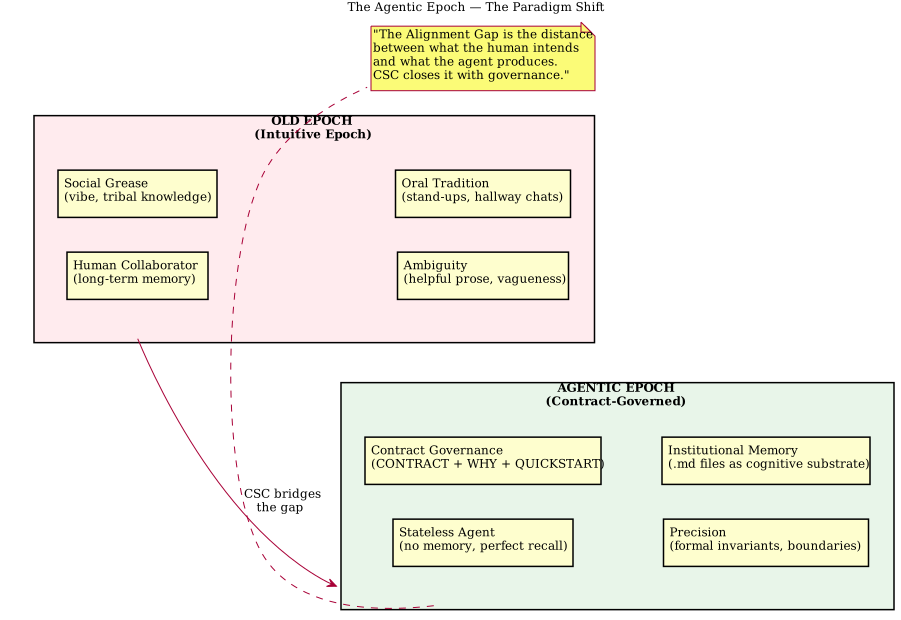

 #1 — 📖 Chapter 00: Preface